Total Pageviews

Showing posts with label migration. Show all posts

Sunday, August 23, 2026

Twelve Daring Grays: A Whale Migration Adventure. Written by Nora Nickum and illustrated by Elly MacKay. Candlewick Press, Penguin Random House. 20236. $24.99 ages 5 and up


"And then the tide turns. 
Eight feet of water. 
Seven feet. 
The twelve long to eat more,
but the mudflat will soon be dry, 
and any lingering whales, stranded. 

They abandon the feast 
just in time.
"

It's February and more than 20,000 gray whales are ready to begin a northern journey from southern California to their feeding grounds in the Arctic. It takes two long months, and as they travel their blubber is depleted to the point where many cannot continue. It is the most amazing thing that twelve of the whales veer from the traditional route taken, leaving the others in order to head east toward the Salish Sea. Why? 

The mud banks of the Salish Sea are rife with millions of nourishing ghost shrimp. The daring challenge lies in the whales needing to move into the shallow waters when the tide comes in. Not wanting to end up stranded there, they move quickly, eat as much as they possibly can, and leave just as quickly when the tide waters recede. 

"The water recedes,
revealing evidence
that their daring plan worked. 

Thousands of pits in the mud - 
whale-size bite marks.
"

They stay for days, eating whenever the tide rises. After a few weeks, they are ready to push on to the cold Arctic feeding grounds. They will stay until the end of summer when they have enough new blubber for their return to the warmth of the California Baja, just in time to welcome new calves. Will those calves make the same trip one day? 

Elly MacKay's luminous artwork is as beautiful as ever: 'The photographs are scenes created with paper, ink, wire, colored filters, and light.' Each spread captures the reader's attention and allows them to travel alongside these magnificent creatures through gorgeous ocean waters. It is a remarkable journey!

Back matter adds fascinating facts concerning the gray whales and the researchers with Cascadia Research Collective who discovered the daring side trips taken to make their full migration possible each year. An invitation to DIVE DEEPER includes places to find more information. 


Friday, May 1, 2026

Hummingbird's Big Trip, written and illustrated by G. Brian Karas. Random House Studio, Penguin Random House. 2026. $24.99 ages 4 and up


"Naptime is over and I'm hungry!
I stop by all my favorite places
for lunch. I have a long list and 
remember them all. 

All that flapping, flying, and 
feeding. 
Time for bed.
"

A tiny hummingbird shares its own story. Its summer has been filled with flight, flora, and enjoyment. As the season turns toward cooler weather and shorter days, it recognizes that the time for the long journey is fast approaching; that knowledge gives the poor wee bird a real sense of dread over what's to come. If you are one of those people who prefers to ignore what needs to be done when the anticipation for a task is worrisome, you will feel real empathy for him.

There is much to be done before the journey can be taken; all thoughts of that lead to avoidance. The exact date is unknown. Many lonely days will be faced on his own as hummingbirds do not fly in groups. Each one flies alone, mile after solitary mile. Every thought is wrought with questions about staying focused, food, exhaustion, and finding its winter home. His friends try to be helpful, offering wise advice and reminders that he does the same worrying every year. They know he will be okay. Days pass slowly, offering time to continue fretting. At last, the day comes. He takes to the sky with strength and knowledge. For many full and exhausting days, he flies. Does he really know the way? Will he arrive at his destination? Yes, he will! 

In familiar artwork that is detailed and emotional, G. Brian Karas offers his readers a story of worry, resilience, and science. As the story is told, young readers will take in information about the bird's yearly journey that is determined by seasonal changes. An endnote supplies further facts.

"I never seem to get lost.
I’m always able to fly the whole distance by myself ... I can do this!"                                                                              


Saturday, February 28, 2026

Fly Away Home, written by Betty Quan and illustrated by Akin Duzakin. Groundwood, 2026. $21.99 ages 3 and up


"Little bird, little bird
Time to fly home
A troubling of hummingbirds
Brings news of beyond

Little bird, little bird
Time to fly home
A mischief of magpies
Clouds over the sun
"

This book reads like a nursery rhyme while also introducing young readers to the idea of migrations that include people. For a small white bird, the text repeats lines that provide a collective noun (some real, some invented) for goldfinches, flamingos, hummingbirds, and magpies as they prepare for the journeys they will make. When the little one is joined by two larger birds, a young girl and her mother are shown to join a line of people making their way along a single path. 

Through day and night, the birds and migrants move forward. All travelers are wearing packs on their backs, holding hands, and looking weary and defeated. As the skies fill with dragonflies, sunshine and butterflies, the walk continues. When they reach water, boats fill with people while the three birds float upon the back of turtles, all headed toward a land where caribou roam and offer further rest and transport for the birds.

Attacked by crows, the birds seek shelter. Still, the line of people moves ever onward. While the birds find protection and sanctuary with nightingales, bobolinks, cuckoos, doves, larks and robins, the human travelers find their place with people who welcome them along the way and provide a new home where they can rest and find safety. In a final spread, the little girl and tiny bird make each other's acquaintance on the balcony of the girl's new home. Lovely, with a touch of hope at a time of unprecedented migration. 

Wednesday, January 21, 2026

My Home Is in My Backpack, written by Eugenia Perrella and illustrated by Angela Salerno. Translated by Sally Polson. Floris Books, 2025. $24.99 ages 4 and up


"I think my special home is my family, Coco, drawing, 
and thinking about my best memories. "Everyone's 
special home is different," says Mama. "If you look 
carefully, you can see them lighting up the darkness."

I decide to ask our friends what they love doing and
draw their answers in my notebook.
"

A family and their dog Coco are forced to leave their home in search of a safer place to live. Leaving behind the place they love and their nights together watching for shooting stars, they pack their belongings and start a long journey with many others. Many have travelled before them. 

The going is tough, and fraught with dangers, both seen and unseen. Papa does his best to bring a lightness to the sadness they are feeling by explaining that their home stays with them wherever they go. Clara is not sure she understands what he is telling them. 

""We have left our house behind," he explains, "but our 
home is special. It is made from the people we love and 
the things we love doing."
"

Taking that lesson to heart, Clara considers what is most important to her, and knows that other travelers will have different things they love doing. She asks her friends to tell her about themselves and collects their answers in her notebook: Juan loves singing, Eva and her parents talk about bright colors, baking and completing homework, Sofia loves fireflies, Maria likes stories, and Tomas plays dominos. Clara has much to think about as she drifts off to sleep. 

The following day, rain forces everyone to seek shelter in a nearby cave; it is decided to suspend travel for a day to allow children a break and a chance to play again. When they return to their camp, they pack up their gear and travel on. Perhaps, they will find a new and safe home in coming days. 

The story is told simply, and with empathy for the plight of so many in the world today. Ms. Salerno uses graphite pencil on heavy watercolor paper to allow readers a chance to see that, while the migration is long and dangerous at times, it does have lovely moments. Her palette of green, gold and blue offers a clear look at the events of their journey and the passage of time. It is a reminder to children who hear the story that they have much in common with children of the world, despite their differing circumstances. 

Thursday, September 25, 2025

Uprooted: A memoir about what happens when your family moves back, written and illustrated by Ruth Chan. Roaring Brook Press, Macmillan. Raincoast, 2025. $19.99 ages 9 and up


"Okayyyy, so .... Do I 
introduce myself to people? 

Or do I just 
smoothly insert myself
into a group? 

I wonder what my 
friends in Toronto 
are doing ... 

Back to looking cool ...
Looking like I just don't care.
Yup. So cool.
"

Ruth's dad has a new job which means the family is moving from Toronto, where she has lived all of her 13 years, to Hong Kong which is her mother's hometown. Ruth couldn't be more upset. She won't know anyone, not even her mom's family. 

Once they arrive, her father is often away on business while her mother is busy with her family and friends. Ruth is left to face many new experiences on her own. She is lonely for the company of her best friends in Toronto; is finding her way through a busy urban environment and a brand-new school; meeting her mother's family and trying to meet their expectations; and missing the bedtime talks she had so often with her father. 

In those talks, her father tells her the story of his worrisome birth while his parents were fleeing war in their home country. His story of survival doesn't have the impact it might have if she weren't going through so many of her own worries. Ultimately, it helps her understand the need for patience, bravery and perseverance as she navigates unfamiliar territory. When she is finally able to explain how she is feeling to her parents (in a very angry tirade), she begins to find some peace with her new life in Hong Kong.   

Middle graders with a love for graphic novels will find much to admire here. The artwork will hold attention as the story is told, the characters are engaging, and the memoir has much to teach about a young girl dealing with change and the uneasiness she is feeling. Ms. Chan uses a mix of English, Cantonese and Chinese to show how difficult it is for Ruth to feel comfortable with her extended family.  

An author's note explains the parallels between her life and her father's as both have to deal with change and difficult times. 

Saturday, June 28, 2025

Above, Below, and Long Ago: Animals, Plants and Fossils in Hidden Places. Written by Michael Bright and illustrated by Jonathan Emmerson. Orca, 2025. $26.95 ages 9 and up


"Throughout the summer in northern 
countries, swallows are seen where there 
are plenty of flying insects - their main 
food - which they catch while flying. In 
the autumn, however, the birds leave.
"

Aristotle thought that swallows hibernated. Naturalists even believed that they actually hibernated underwater, in ponds and lakes. In December 1912, after being fitted with an identity ring, that bird was found in South Africa and scientists finally realized that the swallows migrated. 

In the ABOVE section of the book, readers will learn about the following: Atlantic Puffin, Snow Leopard, Spanish Mountain Flower, Rocky Mountain Goat, Yellow-Rumped Leaf-Eared Mouse, Peregrine Falcon, Yellow-Footed Rock Wallaby and Barn Swallow. In double page spreads, information is provided for these plants and animals that can be very hard to see unless you like climbing rocks. Short paragraphs are accompanied by exceptional linocut prints that show each in clear detail. I thought I recognized a few, but others were brand new to me. 

Moving on to BELOW, where plants and animals live out of sight of prying eyes, Michael Bright wants his audience to know about the Olm, the Basking Shark, the White-Nest Swiftlets, the Mole, the Western Underground Orchid, the Brown Rat, the Common Eel, and the Mariana Snailfish. While I was sure I knew a few, I was surprised to learn much more than I had known prior to reading this book. Did you know the star-nosed mole is the fastest-eating mammal on earth? Or that the eel changes color as it ages ... to yellow and then later to silver? I love learning new things. 

As if that wasn't enough, Mr. Bright finishes with LONG AGO, about which I knew very little. In this section, readers will meet the Ammonite, the Megalodon, the Jurassic Oyster, the Trilobite, the Coelacanth, the Horseshoe Crab, the Ginkgo Tree, and the Tuatara. I did think I knew something about the Horseshoe Crab. Wrong!

"First appearing about 450 million years ago, horseshoe crabs are included as living fossils, but they are not crabs - they're more closely related to spiders." 

Back matter includes a world map, and places each included subject on it with a description of its location. Following the map, there is a glossary, a very interesting description for the making of the illustrations by Jonathan Emmerson, and finally, a useful index.

"Imagine a great white shark that’s almost twice as long as a bus, with jaws that could swallow a fully grown person whole, and teeth as big as your hand ..." 

What can it be?                                                                               


Friday, January 17, 2025

Narwhal: Unicorn of the Sea, written by Candace Fleming and illustrated by Deena So'oteh. Anne Schwartz, Penguin Random House. 2024. $24.99 ages 6 and up


"You are a narwhal --

                        shy,

                                 swift,

                                          small (for a whale).

Scientists call you unicorn of the Arctic ... "

I am ever astounded by the depth of research Candace Fleming does; her shrewd storytelling that brings to life those animals that spark an interest in her; and the way she engages readers in wanting to learn more. 

Using a present tense second person voice for this book, she places her young readers smack dab in the middle of the ocean depths that are home to the narwhal. The young narwhal is known for its shyness, its size, and its ability to move very quickly. Oh, and for its tusk, of course. 

" ... a single

               twisting 

                         rod of ivory
that sprouts from your upper left jaw. 
It began growing where you were a year-old calf. 
Now, nine years later, you are full grown, 
and so is your tusk. 

Through poetic, informative text, readers learn about migration (both summer and winter), the narwhal's pod, predators, finding food, the occasional tangle with another male member of the pod where the tusk is used as a weapon, and some of the hazards they face on their long journeys. Males are the ones with the tusks, only a few females sport them. Needing to breathe air from above, they are always on the lookout for leads (cracks in the ice). 

The atmospheric digital art created by debut illustrator, Deena So'oteh, is filled with the wonder of the Arctic landscapes and its ocean depths. Filled with both light and darkness, they allow readers a real feel for the life the narwhals lead. As hunger gets the better of this sleeping narwhal, a gatefold requires a turn to vertical for readers to feel the depth of the dive made for food. In the darkness there, echolocation is used to find the food required to satisfy that hunger. 

Avoiding orcas and polar bears keeps the narwhal busy as they answer the yearly call of two migrations. There are moments of terror as they are suddenly trapped under the ice in a freak storm and must find a way to break through that icy surface, or swim to shallow waters in hopes of being undetected by five orcas passing too close to where they are. 

Although, at present, narwhals are not yet endangered or of concern for the International Union for Ccnservation of Nature, the threat that climate change poses in the Arctic habitat may affect their future. 

What an adventure in learning this is! 

I do love this quote from Ms. Fleming as she discusses some of what her research taught her, and why what she includes in back matter holds such importance for her work. 

Heck, yeah, collapsible ribs! I also love that the tusk is filled with sea lice, and that its purpose remains a mystery. The tusk is obviously not for protection since only males (for the most part) grow them. So, is to look sexy for the lady narwhals? Is it a thermometer? Does it measure salinity? One of the things that really ramps up my curiosity is the fact that we share our world with so many creatures – 170,00 in the case of narwhals – and we still know very little about them. Don’t you find that amazing? I can hardly wrap my head around it. As for what’s in my backmatter… As a nonfiction writer, my job first and foremost is to tell a dramatic, compelling and true story. If I can weave facts into the narrative without interrupting the flow of my telling (and I try my darndest) then I will. But if a fact feels forced, or I can’t wedge it in, I save it for backmatter.                                                                                 


Saturday, January 4, 2025

Springtime Storks: A Migration Love Story, written by Carol Joy Munro and illustrated by Chelsea O'Byrne. minerva, Astra Books. Penguin Random House. 2024, $24.99 ages 4 and up


"The man scooped me up with gentle hands. 

Together, he and the girl ran with me, 
       farther and farther from Luka, 
         who crouched in the field, 
                 confused, afraid, 
                     feathers ruffling. 
                         I tried to call to him, 
                             but my cry wouldn't come.
"

The female stork, who narrates this tale, is shot out of the air near a farmer's field.  A fast fall has it landing on soft grass, with her mate in full pursuit. Luka is frantic about Katerina's plight; he is frightened off by the people who come to her rescue. A man picks Katerina up and, in a rush, runs far away from Luka who continues to call out for her. The man is accompanied by a young girl. Both are very concerned about the injured stork. 

Luka is always near, and wary whenever the humans come close. At sunlight, Katerina reminds Luka that he must leave to avoid the numbing cold of winter. She will not be able to join him. Katerina has good care from both child and man. Katerina heals, the seasons change, and the child runs with the stork outside in warmer weather. 

"I stretched my legs
and ran. 
I stretched my wings
and winced. 

Still, I had to try." 

Flights are short. The child helps the stork build her summer nest. As birds return, there is no sign of Luka ... Katerina stops thinking about any long flights, and languishes alone. Then, one day, she hears Luka calling for her! The father and mother become a family of five. Luka teaches the brood to fly. The family flourishes through summer sunshine. As the leaves begin to change color, Katerina knows that Luka must prepare to leave again. Promising to be back (and on time) in the spring, he is off with his new family. 

An author's note shares a version of this same story, especially focusing on the devotion felt by the stork pair. A similar event happened in Croatia; each year the male stork returned, and it was captured on video viewed by many year after year. Illustrations created with chalk pastel, colored pencil and digital pencil allow readers a clear look at setting, seasons, the care selflessly given, and the joys of being together again.  

Sunday, February 18, 2024

A Flicker of Hope: A Story of Migration. Written by Cynthia Harmony and illustrated by Devon Holzwarth. Viking, Penguin Random House. 2024. $24.99 ages 4 and up


"Abuela and Mama teach the children to braid 
baskets tight and strong. Like generations before 
them, families weave sweet-scented ocoxal leaves 
and memories together. 

A tradition they know by heart.

A frenzy of orange and black. 
Together, monarchs chase tomorrow's dreams. 
Joining in a flight their families have made for 
generations.
A flight they know by heart.
"

Lucia and her father sit together quietly, watching and wishing. At the same time, on the facing page, the monarchs are stretching and shifting positions. It's springtime - coming closer to the days when Papa and the monarchs will leave for their time north of where they are now. 

Lucia needs assurance that her father will return. A warm hug is the promise she gets, and he is gone. At the same time, the monarchs take flight for their long journey. Migration north is as normal for Lucia's father as it is for the monarchs. For Papa and the butterflies, the journey is a long search for work and new life. Papa works wherever he can find a job with the harvest. The work is tedious; he finds comfort in the presence of the monarchs. 

At home, Lucia waits and worries. The days pass slowly. She sings the songs her father has taught her to keep him close. As the weather turns colder, Lucia rushes to celebrate the return of the butterflies and experience a 'flicker of hope' for Papa's return. When she finally sees him, they run to each other, arms and hearts wide open. 

The telling is heartfelt. The artwork, created using gouache, watercolor, colored pencils, and crayon finished digitally, is rich in color and atmosphere. A glossary follows, as does an author's note and suggestions for helping make life better for migrant workers, their families, and for the monarch butterfly.  

"When the weather turns cold and the monarcas return, our winged ancestors will guide me home."                                                                                      


Sunday, October 29, 2023

Zander Stays, written by Maureen Fergus and illustrated by Scot Ritchie. Pajama Press, 2023. $22.95 ages 3 and up


"One morning, Zander awoke to discover 
that the puddles were hard, cold, and slippery. 
"They've turned to ice," explained the squirrel. 
"That means winter will be here soon."

"What should I do to get ready?" asked Zander. 

"Collect and store nuts," said the squirrel."

Young readers will not have heard such a story. Imagine a goose deciding that staying in the cold for the winter is a good thing! He wants more than the usual fare. No packing and flying south for him this year. 

Zander enjoys the many pleasures of autumn: leaf piles, windy days, sunset walks. He doesn't mind being alone. As the temperatures cool, Zander begins to ask questions of other animals in preparation for the upcoming winter season. Animal friends have varying advice which will elicit delighted guffaws from young knowledgeable readers. Zander is reluctant to consider their suggestions. Snow brings a thrill, and even more problems. No one is around to offer advice anymore, and Zander is far too cold. 

Luckily, help comes in snowboots, warm mittens and earmuffs. A little girl carries Zander to her cozy home. 

"Zander had finally found a northern animal 
whose winter adaptations were a perfect fit.
" 

Grace and Zander spend a marvelous time together in front of the fire, reading to their heart's delight, while also enjoying a myriad of daytime activities outside. As spring bursts forth and his friends return, Zander has entertaining tales to tell. The lasting result of those stories is evident when kids see the new summer plan.  

While this tale from Ms. Fergus is rife with her signature storytelling, Scot Ritchie ups the humor at every turn with wonderfully attractive pencil, ink, and digital artwork that is fully focused on Zander. The final spread and endpapers add even more charm. 

An author’s note describes the winter adaptations of bears, geese, bats, snowshoe hares, and humans and discusses hibernation and migration.

Monday, September 4, 2023

we are STARLINGS: Inside the Mesmerizing Magic of a Murmuration. Written by robert furrow & donna jo napoli and illustrated by marc martin. Random House Studio, Penguin Random House. 2023.$25.99 ages 4 and up


"We find strength and safety in numbers.
We find warmth in numbers. 

We pay attention to the birds nearest to us. 
We are allies. 
Our allies each have their own allies. 
We all guide each other.
"

Their story is told in first person. Two starlings take to the air as a chilly morning warns of colder weather to come. It is time to leave. As they rise and fly for many days, they join other starlings and become a giant flock. Hundreds, then thousands, finally millions together in flight - they become a murmuration.  Their numbers provide strength and warmth. Now, all must pay attention to their surroundings and count on each other to move forward.

"Oh no! 
    A peregrine falcon! 
        We must get away! 

I veer. 
     My allies veer. 
          Their allies veer. 
              We all change course.
"

When the enemy bird is averted, the murmuration turns to fun and dance. An elegant and extraordinary gatefold, created using watercolor, pencil and digital collage, is testament to the colossal numbers of birds that swoop and swirl across a sunset sky. Then, suddenly, they all land to feed and rest. 

Accurate information, simply stated in poetic text, is enhanced by the beauty in movement these starlings display. An endnote contributes additional information about starling behavior for readers. It is a stunning read aloud book for family reading and in classrooms.                                                                                    


Tuesday, September 20, 2022

Serengeti: Plains of Grass, written by Leslie Bulion and illustrated by Becca Stadtlander. Peachtree, Penguin Random House, 2022. $24.99 ages 8 and up


"Hoofbeats thunder under blazing sun, 
a great migration toward the plain, 
grazing zebras, first to begin,
clear away taller, tougher grass. 

Plains zebras have sharp front teeth to cut through the tough stems and leaves of tall grasses. They get the nutrients they need by eating and quickly digesting lots of grass."

Using an impressive mix of carefully researched science and outstanding poetry, as she has done in earlier exemplary books, Leslie Bulion introduces her readers to the beauty and wonders of the Serengeti grasslands. What a truly complex ecosystem it is! 

In early winter as rains return to the Serengeti, a mighty migration brings vast numbers of large mammals back to feast on the plants now growing there. Each of those migrating animals has its own role to play in the complex web of life. Zebras are first, grazing on the tall grasses. Wildebeests make meals of the shorter grassy areas, while acting as transport for oxpeckers in a mutually beneficial practice. The speedy gazelle is next, grazing on the low growth 'gnu-mown grass', and any herbs they may discover. Giraffes, with their twenty-inch-long tongues are able to enjoy the leaves and buds on the tall acacia trees. 

Ms. Bulion then turns her attention to some of the smallest plants and creatures found there - butterflies, ants, and grasshoppers. A turn of the page offers clear information on boulder heaps called kopjes and furry rock rabbits called hyrax. There is so much to learn and to see. Each informative double-page spread brings an array of other residents of the grasslands. Readers will meet the dik-dik, termites, aardvarks, a black mamba, a brave secretary bird, jackals, cheetahs, vultures, hyenas, and dung beetles. 

"Dung beetles are busy recyclers
that mix air and nutrients back 
into the soil of the Serengeti Plain.
"

As monsoon winds shift, the mighty migration begins once more. It is late spring; new food sources and water must be found. 

Opening the book to the endpapers, you can almost feel the heat emanating from the blazing red and its touches of orange and yellow.  Wonderful horizontal spreads fully capture the vast expanse of the grasslands. Seeing through the artist's eyes, readers experience the beauty at all times of the day. Gouache and pastel illustrations bring out the spectacular colors, weather changes and continuous movement. This is a book that encourages further learning. 

In back matter, Ms. Bulion describes the poetic form utendi, a traditional Swahili form from East Africa that was originally used for 'serious subjects and shared wisdom on how to live a good life in the world'. A Serengeti Glossary is useful and enlightening. Websites are shared, as well as a list of books for further reading.                                                                          


Sunday, May 1, 2022

A Long Way Home, written by Jean Little and illustrated by Gabrielle Grimard. Scholastic, 2022. $19.99 ages 5 and up


"One afternoon, Maya was on her knees
staring at the plants when Jane arrived. 
Silent, she waved her arm to her friend.
Come here. Quiet, quiet, that arm said.

A bright orange-and-black 
butterfly was fluttering flower to 
flower. 
At last.
" 

Losing Jean Little in 2020 was a blow for those who have shared her warm and inspiring stories over the years. When she visited our elementary school a long while ago, she showed our kids that a writer could be as warm and inspiring as the stories she wrote. She was funny, quick to share events from her life, and happy to answer questions that children asked. Lucky we are to have Jean's final story to read today for children interested in nature and helping to make a difference.  

This is a story of friendship and migration. Jane and Maya are an unusual pair; despite that, they become fast friends immediately. Jane's outgoing, talkative nature is balanced by Maya's quiet willingness to listen. Jane has lived in the same house for her lifetime. Maya is a refugee, new to the community. At school, they learn from their teacher that many species of birds and animals are disappearing. Jane cries on the way home that day. 

Wanting to do something, the two talk with Jane's grandfather where he is working in the community garden. He suggests that they might save 'some butterflies'. They want to know more, and he is there to help them. They talk about monarchs and their dwindling numbers. Explaining that they need milkweeds to feed the caterpillars, they decide to plant some. Waiting for the plants to grow is s chore. Finally, they see a monarch lay an egg and disappear. More waiting until a caterpillar emerges. They watch carefully as that caterpillar grows, makes a cocoon ... then more waiting. When the butterfly finally emerges, they know from their reading that it has a long journey ahead of it. 

Following its departure, Maya shares her story of the long journey her family took to find a new home. 

""I was also little when we started. 
But I couldn't fly." Her smile was small. 
"My mother had to carry me." She paused. 
"We're here now."
"

The warmth of this timeless story is enhanced by Gabrielle Grimard's soft, emotional art. There is much to see for keen observers wanting to know more about the monarch, its life cycle and its elegance.  It also provides awareness for the arduous journeys some families in their quest for a new place to live.                                                                                   


Tuesday, November 30, 2021

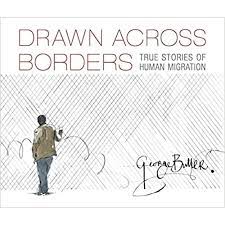
Drawn Across Borders, by George Butler. Candlewick Press, Penguin Random House. 2021. $24.99 ages 10 and up


"When I arrived in Belgrade, I was immediately 
struck by the cold. But there are two types of cold
here: the cold you rush through from one building 
to another, as I was able to do, and the cold you have 
to sit in. Refugees and migrants had a different 
relationship to the cold. Everything they did was to 
combat it.
"

These 12 stories of migration were collected between 2011 and 2018 in such faraway places as Syria, Kenya, Tajikistan, Iraq, Palestine, Serbia and Myanmar. George Butler, an award-winning artist who has an enduring interest in news affairs that are current and compelling, spent those years reporting on critical situations in these varied places. His interviews were with people who had an urgent reason for leaving their homes. Their reasons were many: safety, food, work, love, family, war, a wish for a better future. 

"I have made these drawings. 
I made them in refugee camps, 
in war zones, and on the move, 
and as I drew, people told me 
their stories." 

Mr. Butler believes that as we read their stories, and try to understand the circumstances, the world will better respond to the continuing crisis. Each of the twelve chapters includes several telling sketches of the people he saw or met, his description of the setting and events of the time spent there. This is an emotional look into the faces of people and their circumstances, whatever they might be. Migration is not new. It can affect people from all walks of life, both young and old. The artist assures that we know this to be true. Through his expert lens, we are privy to the dreams, difficulties, and doubts migrants bear as they move from one place to another. 

"The end of this book is not the end of the stories of the people in it. I realize now that this was a small moment in their lives, and while meeting them was significant to me, it was probably not to them. A drawing is not like a photograph - it's not just about recording something: it can hold huge meaning too. Whatever others make of them, these drawings and the people they represent mean everything to me."

Absolutely stunning, heartbreaking at times, and worthy of attention.      


Monday, May 31, 2021

Waiting for a Warbler, written by Sneed B. Collard III and illustrated by Thomas Brooks. Tilbury House, Fitzhenry & Whiteside. $24.95 ages 5 and up


"Daylight comes, but storm clouds blot
out the sun. The birds have been flying 
for eighteen hours now, with no land in 
sight. Weaker birds use up the last of 
their reserves and fall into the stormy 
seas. Other birds keep flying. They claw
at the wind, fighting to stay above the 
deadly waves. The Cerulean is one of 
them.
"

This is a bird migration story that combines fact and fiction to describe Owen's attempt to have his family make their home yard a place for wildlife, especially birds where they will find safety and sustenance. Last year, Owen and his sister Nora welcomed a Cerulean Warbler, a very rare sight in their vicinity. They are hoping it will return. 

Owen and Nora's tale in told on alternating pages, with the pages in between offering clear information about the migration story of the birds themselves. The family, led by Owen, have worked to keep the old trees and plant new native flowering trees to encourage birds to stop. There are now birds aplenty, but only one warbler. They keep journals describing their visitors, while holding out hope for that one special bird to arrive. 

There is much to learn on the pages in between about the migration of a variety of birds as this story moves forward. It is often an arduous journey, made more perilous by terrible weather. Still, they fly on. At school, Owen shares what is happening with the migrating birds and answers questions from his classmates - and his worry about the tiny warblers. The story continues as the warbler returns with a mate, makes the yard their summer home, and allows for further learning by Owen's family and their observations. Perhaps they will return in following summers. 

An author's note offers the genesis of this informative book. Mr. Collard then finishes with instructions for becoming a birder, ideas for protecting birds, and a list of resources to help readers learn more. Thomas Brooks does a fine job of telling both parts of the story in lovely images. His watercolor artwork allows readers to experience the difficulty of the birds' journey, the beauty of the avian visitors, and the welcome habitat that Owen's family has created.                                                                                       


Thursday, September 26, 2019

Migration: Incredible Animal Journeys, written by Mike Unwin and illustrated by Jenni Desmond. Bloomsbury, Raincoast. 2019. $24.99 ages 8 and up

"There's a dark stain on the
sea. The lower you fly, the
bigger it seems to get,
stretching for four to nine
miles along the coast. At first
it looks like spilled oil, but
soon you can see that the stain
is moving, heading slowly east.
Aha! It's not oil but fish -
millions and millions of them,
all swimming in one enormous
shoal."

Kids love learning as much as they can about animals. Many are endlessly engaged in books that tell about the many feats of travel these animals make. In Mike Unwin's newest book, he introduces 'animals on the move'.

"Swallows are not the only long-distance travelers.
Many different animals around the world make similar
journeys - crossing mountains, deserts, and oceans
along the way. These journeys are called migrations,
and they happen in many different ways: while birds
fly through the air, elephants trek across the land and
turtles swim through the sea."

Seasonal changes mean these animals have to move to escape harsh weather, to find a better place to find food, and to have babies. The hazards are many and their journeys arduous; yet, they often make the migration year after year. Mr. Unwin describes twenty different animals here. Their stories are fascinating.

On double-page spreads he describes their journeys. The animals are diverse in size, as are their environments.  He includes mammals, birds, reptiles, fish, and invertebrates. Jenni Desmond uses watercolor, acrylic, ink, pencil and pencil crayon to provide exceptional images of the animals, and adds a simple, single paragraph of text of her own. The design is accessible for young readers, with just enough information to satisfy their curiosity.

In back matter a world map traces the migration paths globally, and the author makes a plea to his readers to speak up and help those animals whose natural habitats are being damaged by people.

Tuesday, August 20, 2019

Hummingbird, written by Nicola Davies and illustrated by Jane Ray. Candlewick Press, Penguin Random House, 2019.$22.99 ages 4 and up


"Out on the veranda, everything
is ready: the nectar feeders are
filled and tiny flies buzz in the
bug dispenser. Just after dawn,
the hungry guests arrive for
breakfast. The sisters laugh as
they remember how their daddy
used to say, "Hummingbirds
need meat AND potatoes, same
as we do!"

What a gorgeous book this is. In the beginning, a young girl and her Latina grandmother wait patiently for the ruby-throated  hummingbirds to sip from the bowls they are holding. They know they will soon fly north, just as the granddaughter will. She is boarding a plane for her home in New York City; the hummingbirds are leaving Mexico to fly north, where they will build nests, lay eggs, have their babies, and wait until it is time to return to the warmth of the south once again.

As one such hummingbird spends the night in the rigging of a sailboat, observant listeners will notice the airplane carrying the girl north to her home.

Nicola Davies, a noted zoologist and exceptional nonfiction writer, ups the impact of the story by including her customary additional notes about the hummingbirds. 

"Hummingbirds lose half their body weight when they 
fly north over the Gulf of Mexico in one long trip."

Page turns show the long journey the birds make from the south, all the way to Canada. Along the way, they are noticed by many people, including the granddaughter in Central Park, who finds a reminder that they have been there. Making that special find on the lawn results in a special package being sent to her grandmother with a note of explanation.

Jane Ray uses 'watercolor and watercolor pencil with gold ink' to create the vibrant artwork. Brilliantly colored, and filled with the beauty of nature and the constantly flitting wings of these wondrous birds, it is accompanied by clear and very informative text which makes for a memorable story. Some of the more than 300 species of hummingbirds adorn the endpapers.

Plenty of facts about these tiny gems are provided as the story moves forward. A map that shows their journeys, an introductory note, and a further note in endmatter add appeal. A bibliography and an index are appended.

"Roads, houses, and cities built by humans
mean that there are now fewer places for 
hummingbirds to refuel on their trip."


Friday, August 31, 2018

We Travel So Far ... Words by Laura Knowles and pictures by Chris Madden. Firefly Books, 2017. $19.95 ages 5 and up

"We are the Caribou, 
the thick-furred travelers
of the icy north.

Every year, in long and
winding lines, we journey
further than any other
animal on four legs.

With our wide and padded
feet, we walk in each other's
footprints to keep out ... "

It is always interesting for young readers to learn more about the animals they know, and those they do not. In this book that deals only with migration, they will learn the stories of 26 such creatures. The author begins with a two page introduction.

"These are the sort of journeys
that we call "migration."
Often, animals migrate with the changing seasons.
Some travel to find food, while others are driven to
migrate to the perfect place to mate and raise their
babies. For most migrating animals, all these
reasons play a part.
The urge to migrate is instinctive:
it is hard-wired in them from the moment
they are born."

Each is given a two page spread, placing minimal, informative text over a clearly drawn illustration of each animal in its own particular environment. The text begins with the swimmers: leatherback turtles, humpback whales, sockeye salmon, Caribbean spiny lobsters, elephant seals, and European eels. On to the flyers, and finally to earth dwellers. Some entries will be unexpected. There is variety in the accurate and enlightening accompanying artwork. Children will find much to hold their attention here. 

The animals narrate their own stories, and the prose is full of relevancy. They tell where their travels will take them and why they have undertaken such a journey. The first person narrative gives a real feeling of immediacy for those reading it. The migrations happen all around the world, are shared with little fanfare, and offer just the right amount of information to satisfy most readers. Those who want to know more have a place to begin.

A map of the world is provided, and suggests that readers might take the time to plot out where each of animals migrates. It is followed by water, air and land migration data for each of the animals included.