Total Pageviews

Showing posts with label farms. Show all posts

Sunday, October 4, 2026

Tom Nancy: The Sheep Who Swapped Brains with a Boy, written by Mac Barnett and illustrated by X. Fang. tundra, Penguin Random House. 2026. $26.99 ages 4 and up


"The next morning Tom Nancy went 
back to school. Felix tried to go too. 

"Look at that!' The children pointed 
and giggled. "A sheep followed you 
to school! Just like in a storybook."

Felix tried to tell them he was actually 
a boy, but nobody listened to a sheep.
"

Kevin lives on a farm with his parents and an assortment of animals that include an arrogant sheep named Tom Nancy. Because Felix looks ready to have a conversation, Tom Nancy speaks to him one day. He has an important question. 

"Do you want to see a marvelous thing?" 

Felix, being Felix, says yes. With Tom Nancy in the lead the two are off to the old barn, where Tom Nancy shows Felix a brain-swapping machine he has built. He explains its workings and suggests they try swapping brains for the day. It's easy to see Felix's vulnerability, and Tom is quick to take advantage. 

BING! 

Tom becomes everything Felix, and Felix is suddenly a wide-eyed innocent sheep. Tom Nancy loves his day as a boy! Everything about it makes him happy. Felix does what sheep do; he spends his day in the pasture chewing grass, which he finds 'interesting.' When Felix is ready to switch back, he is distraught to learn Tom Nancy has no intention of doing so. Tom Nancy takes advantage of every opportunity to keep his new identity, while Felix tries to explain to the other animals what has happened. The other animals are perfectly content with Felix as he now is. They like him that way, and have no warm feelings for Tom Nancy. 

Tom was happy until he has to deal with the realities of school, and the expectations of him concerning homework. He complains to his dad who isn't open to letting him stay home since he hasn't been helping with the chores. With warnings from both principal and father concerning the work he will be expected to do in the future, Tom runs to Felix with a request to switch back. When they get to the barn, Tom Clancy is met with a very big surprise; a comeuppance from Felix and the other animals concerning his future. 

X. Fang drew her eye-catching illustrations with graphite and then added color in Photoshop. She keeps characters center of attention against all backgrounds. Tom Nancy is quite the individual; everything about him is big and outrageous. This is one terrific picture book from the very funny and irreverent Mac Barnett.  

Wednesday, November 13, 2024

Shelly Hen lays eggs, written by Deborah Chancellor and illustrated by Julie Groves. Kane Press, Astra. Penguin Random House. 2024. $24.99 ages 3 and up


"Shelly likes to hang out with her flock. 
They cluck ... and peck ... 
and peck ... and cluck ... 
the whole day long. 

Shelly chases her friends up and down the ramp. 
They all know she's the one in charge.
"

There are four books in the follow my food series. This one helps little ones learn about hens and how they help feed people. Shelly roams freely on the farm where she lives. Her eggs are much appreciated by those who eat them. 

Shelly does what most hens do during the day. She starts with a dust both; that helps her rid herself of any bugs that might have climbed aboard. She likes her fancy feathers, and also likes for them to be clean. Shelly is part of the farm flock, and spends her days doing what chickens do. 

Her hard work keeping the flock in order makes her tired enough to take an afternoon nap in a shady spot. It isn't long until she is up and back to work. The warm and comfy coop assures that she and her feathered friends have a place to settle for the night. Early the following morning, Shelly lays 'a beautiful brown egg' in her nesting box, and prepares for another busy day. 

Told simply, and with artwork that informs and charms young readers, this book allows them to have a clear look at the way hens provide the eggs used for eating and for baking. Back matter includes a game for matching words and pictures, further information about hens, their eggs, and their communication with other chickens. As well, there is a double-page to identify other birds and the size of the eggs they lay, and finally a recipe for scrambled eggs. 

Other books in the series are: Granny Root grows fruit, Milly Cow gives milk and Polly Bee makes honey. Check them out!

Tuesday, March 28, 2023

What If I'm Not a Cat? Written by Kari-Lynn Winters and illustrated by Kelly Collier. Kids Can Press, 2023. $21.99 ages 4 and up


"One day, while Donkey was settling 
down for a nap, 

Farmer said something puzzling. 

Donkey, you're acting 
like a cat! 

YEAH. Obviously. 
I AM a cat! 
A spiffy, strong cat!
"

What a rude awakening it is for Donkey when Farmer tells him he is acting like a cat. Isn't that what cats do? Donkey knows that his name does not describe who he is. Donkey knows he's a cat! When Farmer talks to the animals in the barn, she calls them all kitty cats. Donkey is one of those animals. 

Donkey does what cats do. Tree climbing is his only failing when copying their behaviors. Or is it? He is scared of mice, cannot land on four feet, doesn't fancy eating cat food. and makes the funniest sound when he tries to meow. Farmer's comment about his acting like a cat make him do a lot of soul searching. The cats are quick to suggest what animal he might really be, and to even wonder about their own identities. 

No longer fitting in, Donkey decides to leave the barn. He is miserable, cold, and lonely. When Fox arrives with an eye on a tiny kitten, Donkey musters up his best self and sends Fox off in a rush. The kitten is returned to its mother. The cats accept him for friendship and protection. Donkey discovers who he really is, and settles in. 

Amusing and detailed digital illustrations vary in perspective and form which impacts the action of the story. Expressive faces speak to personality, and are humorous. Young readers will enjoy this story about friendship and being who one is meant to be. 

Tuesday, February 7, 2023

The Sun Is Late And So Is The Farmer, written by Philip C. Stead and illustrated by Erin E. Stead. Neal Porter Books, Holiday House. Penguin Random House, 2022. $24.99 ages 4 and up


"You are right," says Barn Owl. "The sun is late to rise."
"We will have to wake her up," says Mule. 
"Or the farmer will sleep and sleep," says Milk Cow. 
"And breakfast will never come," says Miniature Horse.
"Okay," says Barn Owl. "Here is what you must do ...
"

I am always very interested to see what this married team has in store for young readers. I can say they never disappoint. When a mule, a milk cow, and a miniature horse look out on a dark sky, we learn they are waiting for the sun to come up. It is silent everywhere, but for the squeak-squeak-squeak of a weather vane. The moon is full, the barn light shines down on them. 

Convinced that the sun is late - which means the farmer is also late - they decide to seek counsel from the barn owl. Barn Owl agrees with them. Together they determine they must wake the sun before everyone misses breakfast. The farmer needs to awaken. Following the barn owl's advice for travel to the edge of the world, they wander forth. Don't forget to invite Rooster, they are told. 

They are worried, as they have never left the barnyard. They will need to be courageous in order to do what needs to be done. They walk off together. As they go, they share their wonderings about what they pass along the way. They reach the edge of their world just in time for Rooster to provide a reminder to the sun. What of the farmer? She hears, and all is well! 

Young readers will absolutely love knowing what the animals don't. Using repetition and perfect word choice, Philip Stead writes another charmer of a book that is sure to be read repeatedly. Working in watercolors, graphite and colored pencils, Erin Stead creates a perfect backdrop for her husband's text, using the deep blues and shadows of nighttime as it gives way to the beauty of a morning sunrise. Her 'sleeping giant' is brilliant. 
                                                                               

Saturday, August 27, 2022

Apple Crush, written and illustrated by Lucy Knisley. Random House Graphic, Penguin Random House. 2022. $17.99 ages 8 and up .


"All the parents were asked to come in
for career week and do a demonstration. 

I know. 
It's just such a BIG demonstration! 

We're the only ones in your class 
who live out on a farm. I think it'll 
be really interesting. 

And at least everyone will get some
cider out of it. 

Exactly!"

In this sequel to Stepping Stones (2020), Jen is adjusting to middle school life while living at Peapod Farm with her mother and her boyfriend. Said boyfriend has two daughters who often spend weekends at the farm. Jen and his daughter Andy have found work helping at a pumpkin patch nearby, which also has a haunted hayride. Others work with them. One of them is Eddie, the owner's nephew. Jen and Eddie have things in common, but it is Andy who has a crush on him. 

Things become complicated, as so often happens in middle school. Andy's feelings for Eddie are romantic; Jen isn't at all interested in a romantic relationship. Still, feelings are complicated by many things including divorce, blended families, and new relationships. Jen is not a star student; she does, however, have a real talent for art and finds friends that way. When she stands up for Andy, following a spooky trick gone wrong, she realizes that others are experiencing their own troubles. 

As she so ably showed with her first tale about Peapod Farm, Lucy Knisley brings emotional characters to life in a graphic-novel that is lively and engaging. Readers will feel empathy for each character and their reactions to the events shared. Of interest for some readers will be a focus on farming, and making apple cider. It's an honest accounting of the range of emotions many middle graders feel.                                                                              


Saturday, January 22, 2022

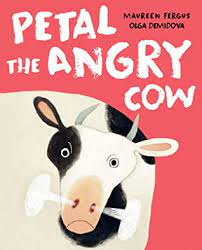
Petal the Angry Cow, written by Maureen Fergus and illustrated by Olga Demidova. tundra, Penguin Random House. 2022. $21.99 ages 5 and up


"Unfortunately, Petal had a temper. 

If the dog borrowed her stuff
without asking, she'd try to bite him. 

If the pigs played a practical joke on her, 
she'd try to kick them. 

If the chickens teased her, 
she'd shout bad words at them.
"

Petal is an amazing cow; she works hard, she creates appealing art, she dances like a champ, and she is smart and kind. She also has the most awful temper. She is a menace when things don't go her way. The farmer is not pleased with her behaviors. He lectures, he demands apologies, and he gives time-outs.  

 At times she gives in to thinking about other ways to handle things, but she prefers retribution. When the farmer makes an exciting announcement, the animals are delighted. They are going to the water park, with a stop for treats afterwards. In her exuberance, the horse jumps joyfully into the air. Regretfully, she lands on Petal's hoof. Petal's explosive anger and name calling upsets the farmer. Petal will no longer be able to attend their field trips until she can control her temper. 

Oh, dear! Petal hurries away, crying. A swan offers an ear, and then displays some pretty peculiar behaviors. As Petal watches the swan scream and knock things over when things don't go its way, or stalk off when the farmer doesn't choose the story it wants to hear, Petal quickly offers advice. 

"If you want to be our friend, you need 
to start acting like a friend. No screaming. 
No shrieking - "

Can Petal take her own advice? What do you think? 

Tuesday, December 21, 2021

If You Want to Knit Some Mittens, written by Laura Purdie Salas and illustrated by Angela Matteson. Boyds Mills Press, Penguin Random House. 2021. $23.99 ages


"6. Once it is dry, pick the 
fleece into pieces.
Then, use bristly paddles 
to card them. 
This untangles the fibers.

It does not work 
on people hair!
 

If you are planning on knitting mittens, Ms. Salas has some advice to offer. It will take 18 steps, and begins with finding a sheep. Luckily, there is one for sale at the apple stand our young narrator and her father visit. Then, there is work to be done. Keeping the sheep fed and comfortable through the winter means that it will be ready for shearing in the spring. Once sheared, the fleece needs careful cleaning, carding, spinning, and dyeing. 

Marigold is the color the sheep chooses for the mittens. So, seeds must be planted and tended. Wait time is tedious. Finally, the marigolds are ready to be dried, then soaked to be cooked with the yarn. What a gorgeous color. All that is left is to learn how to knit! Patience pays off. The arrival of winter means mittens for the knitter, and a new golden toque for the provider of the wool. 

Charming illustrations 'painted with acyrlics, gouache, and a touch of colored pencil on wood board' provide a gentle, cozy softness for this affable, tongue-in-cheek instruction manual. 


Saturday, December 18, 2021

One Smart Sheep, written by Gary D. Schmidt and Elizabeth Stickney, with illustrations by Jane Manning. Clarion Books, Houghton Mifflin Harcourt, Raincoast. 2021. $23.99 ages 8 and up

"He moved farther into the warm pen and looked around.

No Tippy. 
No Abigail. 
No woodstove, either. 
Wilson began to wonder if a friendly, woolly,
smart sheep belonged here after all. 

Then the two deliverymen lifted the ramp
into the truck.
"

Abigail Atwood and her border collie, Tippy, work hard every day to keep their 27 sheep happy and healthy. Abigail is aware that there is something very special about Wilson. In fact, she notes that he is the “friendliest, woolliest, smartest sheep” of the flock. As a young lamb, Abigail had kept him in a box near the woodstove, and fed him with a bottle. Now, Wilson is an important member of her flock. 

Abigail has a neighbor named Jeremiah Jefferson. He is a bit of a curmudgeon, who is handy with tools and fixing things; he is not keen on sheep. He has much to say about them that Abigail does not appreciate. After an annoying encounter with Jeremiah one day, Abigail and Tippy are upset enough not to check the gate as they head back to the house. As luck would have it, a series of ill-timed events create a real dilemma. 

Abigail has a piano delivered; Wilson discovers the gate unlatched; Wilson makes his way to the house, and then into the back of the delivery truck. Only Tippy notices there is something amiss. Tippy tries to warn Abigail, to no avail. The scenes created for Wilson's wild ride to the city, and his subsequent escape will have readers chortling. Abigail recruits Jeremiah to help with the search. After many attempts to find Wilson, the search is ended. Inadvertently following the path that is leading Wilson home, the team finds him heading straight for the pasture that is his home. What a smart sheep! 

Large print, easy-reading text, and short chapters make this action-filled book perfect for kids wanting to read chapter books on their own. It has everything to attract them: action, suspense, great characters, humor, and excellent illustrations that engage and entertain. 

Tuesday, December 7, 2021

The Barn, written by Leah H. Rogers and illustrated by Barry Root. Candlewick Press, Penguin Random House. 2021. $23.99 ages 4 and up


"I am a barn. 

My cows chomp on tall, rich grass, 
shooing flies with their swishing tails. 
And the dogs romp and wrestle in my outstretched fields, 
never seeming to tire of their joyous play.
"

Narrated by a sturdy red barn, this poetic homage to that familiar part of many farmyards presents the daily routines of a building that is emblematic of earlier, peaceful, and profitable farming operations. 

The reassuring voice describes its beginnings, and the many hands that worked to construct it. The barn's day begins in warm sunshine. Inside, the animals are eager to begin their day with needed food, and an immediate release to a new day. The scenes are bucolic, showing the farm from various perspectives on full-color, double-page spreads that invite careful consideration of the many details of farm life. 

"I am a barn. 

A cat lurks in a distant field, 
crouching to catch her unsuspecting dinner,
while I cradle her kittens in a bed of discarded blankets. 
They lie wrapped together like tangled yarn,
waiting for their twilight milk.
" 

The language has much appeal for the senses; an invitation for young liseners to create mind pictures for the events being depicted. It invites a quiet, careful reading for those sharing it to delight in the pastoral descriptions. Throughout the day and into the early evening, the farm operates as it is meant to do. The fields are inviting; the animals are safe and cared for; the day slips slowly into dusk when all animals return to the warmth and comfort of their home. Sleep comes peacefully as the barn calms, and night falls - all ready to begin again with the rising of tomorrow's sun. 

Ah, sweet comfort! What a lovely debut for Leah Rogers, and what warm and inviting scenes from the deft hand of Barry Root.   

Older readers might find this documentary of interest. 

https://youtu.be/vfKkuZmlx6U

Tuesday, June 22, 2021

Gone To The Woods: Surviving A Lost Childhood, written by Gary Paulsen. Farrar Straus Giroux, Macmillan. Raincoast. 2021. $24.50 ages 12 and up


"He'd seen books before. Of course. 
But never one that seemed so ...
so alive. Like it wanted to be his 
friend. Silly thought; how can a book 
be a friend? But the librarian had 
done the same thing, said follow me. 
Into this stack of books. 
And for the first time in his life he 
truly wanted to know this book, 
know what was in it, how it was, 
and what he had to do to know what
it was saying to him. Really wanted 
to know.
"

Gary Paulsen is a wonder. I have taken his advice to heart for many years: Read like a wolf eats! 

To say I have found myself in his books is not true; I have found characters to love, to admire, to never forget. I started reading his books in 1986 when Hatchet was published and continue to read as many as possible. Some I have read multiple times (Harris and Me, How Angel Peterson Got His Wings, Nightjohn, Sarny). I have recommended them to students, friends, non-readers, my own children. He has never disappointed me. I knew some of his story. 

Reading Gone to the Woods has been heartbreaking and hilarious, and definitely memorable. I will not forget what life was like for 'the boy' he describes in this moving memoir. Mr. Paulsen writes about himself with clarity, and explores some of the childhood experiences that led him to writing. His alcoholic, abusive parents made his early life a nightmare. Rescued by his grandmother, and sent to Minnesota to live with his aunt and uncle offers a love he has never known. The fact that he made the trip by himself, in the company of returning and injured WWII soldiers had an enduirng effect on him. 

While living in Minnesota, he learns about survival in the woods. When his mother shows up to take him to meet his father in the Philippines, his life is filled with the trauma of the unforgettable conditions there. They will haunt him throughout his life, and informs this honest account of some of his most difficult memories.   

This is his life story, and those who love his books will begin to understand where many of those stories originated. The return to North Dakota with his parents is unbearable, and he often runs away to the woods. There, he uses all he learned while living with Edy and Sig to keep himself safe, fed and happy. It is at this time he discovers the library, and a librarian who encourages him to find solace in books. She also provides a notebook and pencil, and the rest is his history. Would that his many fans could give thanks to that remarkable woman. She changes his life, as does his time in the military. There, he finds his voice and so begins his journey as a prolific, masterful storyteller. 

"But there's the other thing, 
the other way. You can see things, do things, learn things
on your own, and see if you can write them down to 
make mind-pictures for other people to see. To under
-stand. To know. To know you ... 
"Who?" Who would ever want to see his private 
word-pictures? Or understand him or know him - 
an ugly kid, with bad hair, old clothes, no money. Just 
nobody. A wrong kid in the wrong place with the wrong
people at the wrong time doing all the wrong things. Who 
would ever care about him and what he had to write?
"

Mr. Paulsen, you are a hero! 

Sunday, November 8, 2020

Sorry (Really Sorry), words by Joanna Cotler and illustrations by Harry Bliss. Philomel, Penguin Random House. 2020. $23.99 ages 3 and up


"When Duck came along, Cow kicked mud in her face. 

"Why'd you do that?' asked Duck. 

"I felt like it," said Cow. "And I'm not sorry."

Flapping furiously, Duck wiped mud from her beak."

Life is not without its difficulties. Even farm animals can have bad days, or so this tale proves. It begins with Cow, who is very unhappy with the mud she must slog through because of the overnight rainstorm. Duck, expecting a usual cheery greeting, is stunned when Cow covers her with mud, and then refuses to apologize. Duck is offended. 

Poor frog must bear the brunt of Duck's annoyance. Frog mentions the mud, and wonders about a swim. Duck is rude, but speaks an apology that has no sense of remorse in it at all. Frog is aware, and angry that Duck has called him a nasty name. Bird is quickly made to feel badly when Frog is mean to her. Frog is not sorry at all, but makes a stab at an apology even though he doesn't mean it. Bird follows through by kicking Goat off the branch she says is hers. Goat runs from Bird's meanness, straight into Pig. 

When Goat tells Pig that he did exactly what he wanted to do (even though he did not), Pig is heartbroken and breaks down in tears. Can Dog right the wrongs of a day gone badly? His kind nature, patience and gentle reminders about love and friendship turn the tide, and lead to sincere apologies from one animal to the next. 

Kids know being sincerely sorry is a big thing. Would that some adults might learn the lesson those kids so willingly teach. 

Monday, June 1, 2020

The Old Truck, written and illustrated by Jarrett and Jerome Pumphrey. Norton Young Readers. 2020. $23.95 ages 3 and up

"The old truck
sailed the seas.

braved the skies,

and chased the stars.

But the old truck
grew older.

And older."

This is a story told so simply, and yet marvelous! Its heart is in farm life, and the work farmers do day in and day out. It may not be easy; it is full of rewards. The old truck is as important to the work as those who make the farm viable and profitable.

A young family lives here. When we first meet them, the mother is expecting a child. The father is busy with barn construction. As the story begins, that baby has grown, the parents are loading the truck's bed with produce ready for delivery. The farm grows; the child grows; the family works hard, and so does the old truck.

As happens with old things, the truck eventually needs a rest. It is replaced by a tractor. The farm grows and changes while the old truck finds solace in dreams of sailing, flying, and exploring. The hard work continues as the mom tends chickens, the dad tends the tractor, and the ever-growing girl tends to her bicycle. All is well - and the truck ages.

The girl soon grows to be a young woman, and a capable farmer. The truck rests. One day, the 'new' farmer uses her tractor to haul it from its resting place and work some magic on her old friend. The story comes full circle when she and her daughter use the newly-refurbished truck to haul produce of their own. Bravo!

The Pomphrey brothers created more than 250 stamps to help them tell this outstanding story of resilience and persistence. The shapes and colors on every spread perfectly suit the simple storytelling. Time passes, the seasons change, the truck grows as weary as the farmers, and eventually the young woman takes up the challenge of farming with help from a dear old friend. How amazing is that?

One of my absolute favorite books this year!
                                                                                 

Saturday, November 9, 2019

The Hundred-Year Barn, written by Patricia MacLachlan and illustrated by Kenard Pak. Harper, 2019. $21.99 ages 4 and up

"The barn boards were nailed. The roof shingles were nailed. The sound of hammering echoed in the valley like the beat of music. And after many days, when the building was done, Emma climbed a ladder and placed a pine bough at its peak. Everyone cheered."

One rarely sees a barn like this today. Although I know there are places where barns are built by a community, I have never seen a barn raising and don't often see barns that have stood the test of one hundreds years of existence. This one has done so.

The narrator of the story, now a grown man, informs the reader that the barn was built exactly one hundred years ago ... in 1919. He was a five-year-old boy at the time and was impressed by all he saw. It took a village.

"The hundred-year barn was built one summer in our meadow
with a small stream running through.
It was built by townspeople:
fathers and daughters,
mothers and sons,
grandmothers and grandfathers,
and friends."

Barn building was an important community event. The boy watched with his mother as people worked hard day after day until it was done. They worked through blazing heat, while the children played. While it was happening, his father lost his wedding ring. It was never found. Father joked that not only was he married to his wife, he was now married to the barn as well.

The barn stood in a stately manner on the wide prairie. After it was finished, friends and neighbors gathered for food and a photo. It was a huge undertaking made easier because everyone pitched in to help. Once the inside of the barn was complete, the barn was painted a bold red color on the outside. Through numerous seasons, the barn housed animals, implements and memories to last a lifetime.

The boy grew up, left for school, and came back to help on the family home. Weddings, birthdays, holidays were celebrated, and all manner of animals were welcomed within the barn's walls. It offered warmth and shelter, and withstood the many challenges of seasonal weather. And eventually, it offered up a very special surprise!

Patricia MacLachlan is a skilled and beautifully consistent teller of family stories. Focusing on the barn to tell this one is another example of her ability to inspire her readers to appreciate the many great and small moments in life. Kenard Pak uses watercolor, gouache, pencil, ink, and digital media to show farm life across wide landscapes and in quiet moments at every turn of the page. 
                                                                           

Thursday, October 31, 2019

Pumpkin Heads, written by Rainbow Rowell and illustrated by Faith Erin Hicks. First Second, Macmillan. Raincoast. $24.50 ages 12 and up

"We came to the wrong Kettle.

Yep. Let's go. 

Deja, that's on the other side
of the park.

We've got nothing but time! 
It's seven o'clock - the Patch 
doesn't close for three hours!
We'll cut through Gourdy Golf, 
go around the Freeto pie stand ... "

The yearly pumpkin patch has provided fall work for Deja and Josiah for the past three years. They like working together, and are best friends. It's the last night, and Deja is ready for adventure. Josie has a crush on the Fudge Girl, and Deja wants to find her so Josie can say hello for the first time. The two leave their stands and head out to see if they can find her.

Readers get to know a lot about each of them as the evening wears on. They encounter problems in making sure Josie has a chance to meet his crush before college attendance takes them all in different directions. Josie is shy and likes to follow the rules. He is not comfortable with events as Deja pushes him to move forward. Deja is funny, outgoing and knows and likes many of the young people who have jobs at the pumpkin patch. With her encouragement, Josie agrees to takes the chance to find and talk with the girl he has been dreaming of for so long.

They make a number of stops along the way. The Fudge Girl is never where she is supposed to be. As they go, they find unexpected adventure: an annoying young boy who steals one of Deja's treats, a new treat at every stop along the way, a runaway goat with a mission to upset the goings-on in the patch, getting lost in the corn maze, and almost not catching up to the object of Josie's affection. As well as that, spending all that time together has them exploring their own friendship.

Readers who like graphic novels will find much to like here. The bright colors of autumn create an ideal setting for young love. The two are terrific characters and their story is filled with humor, heart and discovery. I love the setting and the opportunity to explore the pumpkin patch fully. It is quite the place!

If you are not sure that you like graphic novels, this is a great place to start.

Happy Halloween!

Sunday, March 24, 2019

Lambslide, written by Ann Patchett and illustrated by Robin Preiss Glasser. Harper. 2019. $23.99 ages 4 and up

"They were impressed that the lambs had thought things through so carefully.

The Farmers decided that the whole farm should vote on whether or not there should be a lambslide.

When all the votes were counted, the lambslide won by a landslide.

All thoughts have turned to spring! Water is running down the streets, the snow is melting quickly, the sun is shining brightly. We can even see patches of soil on nearby fields. What better time to take a look at books that make us 'think spring'?

The kids who pick this book for a quiet read are likely to do it because of their love for animals.  Just look at those wee, active lambs on the front cover. What are they doing? It takes some time, and a lot of cajoling to get them the 'lambslide' they so badly want to have.

They are three lambs, mostly concerned about themselves and their own happiness. A misunderstanding while listening to a conversation between Nicolette Farmer and her parents inspires an original thought.

"One day Nicolette Farmer announced to her Farmer family,
"I'm going to run for class president today!"
Mrs. Farmer said, "You'll win by a landslide!"
This meant her mother thought she'd win by a lot.

But the lambs thought she said, "You'll win by a lambslide!"
This was exciting news."

It is also the beginning of a concerted effort to get that lambslide built on the farm. They have personal complaints about the flat land that allows pigs to play in the mud, the horses to go for long rides, and there being nothing special for them to do. Their mother suggests checking with the other animals on the farm about the viability for their very original idea. The chickens wonder who will pay. The lambs certainly don't have money. The goats want to know if they will be welcome. The pigs want to be sure it will not interfere with their muddy spots. The lambs return to their mother for her next suggestion. With some help, they make their point.

Everyone counts in the decision that is made concerning the lambslide. Ms. Preiss Glasser assures there is plenty to see in her watercolor and ink images that depict life on this particular farm.  Humorous and filled with personality, children will learn a little about cooperation and the chance for everyone to have a say in decisions made.

Thursday, January 17, 2019

Chicken Talk, written by Patricia MacLachlan and illustrated by Jarrett J. Krosoczka. Harper, 2019. $21.99 ages 4 and up

"In the kitchen, Otis smiled as he drank his coffee. And soon it happened. Outside there was a loud howl from Tripp. Otis opened the kitchen door and looked out. Tripp clutched his pillow, his tent collapsed on one side. He pointed to a message in the dirt.

You snore and there is a 
snake in your tent." 

The 12 chickens who live on the farm with Otis and his family are well-loved. Each has a name, as does the rooster. Life on the farm is pretty quiet and the days pass with little drama. Until one day, when Otis and his wife have gone to town for supplies, the children notice something very unusual.

Willie notices it first, and calls his sister over to see a written-in-the-dirt message that says:

'No more arugula." 

Since the parents are not at home and the children know it was not their doing, there is a mystery afoot. Upon their return, and after a quick visit with the chicken named Trixie, Otis feels certain that Trixie did the writing. They are afraid to share that sentiment in fear their friends will think them 'nutty'. The messages continue, each written by a different member of the flock. Finally their mailman Tripp is first to see a new message one morning while making his rounds. No one believes it when he spreads the news to the townfolk. They are in disbelief, as is he.

It takes a big surprise to convince Tripp about the writing. He is quick to spread the news. Visitors all flock to the farm to buy eggs and to see the 'chicken talk'. Finally, the seven white chickens, all named Joyce, make their true feelings known, and bring about change.

Having a voice is an important message for the book's readers. Soft, warm watercolor artwork is a match for the gentle tone of the story and the peaceful farm setting. There is a great deal of affection displayed here, and a sense of peace when the reading is done.

Tuesday, October 16, 2018

A Home in the Barn, written by Margaret Wise Brown and illustrated by Jerry Pinkney. Harper, 2018. $21.99 ages 3 and up

"The breath of the horses rose like smoke in the cold air. And the winter wind told them it was time to move into the big warm barn. In the big warm barn all the animals were waking up, slowly and hungrily, except for the little mice in the hayloft, who had been up all night and were just going to bed. High up in the rafters of the barn, the swallows began to chirp in their deep, warm nests of mud."

Never before published, this new book by the prolific Margaret Wise Brown is perfect fare for the illustrative genius of Jerry Pinkney. It begins and ends with a repetitive refrain:

"Here is the barn
Hear the wind rattle
Open the door
And see all the cattle."

What a lovely invitation! I am going to take this with me when I go to visit my granddaughters next week. They are currently enthralled with a new farm set and spend endless hours caring for the animals and their housing. I know they enjoy this book as much as I do.

Winter is just around the corner, and it's time for all animals to seek the warmth and safety of the big red barn. Each turn of the page provides new text that evokes the sights, sounds and the urgency for finding shelter. Jerry Pinkney focuses attention fully on the animals and their comfort as they settle into nests in the rafters, soft bundles of straw, cozily-lined pens, and the warmth of a birthing bed for a newly-arrived calf. The farmer and his son are there when needed. As the wind howls and the plethora of animals hunkers down, the warmth spreads and peace falls over their shelter.

The radiant warmth of the pencil, watercolor, gouache and pastel images creates a comfortable, peaceful setting. Young readers will appreciate extra time while reading to note the many captivating details included to hold their attention.
                                                                           

Thursday, August 16, 2018

Rooster Summer, written by Robert Heidbreder and illustrated by Madeline Kloepper. Groundwood Books, 2018. $16.95 ages 7 and up

"Some cooler days
we do attic play,
where trunks, boxes, corners
are full of come what may.
We love the old clothes,
toss them on any which way
and play, play, play -
school, storybook people,
tough-talking city folk,
fancy-pants rich guys,
hoity-toity dancers at a ball.
This we like best of all."

It was such fun to read this book, and to remember events from my past. My brother and I spent time with family on their prairie farm for a few weeks during the summers from ages nine to thirteen or so. He loved being on the land and getting dirty; I loved being at the lake. Before we could go, the work had to be done. So, we picked vegetables, helped pack a picnic and would head off for the afternoon with my aunt.

Robert Heidbreder shares memories from his childhood in poetry about a pair of siblings who are spending the summer on their grandparents' farm. Each of their little excursions include the companionship of four very special animals - Rexter is a rooster, Seed-Sack is a mule, Tuffin is a cat, and Ginger-Tea is a replacement dog for the one that has just died.

Farm life proves to be an enjoyable time even though there is daily work to be done. They gather eggs, then entertain train passengers as the train slowly makes its way to the city.

"City folks on the go
need a barnyard show,"
Grandpa says.
In a rag-tag line
we shuffle back,
singing high and low.
"City folks on the go
need a barnyard show!"

Imagine the stories those people have to share when they get back to the city.

The garden abounds with colorful delight, and waiting for the watermelons to ripen seems endless. Playing in the barn offers new adventure and a chance to make friends with its feline residents. Tuffin is one of them, and they do their best to make her comfortable with their presence. Dusk and its approaching darkness offer a chance to see a myriad of stars, something children rarely see in the city. Splashing in the creek, running from a coming storm, and discovering a quiet hen yard after a fox has visited are all a part of their summer life at the farm.

"We get hammers, nails, wood,
and work to make it strong and good.
"Foxes, they gotta eat too, I guess,"
Grandma whispers,
a little sad, we think.

Life in the barnyard can sometimes be hard."

Those who read this book with very much enjoy the many adventures, and will be pleased to meet and get to know both Rexter and Seed-Sack. They play a lively role in many of the day's events.  The book is perfect for reading aloud, and for discussing character development as each of the poems is shared. Madeline Kloepper's pastoral artwork is created using inks, gouache, graphite and digital technique. Using shades of brown, orange and yellow she evokes the warmth of a farm summer and add context for the memories shared here.

Sunday, March 4, 2018

The Wild Robot Escapes, written and illustrated by Peter Brown. Little, Brown and Company, Hachette. 2018. $22.49 ages 8 and up

"The children smiled and hugged the robot. They really seemed to care about her. Roz wondered if they cared enough to help her escape from the farm. One of these days, she would have to risk everything and tell them the truth. For now, however, she did the next-best thing. She led Jaya and Jad out to the oak tree and told them another story about the robot on the island."

If you have missed Roz (ROZZUM robot unit 7134), miss her no more! She is back in a sequel that I found to be as good as her first story. At the end of The Wild Robot (2016), she was captured by the RECO robots and quickly removed from the island home she had been sharing with the animals there, and her adopted goose son, Brightbill. Her life on that island was never meant to be. In fact, as you might expect, Roz was never meant to learn how to speak the language of the animals or feel love for the gosling who became her adopted son. But, she did!

After reconditioning, Roz is sent to help a widower and his children maintain the Shareef dairy farm that has been in the family for generations. There she does what a robot is meant to do ... work to make human life better. However she cannot forget her island life or the love she feels for her son. Roz talks with the animals there, sharing her story while caring for them. Her farm work and competence are are highly valued and much appreciated.

She enjoys her farm life, and loves the children. That does not lessen the ache in her heart for home and hearth. She misses her island, she misses her son, and she wants to go home. The children love Roz, and are willing to help her escape. Brightbill also comes to her rescue. The day arrives when the two must take a chance. Their journey is long and arduous; not without tension and danger. With the help of other animals along the way, and a meeting with her inventor who is intrigued by Roz's unusual capabilities, the two finally return to their island.

The audience is always a part of the journey through personal addresses that ensure they are keeping up with Roz. They will have questions. Are the risks she takes worth it? Will she find Brightbill again? Will she miss the farm and the children, and her life there? Will the two escape the many perilous events that challenge them along the way?

Readers, like me, who have loved Roz from her beginnings, will be happy to share the 'rest of her story'!

Saturday, December 30, 2017

The Night Garden, by Polly Horvath. Puffin Canada, Penguin Random House. 2017. $21.99 ages 9 and up

" ... everything is now changed. But that is the whole of what life is. See the sun sinking over the edge of the sea? This day is done. This day will never come again. Everything has changed. Remind yourself of that every morning and every night, and then you won't expect anything but what is. It's expecting anything but what is that makes people unhappy."

Franny is one lucky girl! When her meant-to-be adoptive family dies in a fire on the day she is to join them, their neighbors, Old Tom and Sina
open their door to a caseworker, not sure what to do with the baby. That caseworker dies from a heart attack at the front door, leaving Franny on a Vancouver Island farm near Sooke, BC under the care of Sina, a sculptor, and her husband Tom, a gardener. It is an unusual, yet auspicious, beginning.

Franny's story is personal and full of candor. Her voice is strong, humorous and inspired. She is the writer in the family. The life they live together is mostly comfortable, honest, and endearing. Then comes the day when she is 12, and WWII is a backdrop to some of the happenings near their home.  A big change is occasioned at the request of a neighbor, the weepy Crying Alice. She comes to the door asking for help in caring for her three children, as her husband is threatening to do 'something stupid'. He works on a nearby military base and she needs to be with him.

Franny has no need of family beyond the one she has. She is not pleased when Sina accepts responsibility for Crying Alice's three children, Winifred, Wilfred, and Zebediah. They are noisy, opinionated, and rambunctious. Their energetic presence upsets the equilibrium of the life the three have lived until their arrival.  Franny soon discovers that she quite likes having other children in the house, despite the complications that come with their presence. They have all been warned sternly by Tom, as has Franny throughout her lifetime, that only one garden of all those he nurtures is off-limits. They are NEVER to go into the Night Garden. Only Tom and the Hermit are allowed inside.

Of course, you know that is the exact motivation some children need to make that particular garden the most impressive and appealing of all. Zebediah is the youngest and he is communicating with his father in a series of mysterious letters. Once the children discover the garden will grant a wish to anyone, one that cannot be reversed, he is determined to test its power. Will he use it to help his father in his effort to steal the plane he loves so much? Will anyone else test the magic of the Night Garden?

Filled with memorable characters, an absorbing  plot, an air of mystery, and a pleasing conclusion, this story will find favor and fans in any middle years classrooms, and is a winning book to read aloud.