Total Pageviews

Showing posts with label persecution. Show all posts

Sunday, June 22, 2025

One Day: A True Story of Survival in the Holocaust. Written by Michael Rosen and illustrated by Benjamin Phillips. Candlewick Studio. Penguin Random House, 2025. $24.99 ages 8 and up


"We were in this camp for two months, breaking stones.
I was just skin and bone. 

Get through one day and then on to the next.
One day at a time. One day after another.

Then we were transferred to a camp at Drancy.
This was a new housing complex that been turned into
a prison camp for Jews.
" 

When Michael Rosen discovered that his father's uncle and aunt were on the same convoy as Eugene and Oscar Handschuh, he was inspired to tell their true story of survival. In first person narrative, he introduces the father and son who, as Hungarian Jews, were living in Paris and working in the Resistance against the Nazis. 

They had done all they could to protect themselves with false papers. While trying to get new ones, they were discovered and their lives changed. It was December 28, 1942. They were interrogated, treated poorly, and forced into a work camp. They lived their lives from then on one day at a time, never knowing what might happen next. Next, they were sent to a prison camp and worried so much about being deported that they hatched a plan to dig themselves out. When the entrance to the tunnel was discovered, the Nazis gathered needed information from one of the men who worked on it. 

Names were named, and deportation became the punishment. Eugene and Oscar were placed on Convoy 62 with twelve hundred other Jews. They knew nothing about the Holocaust, only that something bad was happening. They had prepared to find a way out, carrying hidden tools with them. Nineteen prisoners escaped, including the father and son. Two made it to Paris, while the father found a place to hide at a farm close by. When safe, he was taken to Paris where he was reunited with his son. Never had hugs been so tight. Still, they didn't know that the train was headed to Auschwitz, or what would happen there. Eugene and his father Oscar survived, Michael Rosen's relatives did not. 

The book ends with hope for father and son. Never does it fail to remember the horror of what happened to so many others. 

"What happened to the twelve hundred people on that train? 
 There were nineteen of us who jumped
on that one day. 

The rest went to Auschwitz. 
Only twenty-nine came back. 

And that's a true story."

Somber colors, created using ink, charcoal and pencil, echo the real sadness for those who endured the horrors of the Holocaust. The repeated "one day" is a reminder to all of the uncertainty of life and the need to be brave and resilient. It introduces the topic to a younger audience in a way that is both solemn and safe, yet informative about a terrible time in the world's history.  It should be shared, then read again to understand the truth of what happened to so many. Much is left unsaid, as it should be for this audience; yet, it balances truth, hope and despair in the most sensitive way. 
                                                                                       

Friday, June 16, 2023

The Librarian of Auschwitz (The Graphic Novel), adapted by Salva Rubio and translated by Lilit ZekulinThwaites. Illustrated by Loreto Aroca. Henry Holt and Company, Macmillan. Raincoast. 2023. $19.99 ages 12 and up


"Dita, our library now also contains 
"Living Books". Let me introduce 
Mrs. Magda, also known as The 
Wonderful Adventures of Nils Holgersson.

The "Living Books" became another 
secret of the Library of Auschwitz.
Soon, people could borrow both the 
paper books, and the living books, 
and many wanted to listen to them. 

Soon, they had a living book about 
the history of the Jews ... 
and a collection of stories about the 
American Wild West ...
and Mrs. 
Marketa became The Count
of Monte Cristo.
"

This graphic novel has been adapted from Antonio Iturbe's acclaimed novel, published by Henry Holt and Company in 2017. It is based on Edita Kraus' story of working in a forbidden school within the Auschwitz concentration camp. Before the arrival of the Nazis, Dita lived a happy life in Czechoslovakia. She loved books and school. That soon changed when schools were closed, and the family was deported to Auschwitz in 1942. Dita was 14. At first, they were lucky enough to be placed in the family camp established there. There, they were part of what was shown to be the humane treatment of prisoners to the outside world. 

Dita worked in secret to gather eight smuggled books, and ensure they got tino the hands that needed them so badly - teachers and students. It was a daunting task, fraught with worry at being discovered. Dita knew that books could make a difference. She was willing to risk her life so that others would know the magic of story. They could give hope in a hopeless time, as they had given her hope growing up.  

The story is carefully translated and shown in remarkable visuals that carry the emotional impact of the lives of fear and terror prisoners endured, worrying every day about what was to come. Using dialogue bubbles and text boxes to establish all that happened from the family's arrival, the telling is effective and horrific. 

Changes in tones from sepia to shadows cast in blue-gray assure understanding for the emotional toll taken at the camp. Bold red denotes the panic and terror that comes with the arrival of Nazi soldiers. Following images include a mass grave, prisoners being led to the gas chambers, further atrocities inflicted, and finally freedom for survivors. An illustrated epilogue provides further information about Adolf Hitler's plan and describes a few of the people who played a role in the events described.

Unforgettable and heartbreaking indeed. As it should be. 

Sunday, January 22, 2023

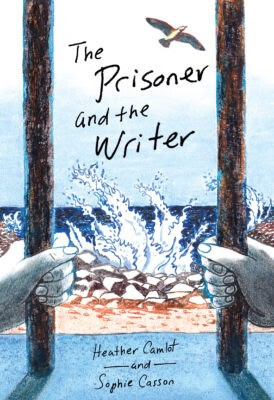
The Prisoner and the Writer, written by Heather Camlot and illustrated by Sophie Casson. Groundwood, 2022. $14.99 ages 12 and up


"At the lowest point in his life,
Alfred has nothing left to lose. 
Guards follow him wherever he goes. 
They watch him day and night, even 
when he's chained to his bed, unable 
to move.

                   Unable to sleep."

It has been more than 125 years since Emile Zola wrote 'J'Accuse', an open letter to the president of the French Republic in support of Captain Alfred Dreyfus who had been wrongly accused of treason. Dreyfus was imprisoned on Devil's Island, in exile and entirely alone. Zola, well-regarded and very popular, chose to expose the injustice of the Dreyfus' trial to all who would listen. 

The attention that his letter brought to the plight of Captain Dreyfus was met with worldwide condemnation. To be tried and convicted of treason because of his Jewish heritage was abominable. Anti-Semitism was not to be tolerated. While Dreyfus languished in prison with little hope for his future, Zola continued to put pressure to have him released. Eventually, Dreyfus was pardoned and returned home to his family. 

It did not end there, as we well know. Zola faced much criticism and hatred for speaking the truth. Jewish people today continue to be victimized by hatred and disinformation, as do many others. It is critical that people stand up to injustice wherever it rears its ugly head.  

Written for middle-grade readers, the novel is focused on both men with powerful words and images that bring this famous story to new life and reminds readers that they do have a voice, and can stand up to those who spread hatred and lies. It takes courage; ultimately, it is worth it. 

Valuable and compelling. 

Wednesday, December 2, 2020

Chance: Escape from the Holocaust, written and illustrated by Uri Shulevitz. Farrar Sraus Giroux, Macmillan. Raincoast. 2020. $26.99 ages 10 and up


"To be able to lie down and stretch out, we sometimes
had no choice but to go outside, hoping it wouldn't rain.
Lying on the cold, hard ground was far from comfortable, 
but we also had to sleep with one eye open, like wild animals, 
because of thieves and other criminals, who were looking for 
easy victims to rob and, if necessary, kill.
"

In an afterword, Uri Shulevitz credits his father with writing his own memories of the war years in his later life. Using that writing as guidance, Mr. Shulevitz sat to write his own memoir of the war years and how they affected him. He was only 4 when he and his parents were forced to flee Warsaw for a life in Bialystok, a Soviet-occupied city in northern Poland. The family had no standing there as they were denied citizenship. Three years later they moved to Turkestan, a new and harrowing experience for the 7-year-old. 

Always hungry and deprived of any kind of normal life, the family suffered from a lack of employment, debilitating illness, and even time spent without his father after his sudden disappearance. Uri found what comfort he could in his love of art, and his mother's storytelling which led him to his lifelong love of reading. His art offered a chance to forget his circumstance for small moments in time, and to let his imagination create a new existence. 

In his teens, the family lived in Paris where his father's brother and his family lived. His memory for the many events of that time offer a less bleak outlook. Still, he faced bullying and anti-Semitism from his classmates, who were only impressed when they recognized his artistic talents. 

The many illustrations are filled with memories that are both funny, and often scary. Such a life cannot be imagined by those who will read this absorbing memoir. Told with honesty, it will certainly make the experiences of war more personal and powerful. It is those stark images and compelling storytelling, mixed a modicum of good luck, that will carry every reader through the often dire circumstances that this family of three experienced as they persevered and survived.  It is a tribute to love of family and the power of creativity. 

Extraordinary! 

Monday, August 3, 2020

Survivors of the Holocaust: True Stories of Six Extraordinary Children, edited by Kath Shackleton and illustrated by Zane Whittingham. Sourcebooks, Raincoast. 2019. $19.99 ages 10 and up

"In 1938 when I was eight
years old ...

... there occurred what has
become known as the
"Polenaktion."

Early in the morning, we
were all sleeping in our beds
in our home in Germany. The
Nazis entered our flat."

Memories of the Holocaust are always heartbreaking, yet often remarkable. The six Jewish children whose first-person narratives are shared in this outstanding graphic novel survived. That in itself is noteworthy and helps readers recognize this harrowing time in our world's history.

Courageous and honest, Heinz speaks of the persecution in Germany because of his family's Jewish heritage, finding refuge in England, followed by internment in Canadian camps when the British wanted them gone. Solemnly, Trude tells readers that many children died at the hands of the Nazi regime, and how she was sent away from her family to England where she lived in 15 to 20 places over the war years. She never saw her parents again.

Ruth's remembrance is of her father running from the Nazis, leaving her mother with two small children. Unable to find protection for her children, the family awaited the Nazi soldiers. A brave British woman found them, and gave them papers to get them to England. Just as they arrived at Liverpool Station, Britain declared was on Germany. Martin was only 8 when the Nazis came for his family, and put them on a train. Separated from the family, he and his sister found safety on the Kindertransport and spent the rest of the war with a foster family in England where they endured and survived the Blitz.

Suzanne was living in Paris when the occupation forced her parents from their home. Luckily, a neighbor claimed Suzanne as her own, and she was saved from her parents' fate. She was then moved into hiding at a farm where she worked hard and spent extra years  as the family had no knowledge the war had ended. Arek, at 15, was sent to Birkenau, Auschwitz where he endured the continual horrors of confinement and abuse.

Back matter includes an up-to-date photo of each of the survivors, who live in Leeds. England, and a short report on What Happened Next for each of them. It is a painful novel to read, but so important, too. Each testimonial ends with a touch of hope. Though their stories are different, their lives were changed through events that were not of their making or by choice. What happened to these children should act as a reminder today that it should never happen again. 

Tuesday, July 28, 2020

They Called Us Enemy, Written by George Takei, Justin Eisinger and Steven Scott. Art by Harmony Becker. Top Shelf, Penguin Random House. 2019. $25.99 ages 12 and up

"We are going on a vacation ...
A long vacation to a far-away 
place called Arkansas. 

What's it like there?

I ... I'm not sure ... 

I saw people crying and couldn't
understand why. Daddy said we
were going on a vacation."

I have read two graphic novels recently that help readers understand the repercussions of internment for so many Japanese Americans during WWII. Following the attack on Pearl Harbor by the Japanese air force, the government determined that all citizens of Japanese heritage were an immediate threat to the US. The decision was made to take them from their homes, asking them to leave with what they could carry and shipping them to one of ten camps that were being set up to house the families.

George Takei was only 5, the oldest of 3 children, when he and his family were rounded up in the night and eventually sent to their first internment camp. His father downplayed the move, suggesting they were going on vacation - tough for a young child to understand when people around their family were frantic and crying. Arkansas provided wooden barracks, barbed-wire fences and a watchful rifleman.

Takei's narration is through the eyes of a young child. Their new home was hot and flooded often. The food was unfamiliar and unappealing. It was difficult to adjust to a life where furniture had to be built from scraps, where older children did their best to get the young boy into trouble, and where startling discoveries were made because nothing was normal (Santa was not his roly-poly self). His parents did what they could to make the most of their situation. His father became a leader in the camp, helping newcomers and dealing diplomatically with guards. His mother used a hidden sewing machine to ensure her children were clothed and comfortable.

When his resilient and proud parents refused to swear loyalty to the United States and denounce Japan, they were immediately coined 'No-Nos'. This meant a transfer to Tule Lake in California, a place where 'disloyal' Japanese people were sent, and notoriously labelled the 'worst' of the ten camps set up by the American government. The camp's atmosphere was strained, pitting activists against those who resisted protest. George had difficulty accepting some of his father's teachings as a young man; he did come to see what his father had been saying and has lived the rest of his life emulating his father's legacy of truth, kindness and understanding. 

George Takei speaks brilliantly of his childhood memories when he compares what he felt at the time to the plight of many people in the world today. He uses his celebrity to make a difference, just as his father used his intelligence and patience to help Japanese families when they needed his guidance.

This is another distinguished graphic memoir published by First Second. It gives readers a clear understanding from this author, actor, and activist of the impact that the internment had on generations of Japanese families.

If you want to hear more, check out George's TED talk from 2014, and his address at the  FDR Museum and Presidential Library in 2017.                                                                         

Sunday, June 7, 2020

Catherine's War, written by Julia Billet and illustrated by Claire Fauvel.Translation by Ivanka Hahnenberger. Harper, 2020. $15.99 ages 10 and up

"Miss Armande is awful. The little kids don't understand anything she says, and the older ones are bored to death.

If she won't do it, I'll teach Alice how to read.

She is so incredibly strong and brave. I want to protect her and teach her everything I know.

I hope I won't fail."

The stories told in graphic novels being published today are quite remarkable, and a wonderful way to get great books into the hands of those kids who find middle and young adult novels a bit overwhelming. Sharing important stories in a more accessible format can make all the difference to their willingness to tackle them.

This emotional, and at times heartbreaking, story concerns one of the 'hidden children' of France, and finds its roots in the author's mother's experiences during World War II. In 1942, Rachel Cohen is living in the Sevres Children's Home near Paris. Her new passion is photography. This home is being run by a headmistress known to the children as Seagull and her husband, called Penguin. It is Penguin who loans Rachel a camera and encourages her to try learning something brand new.

In order to protect her from the Nazis, Rachel is given a new name, Catherine Colin. The Children's Home is the first stop on a long journey the children must make in the last years of the war. It is the only way to protect them and keep them safe. Informers are everywhere, and the children must be hidden in plain sight. Catherine finds safety in a convent, at a farm, in another orphanage, and finally in a secluded forest cabin. The photographs she takes as she hones her new craft document the people and events she encounters as she moves from one place to another, always trying to evade capture at the hands of the German army.

At war's end, she returns to Paris in hopes of finding her parents. The ink and watercolor images that give such life to this story are commanding and memorable, Readers will long remember the settings and the people whose courage, bravery, and willingness to help impacted the lives of so many children. This story is filled with danger, but remains ever hopeful.

 A map of Catherine's journey, a gallery of archival photographs from the Sevres Children's Home, a note to the reader, and a list of questions asked by readers follow the main text.

Wonderful!
                                                                           

Saturday, February 22, 2020

Prairie Lotus, by Linda Sue Park. Clarion Books, Houghton Mifflin Harcourt, Raincoast. 2020. $22.99 ages 10 and up ages

"Although she and Papa had never spoken of it, she had gradually come to realize what leaving California had meant for her future. In the Chinatowns of Los Angeles and San Francisco, there were so many men and so few women that she might have been able to marry a Chinese man, despite being half-white. But the further east they went, the fewer Asians they had seen, and here in the eastern half of the Dakota Territory, ... "

The challenges of the long days of travel come to an end after three years: now, in LaForge, the two are faced with further concerns. In this new town, there are no Asian faces. Hanna's father is seeking a better life for the two of them. Her Chinese mother has died, after teaching her young daughter dressmaking skills that should ensure work in her father's new store. Hanna has to convince her father of that, and deal with the town's rampant prejudice toward a young mixed-race girl in 1880. She wants to finish her schooling before becoming the seamstress she so badly wants to be. While many of the townsfolk, and in turn their children, are unkind to Hanna, she uses all the lessons she has learned from her wise and gentle mother to overcome their racism with dignity and as much warmth as she can muster.

Readers of the Little House on the Prairie books will find similarities when reading Hanna's descriptions of food, life on the frontier, the construction of new buildings and available fabrics and dressmaking details. Her quiet, observant nature allows many memorable moments, including her encounters with a group of women and children from a nearby Ihanktonwan community who teach her skills she can use at home. Luckily, hints at humor throughout offer respite from some of the meanness Hanna faces.

Reading this book, alongside the Laura Ingalls Wilder books, helps children look closely at historical events. It is a powerful and impressive tale about a young girl who yearns to fulfill her dreams: education, meaningful work, and finding a true friend.

Sunday, December 22, 2019

Francesco Tirelli's Ice Cream Shop, written by Tamar Meir and illustrated by Yael Albert. Translated by Noga Applebaum. Kar-Ben Publsihers, Thomas Allen & Son. 2019. $23.99 ages 8 and up

"He opened his ice cream shop
right in the center of Budapest.
He sold ice cream and chocolate
to everyone, even to those who said
nobody would buy it.

Francesco thought to himself,
"Mothers are always right. I did
end up with an ice cream shop
growing in my tummy (and my
head), just like my mother said."

This is a quiet story of two ice cream enthusiasts, the war, and heroism. Francesco, an Italian boy, loves his Uncle Carlo's ice cream cart and all it has to offer. Once a day he finds a reason to visit and choose his favorite flavor. Francesco loves it through his childhood, his teens, and as an adult. But, when he moves to Budapest, there is nothing to compare,

Though an ice cream shop is not the norm in Hungary and many try to dissuade him, he cannot get ice cream out of his thoughts. Despite the naysayers, Francesco's Gelato opens, attracts many customers and is a huge success. A young Hungarian boy named Peter is a regular visitor, loving ice cream as much as Francesco has always loved it ... every flavor. Peter's mother tries to discourage his visits, warning him as Francesco's mother had warned her son that too much ice cream is not a good thing.

Peter grows up, and Hungary changes. War comes and everyone lives in fear. He no longer stops for ice cream. Eventually, Francesco is forced to close his shop. Such sadness for all. Francesco worries about the war, and about his neighbors even more. Peter's family makes the decision to hide, but don't know where. Francesco knows exactly how to help all who need shelter.

"Someone ... I've got it!
My ice cream shop!
I will help them.
I am that someone."

So, he does. Slowly, Jewish people gather there to hide. Francesco cares for them all. Sad to be hiding in darkness, concerned about missing Hanukkah and the celebration of the light, Peter decides he will make a difference just as his good friend has done. Ingenuity wins out, the improvised menorah is lit, and all who celebrate hope that summer will bring better times. It does.

Based on a true story, the final scenes follow Peter to Israel where he raises a family of children, grandchildren, and great-grandchildren who love ice cream as much as he and his old friend. An epilogue tells of the "Righteous among the Nations', who protected the fugitives during the war. Francesco Tirelli was one of the many. Archival photos add interest and context to this very special story told by Peter's daughter-in-law. 

Moving, memorable, and illustrated with detailed, historical settings and worthy characters.
                                                                               

Thursday, November 7, 2019

Caravan to the North: Misael's Long Walk, written by Jorge Argueta and illustrated by Manuel Monroy. Translated by Elizabeth Bell. Groundwood, 2019. $16.95 ages 10 and up


"For over a week
we’ve walked.
We’ve ridden in trucks
and buses.
We’ve slept in parks, in streets
and in shelters.
In some places
people are glad to see us, they help us.
In others they chase us away.
I don’t know where the North is."

If you want a clear picture of the plight of the El Salvadoran people and their 2018 caravan, listen to this story told in the voice of a 9 year old child who must leave his much-loved home and community to head north. There is nothing left for them where they live ... no employment, constant terror and violence, nothing left to sustain a family.

Misael, his mother, father, and brother reluctantly join the 'caravan' that will take them on a journey north. They travel with a very large group of migrants, all looking for a better life. The road is long, and the conditions are less than ideal. If they are together, they think they will be safe. None know what the future holds for them. They have hope for a better life.

"When we get there,
I'm going to have an apartment
with water you can drink.
I'll bathe in warm water
and have a washing machine.

"I just want to work
and send money to my mom.
She's really old and has no pension,"
says a boy
who is walking by my side.

"I'm going to start college.
Maybe I could be a lawyer
or a teacher or a doctor.
Well, I'll settle for just getting there
and then we'll see," says another boy."

Misael's voice is heartbreaking as he observes and shares the stories of those who walk with him. They all experience both fear and hope. That is what guides them through exhausting days and endless nights. Only in hearing Misael's voice as he describes the 4,000 km trip can we begin to understand why they would risk their lives to find asylum.They carry what they can on their backs, are encouraged by kindness as they pass through El Salvador, Guatemala and Mexico. Upon reaching the United States border, all that changes. They are met with the threatening presence of the military and border police, batons, tear gas, protesters, chaos, barbed wire, and a wall ... and reason to fear for their lives once again. The border is closed.

That night Misael dreams:

"I fell asleep and I dreamed.
I dreamed I was flying.
I dreamed I was a song,
I dreamed I was a butterfly,
I dreamed I was a fish
and a wave.
I dreamed
the sweetest dream of all.
Instead of going to the North,
I went back to El Salvador."

It is not the Misael's dream to leave his beloved country; it is a necessity if he wants to live a more peaceful life. Would we not want the same?

Choosing to tell his story in spare verse, Mr. Argueta creates real emotional impact. Manual Monroy's back-and-white drawings perfectly match the crushing sadness of Misael's tale. In an afterword, Mr. Argueta explains why he chose to tell his story:

"I've written this text in my eagerness to share the voices of hope, of anguish, of the thousands of immigrants from Central America who abandon our countries because of all the violence and the lack of opportunities. In their midst, I saw people who were hard workers, humble, desperate and tired of suffering.

“It’s up to us to change things. I believe in the gentle power of reading. I believe reading changes the hearts, spirits, and minds of people.” —Jorge Argueta

Sunday, November 3, 2019

Front Desk, by Kelly Yang. Scholastic, 2018. $22.99 ages 10 and up

"Lupe explained. According to her
dad, there were two roller coasters
in America - one for rich people and
one for poor people. On the rich
roller coaster, people have money,
so their kids go to great schools.
Then they grow up and make a lot
of money, so their kids get to go to
great schools. "and 'round and
'round they go," Lupe said. "And
poor people?" I asked."

Lupe's response is telling:

"We're on a different roller coaster. On our roller coaster, our
parents don't have money, so we can't go to good schools, and
then we can't get good jobs. So then our kids can't go to good
schools, they can't get good jobs, and so on and so forth," Lupe
said."

This story set in 1993 shows that things haven't changed much, have they? Mia Tang and her parents are Chinese immigrants who are courageous, hopeful and hard-working when they arrive in the United States, wanting a better life than they had in China. It doesn't take long for their hopes to be dashed.

Looking for a job that will support their family, the parents are hired by a rich and indifferent motel owner who takes advantage of their situation. Given a small room behind the office in which to live, and enduring overburdened days of cleaning, laundry, making needed repairs and looking after the front desk, the three are soon worn out.  Their hard work is neither appreciated or given any worth.

Mia's voice is always hopeful, even in the worst of times. There are many days when a less resilient and strong fifth grader would just give in to despair. Mia is not that person. Rather, she works as hard as her parents do, trying to make their world a better place. Despite her mother's disdain for the writing she loves to do, Mia remains positive and moves forward in learning English and using her skills to write pertinent and heartfelt letters to people who need to hear what she has to say. Life at school is not easier than it is with her parents. She is bullied and lies are told about her. She holds her ground and stands for what she believes.

In this autobiographical debut novel, Ms.Yang creates characters worthy of our admiration and, at times, contempt. There are friends and supporters, and those who are championed by Mia for their worthiness in spite of what others think. There are many cringe-worthy moments, but there are also wonderful times of support and love. Mia has dreams to fulfill and the determination to make them come true, no matter the odds. There is injustice, but there is always hope. She thinks quickly, writes awesome letters, and faces challenges that seem insurmountable. She does it fiercely, all the while becoming a part of a very unique and supportive community.

And the ending! What a coup ...

A powerful and timely read, despite its early 1990s setting, for any middle years classroom.

Saturday, September 14, 2019

Ghost Boys, by Jewell Parker Rhodes. Little, Brown and Company, Hachette. 2018. $22.49 ages 10 and up

"Being dead, I see places I never saw before. See homes not high-rise projects, schools better than I ever imagined. Who knew there were schools with computer and science labs? Libraries with fluffy pillows and couches? I wouldn't have minded going to Sarah's school, I never would've been late or faked being sick. I don't think any kid at my old school - even the troublemakers - would've minded a sky-blue-painted school ... "

One of my good friends recently tole me that had I asked her grade seven and eight students which book had the most impact on them last year, they would have chosen this one. Deservedly so.

It is a story of a young black boy killed by a white police officer. Readers watch as the scene unfolds. Jerome lives in a poor neighborhood, and attends a school that does not have the funding it needs to support the children it serves. He is bullied and scared each day as he walks to school; and he is scared for his little sister as well. He protects her as best he can.

When Carlos, a new student from San Antonio, arrives and befriends Jerome, he shares what he learned there. When the bullying starts for him as well, he scares the three boys with his attitude and his toy gun. They stand off; Jerome is surprised and thankful. After school that day, Carlos encourages Jerome to take the gun for some imaginary play in the park near his home.

A police officer finds him there and shoots him, concerned that he is carrying a gun. Jerome's ghost is witness to all that happens following the shooting - his family's anguish, Carlos' guilt, the police officer's trial and subsequent not guilty verdict. Jerome also spends time with other ghost boys, including Emmit Till. He learns their stories, and the history that he is now a part of, and he is only seen by Sarah, the police officer's daughter. She can see all of the ghost boys, and is trying to come to grips with the action that changed all of their lives. 

Jerome's story is written in the past and his ghostly present (Alive and Dead), allowing readers to begin to understand the realities faced by black families as they lose their sons to the reality of racial injustice, and to the plight of those officers' families who must also deal with the aftermath of making a grave (conscious or unconscious) mistake. 

Challenging, historical, filled with enduring pain, and sure to spur discussion in middle years classrooms, you will not forget Jerome, his family, his friends or his circumstances.

I will leave the last words to Ms. Rhodes:

I write for children now. I believe they are our best hope for a better world. The young are curious and have such open hearts. I write challenging stories not to embitter them but to empower them to “be the change,” to remember always the sense of justice and fairness they knew instinctively as children when they become adults. Writing stories about ending all forms of bias and discrimination, I hope will be my legacy—my own personal attempt to “bear witness” beyond the grave.

Friday, May 17, 2019

Noodlephant, written by Jacob Kramer and illustrated by K-Fai Steele. Enchanted Lion Books, Publishers Group Canada. 2019. $25.95 ages 8 and up

"They called the machine
the Phantastic Noodler. It
was a very complicated, but
also very simple. With a few
turns of the crank, it could
turn anything into noodles.
Noodlephant tossed in some
pens. She turned the crank ... "

It is advantageous for our children to learn to have a say in things that matter to them; we don't want them to be afraid to express their opinions. In the political and social climate that permeates the world today, too many people think that the way they think is the only right way to do it. We all need to remember that we have a voice; it does not have to be in agreement with the anyone else. But, we do need to have a say and help garner the strength to work together to make our world, and our own lives, better.

This witty book will have kids thinking about that.

Noodlephant loves food. That's obvious from the nickname her friends have bestowed upon her, right? She adores pasta, and likes to share that love by cooking for all of her friends. The kangaroos are the exception. Their main concern is enacting laws deemed unfair to the rest of their community.

"They made laws about who could swim at the beach
                                                          (only kangaroos)
who could enjoy the Butterfly Garden
                                  (only kangaroos)
and who could make laws
               (only kangaroos)."

When they decree that elephants must eat sticks and branches, they also inform that, should the law be broken, elephants are to be confined to the zoo! The rest of the animals are not pleased; they love Noodlephant's pasta parties. It takes time and effort to design a new kind of machine to solve their problem.

"Those kangaroos are kanga-rude
Making rules about our food. 
Telling us how we should think
What we can eat and what to drink."

A few turns of the new machine, and pasta can be made from anything. The kangaroos are furious and call Noodlephant to 'kangaroo court'. There, she tries to plead her case. The verdict is rigged. Once confined to the zoo, she turns her protest up a notch ... a hunger strike. Worried, her friends seek and find a brilliant solution.

The comedic images created by K-Fai Steele add a welcome dose of fun to the pasta parties, a gloomy sense of sadness to the enforced imprisonment, and a satisfied smile for the cooperative solution to the community's difficulties. 
                                                                       

Friday, September 21, 2018

The Unwanted: Stories of the Syrian Refugees, written and illustrated by Don Brown. Houghton Mifflin Harcourt, Raincoast. 2018. $26.99 ages 14 and up

"Hundreds, then thousands flee.
Many simply cross into Jordan and Lebanon, where they try to take up a new life. Others pile up at the Turkish border. Turkey will officially accept those with passports. The mass of people are without and sneak in. The night is cold. Families with nothing but the clothes on their backs steal toward the Turkish border in silence. We felt maybe it's our turn to die, but we didn't want to die. So we made up our minds to leave."

It has only been seven years since the civil war in Syria began when a group of teenagers were tortured and imprisoned for speaking out against the Assad regime. It was the beginning of a long and continuing war between the country's dictator and those who oppose his rule. Protesters were met with tanks and bombs, causing millions to flee for their lives. The resulting refugee crisis has had worldwide repercussions.

In his new book, Don Brown provides a clear look at the awful reality that is the life of those fleeing hatred and persecution in their home country. He does his best to let his readers know about the conditions the Syrians face as they try to find peace and security elsewhere; they cannot find it at home. He tells of dangerous and insidious smuggling schemes, neighboring and other countries of the world who do not welcome their arrival, the dangers inherent in fleeing for their lives, and the sadness and anger many feel for their circumstances. Resentment has grown throughout the world for those seeking asylum. There are many tragedies, but also joys shared as some find new homes. The refugees are resilient, determined and always hopeful.

Emotional renderings of this very real tragedy allow the target audience to begin to understand the enormity of the crisis. Grief, fear and total exhaustion is clear on every page. It is a heartbreaking account of the exhaustive research Mr. Brown has done while visiting refugee camps in Greece and seeing first hand what life in like in the camps where they are housed. He provides a journal summary of the visits he made a year ago, focusing his attention on the people, rather than the reasons for their flight from their homeland.

"This last visit to a camp heightened the discomfort I'd experienced on my first visit - that I was a voyeur to tragedy. The notion of having refugees recount their awful experiences of exodus seemed unnecessary and cruel. After all, those terrible stories are already widely circulated. My unease was hard to shake. In the end, I found value in the visits by their having made me a more sensitive witness to the refugees' dilemma and a more powerful advocate for their salvation."

These are ordinary people experiencing untold hardship. If you want a starting point for discussion, you would do well to share this honest, clear, and authentic account of what life has been like for so many. For those wanting to know more, the author provides pictures, a summary of his visits to the camps, source notes, a lengthy bibliography and a poignant poem of hope by Sahir Noah.

Tuesday, March 13, 2018

Write to Me: Letters from Japanese American Children to the Librarian They Left Behind. Written by Cynthia Grady and illustrated by Amiko Hirao. Charlesbridge, Penguin Random House. 2016. $19.99 ages 7 and up

"The US government thought Katherine and all people of Japanese heritage living on the West Coast could be dangerous. They looked like an enemy of the United States in a complicated war halfway around the world, so the government ordered that they be imprisoned. Miss Breed gave Katherine a stamped, addressed penny postcard ... "

We have all heard stories of the Japanese internment following the bombing of Pearl Harbor in 1941. In Canada and the United States, governments made the hasty decision that all people of Japanese descent were a potential enemy to their country, and they removed them from their homes and communities to isolated locations where they lived out the duration of the war.

It is hard for any of us to imagine what it was like for those families and their children. Clara Breed loved and empowered all the children who visited the San Diego public library where she was librarian, offering guidance for book choice and encouraging their passion for reading. So, when some of the children who were regular visitors were forced to move away, she wrote to and received letters from many of them. Those letters made a connection to the lives they led before the war made them prisoners.

Ms. Breed sent books, postcards and art supplies, wrote letters to the children and to those who had put them in those camps. She sought justice from an unjust system. The letters are housed at the Japanese American National Museum and speak to the power of books to make life better. Many quotes from the children's correspondence are included on the pages of this uplifting  book.

"Dear Miss Breed,

I was overwhelmed with joy to see
the books when the postman
opened the package for inspection.
Thank you, Miss Breed, Thank you!

Very sincerely yours,
Louise Ogawa"

"Dear Miss Breed,

We have one large shower
and one large laundry room.
We certainly don't see how
they expect over 16,000
people to be clean and also
have their clothes clean.

Yours truly,
Fusa"

Archival photographs with informative captions are featured on front and back endpapers. Colored pencils are used to create the soft, sepia-toned artwork that shows the conditions in the camps, the joy the children felt when books and postcards arrived, and the uncertainty that awaited them at the end of the war. An author's note, a timeline of important dates in Ms. Breed's life, a short history of the people who came from Japan to live in the USA, source notes, a bibliography, and books for further reading extend the learning.

Teachers and parents wanting to know more about Miss Breed should check at the library for Dear Miss Breed by Joanne Oppenheim (Scholastic, 2006). It is also worth your attention.

Sunday, September 10, 2017

Refugee, written by Alan Gratz. Scholastic, 2017. $22.99 ages 10 and up

"Rain lashed Isabel as she shoveled water out of the boat. Scoop, pitch. Scoop, pitch. The bottom of the boat filled as fast as they could bail it out. Isabel, her mother, her father, her grandfather, Luis, Ivan, Senora Castillo, they all worked feverishly, none of them talking - not that they could hear each other over the storm. The only ones not bailing were Senor Castillo, who looked like a ghost ... "

Three families, three countries, three conflicts ... years apart, yet the effects for the families are equally devastating at any time. The three main characters, whose parallel stories are told in this heartbreaking book, have much in common despite their many differences.

Josef is a Jewish boy living in Nazi Germany in 1939. His father has been in a concentration camp for a year before being released, with the instructions to leave Germany within hours. With his family at his side, they board the MS St. Louis bound for Cuba. When unrest breaks out in Cuba in 1944, Fidel Castro allows anyone who wants to leave the chance to flee. Isabel, her family and neighbors board a makeshift boat headed to Florida in hopes that they can land before being caught at sea, In such an event, they will be returned to Cuba. Mahmoud is a boy from 2015 Aleppo where his own government is bombing his city, leaving far too many without a place to live and with nothing to call their own. His family must use any means to make their way to Europe where they hope to find safety.

They have much in common - a dictator, an escape by boat, a fervent desire to find peace and safety for each family. They endure terror, loss, hope, and are unbelievably brave in the face of tragedy. Nothing is easy here, and their stories offer a realistic look at families forced to leave the homes they love. Alan Gratz manages to share their stories through brilliant writing, all the while drawing parallels that end each of their chapters with heart-stopping action. The fact that he connects the three is quite a remarkable feat!

Using historical fiction to bring these three remarkable characters to his readers, he is respectful of their circumstances, aware of the emotional toll, and fills his pages with the suspense that will not allow the reading to stop. Urgent, dangerous action and full of empathy for the plight of migrants, this is a book that should be shared in middle and high school classrooms.

Timely, and necessary - of that there is no doubt!

Wednesday, July 26, 2017

wishtree, written by Katherine Applegate. Feiwel and Friends, Macmillan. Raincoast, 2017. $23.99 ages 10 and up

"But this isn't a fairy tale, and there was no spell. Animals compete for resources, just like humans. They eat one another. They fight for dominance. Nature is not always pretty or fair or kind. But sometime surprises happen. And Samar, every spring night, reminded me that there is beauty in stillness and grace in acceptance. and that you're never too old to be surprised."

Some books come in the mail, and I can put them in a TBR pile and know that I will get to that book sometime in the future. Some arrive and go straight to the top of that pile to be read that very same day. Because I lent Katherine Applegate's incredible new book to a friend, I waited one extra day to read it. Karlyn got it back to me the day after she borrowed it, and I finished it that evening. Am I glad that I did? A resounding YES!

Red is a two hundred and sixteen year old tree - the rings prove it and offer a multitude of stories to tell. The voices of the animal and bird characters are strong, unique and amiable. The story is beautifully constructed and powerful in its treatment of intolerance as well as the need to protect our environment. Using Red as her narrator, Ms. Applegate crafts a story that will live long in the memories of those who share it. It would be a wonderful way to begin a year filled with wonderful books, if it were shared in the first days of the coming school year in any middle school classroom.

Bongo, a crow who lives among Red's branches is a terrific character - funny, caustic and supportive in the best possible ways.

"Charm," Bongo sneered. "Did you know that's
what people call a bunch of hummingbirds?"
"No, actually."
"Hummingbirds! Which, let's face it, are pretty
much just overdressed flies. But a bunch of us crows
together, guess what we get to be called?"
"What?"
"A murder! A murder of crows! Can you believe
it? A bunch of trees, you're a grove. A bunch of rac-
coons? A gaze." Bongo flapped her wings. "But crows?
We're a murder."

Red plays a very special role in the neighborhood, as home to many animal families and as the depository for many personal wishes every year in early May. Those wishes are heartfelt and important to the 'wisher'. Samar is a newcomer to the neighborhood and an important human voice. Her Muslim family is the target of hate, her neighbor is a boy from her class at school whose parents also ostracize Samar's family. Both need a friend. The carved message meant for Samar's family upsets the owner of the land where Red resides. She decides that cutting the wish tree down will solve all problems. Red decides to take a stand!

Powerful, thoughtful and filled with kindness that will inspire, this is one terrific book from a very gifted author. Lucky we are to be able to share it.

I enjoyed reading this post from Katherine Applegate at Nerdy Book Club on January 17, 2017.

Red is a red oak, common and tough and beautiful. A neighborly tree in an immigrant neighborhood, it’s stood witness for over two hundred years to the best and worst of human behavior. Sadly, it’s not entirely a surprise when someone carves “LEAVE” into Red’s bark, clearly targeting the Muslim family that lives nearby. “I love people dearly,” Red says. “And yet. Two-hundred and sixteen rings, and I still haven’t figured them out.” In writing wishtree, I wanted a simple story, one where even the youngest reader would be prompted to ask that most heartbreaking of questions: why are those people being treated unkindly?  I wanted an outsider’s look at human behavior, not unlike the way Ivan the gorilla, in The One and Only Ivan, worked to understand his world. The character of Red provided me with just that kind of observer. But Red gave me something else:  hope. In Red, I found a narrator who could reassure us that — big picture — it’s going to be all right. I wanted a narrator who’d been around the block, so to speak, a historian.  ... I didn’t want to sugar-coat things. But I wanted Red to comfort readers (and me) that this, too, shall pass. That there is always goodness to be found in the midst of fear, and hope in the midst of darkness."

Tuesday, November 1, 2016

The Bone Sparrow, written by Zana Fraillon. Orion, Hachette. 2016. $18.99 ages 10 and up

"Some of the oldies ask me to draw them things. Sometimes they ask me to draw them things I haven't ever seen, and they have to talk and talk until I can see in my head what they have in their rememberings. Queeny says they only do it is so that I shut up for a bit and stop pestering them for more stories. She reckons the only time I'm ever quiet is when I'm being told a story."

Let's begin November with a novel. I have read some pretty amazing ones this past month, and want to share them with you. To say this one held my attention from first page to last is definitely understating the impact it had on me!

I knew absolutely nothing about the Rohingya people of Burma. I am not happy with myself for that. After reading this compelling and heartbreaking story of Subhi and his family, I wanted to know more. That is the power that books have for all of us - they teach us about the world and its ways. They make our hearts ache and soar, and they provide windows into the lives of others.

Subhi's family is persecuted for their religion and forced to leave their village home. Their journey ends in an Australian detention camp, where Subhi is born. Ten years later, it is the only life he knows. To say it is not a good experience is putting it mildly. Subhi loves to hear his mother's stories of life in Burma, but she is slowly losing her will to live and the stories have become few and far between as her health declines. The family lives in hope that Subhi's father will find them there.

Despite the abusive guards, the terrible food, and the hopelessness felt by so many, Subhi does find friends. Each helps to sustain him and his sense of hope for a better future. It does not look promising. Each of these friends is worthy of the young boy's admiration. Harvey, one of the guards, is as kind as he can be when no one else is watching. Eli, also a refugee, is an older boy whose tireless attempts to make things better have an impact on his young friend. Subhi believes that the Great Sea is bringing signs from his father of better times. He dreams his dream often.

Then, there's Jimmie. Jimmie is an illiterate girl who lives outside the detention center fence. The two meet by chance, and Jimmie begins coming into the camp so that Subhi can read the stories that her dead mother has left in a notebook for her. She cannot read them herself. Several chapters of the book are written to focus on her life when she is not at the camp.

Subhi's narrative is strong and personal. Through his eyes, we are witness to moments of loss, anger, fear, and injustice. We also see tiny glimpses of love, hope and redemption ... and we come to know that stories do heal, even in the most brutal conditions.

This is not a easy book to read. It is quite lovely as well. It made me cry, and smile. It caused me to ache for those who live where there is no freedom, where conditions are deplorable, and where happiness is a distant dream. The friendships are strong, the characters unforgettable, their story eye-opening. Subhi, Eli, and Jimmie share personal stories that have helped to make their lives bearable. That is the true message of the book for me - the need for stories in our lives.