Total Pageviews

Showing posts with label gardening. Show all posts

Saturday, November 8, 2025

Daisy Rewilds, written by Margaret McNamara and illustrated by Kerascoet. Penguin Random House, 2025. $24.99 ages 4 and up


"In June, Daisy attracted a lot of attention, 
especially among the pollinators. Hummingbirds
thrummed by her bee balm. Bees buzzed about 
her harebells. Monarchs feasted on her blazing 
stars. 
"Should we introduce more worms?" asked 
Auntie Betsy. 
"I'm good," said Daisy.
"

Daisy has been interested in the natural world and conservation forever. It is said she composted her own baby food when she was but one year old. Later, she liked to sleep on a bed of leaves and was constantly experimenting with plants and foods to grow new and wonderful things. 

Spring brought a new kind of experiment. Daisy decided to skip her bath and see what happened. Her body began to grow plants behind her ears, on her toes, and around her ankles. Nobody but Daisy paid any attention, until her mom asked and Daisy explained she was rewilding. Daisy loved what she was doing; her mother was worried about what the neighbors might think. 

Aunt Betsy approved and agreed to homeschool her niece. Daisy loved it all. As Daisy grew more and more like the plants she so loved, Aunt Betsy encouraged her and recognized the vegetables that Daisy was now growing on her person. Summer brought pollinators, who buzzed around and feasted on her plants. Birds were next. The warmth of August had her drooping, but she was not ready to put a stop to the growth. 

Finally in September, the neighbors expressed awe at all that Daisy had done in her own yard. Many wished the entire community could look similar. Daisy is now satisfied she made the difference she wanted to make in calling attention to what everyone had been missing. She picked herself up, and began the work of replanting and rewilding the many creatures now flourishing in her yard to the surrounding neighborhood. 

""Daisy!" said Pa. "You rewilded!"
"How did you do it?" asked the neighbors. 
"I encouraged sustainable biodiversity and ecosystem
health," said Daisy. 
"What on earth does that mean?" asked a little kid. 
"I helped the land heal," replied Daisy,
"by leaving it alone."
"

This is a captivating story about a young girl with a big heart and a love of all things natural. Ink and watercolor are used to create a gorgeous  backdrop for the storytelling. Filled with details and wonder, they will have your readers checking out every spread to see what they might discover there. 

Daisy's magic may not be possible. What can you do with what you know and have to make your neighborhood a healed place?  

Sunday, September 7, 2025

Benjamin Grows a Garden, written by Melanie Florence and illustrated by Hawlii Pichette. Kids Can Press. 2025. $21.99 ages 4 and up


"Benjamin watched the tiny shoots poke out of 
the ground and slowly unfurl their leaves. The 
stalks grew higher and he could almost taste 
the buttery corn on the cob he'd eaten with his
cousins after last year's harvest.
"

As Benjamin welcomes the warmth of the spring sun, he listens for the birds and sings back to them. The feeders encourage birds to stop and stay. Spring also offers a time for he and his mother to plant their garden. It's a garden that will not only feed his family; its bounty will be offered to others in their community. Benjamin is excited to get started. 

Every seed they plant will grow into vegetables to be used for soup, stews, pies and salads. It's a very busy time. There is hard work ahead, but both are willing to do what is needed to grow a garden to be proud of. As they plant, his mother offers wise advice. Once the seeds are planted, they take the time to water, then watch and wait. 

First, they plant corn. When it grows to a few inches, Benjamin digs around the corn stalks to plant bean seeds. As the beans get started, he carefully sows squash seeds close by. As he plants them, Benjamin is reminded of how good each vegetable from last year's garden tasted when they were harvested. The plants need water and the sun for growth. 

""The beans use the corn to climb," he said. 
"And the squash leaves cover the ground to 
keep it cool and damp. They all help each 
other grow."
"

They also tend tomatoes, cucumbers and strawberries; all will be shared with others. Those vegetables will make many meals throughout fall and winter. Soon, spring will come again and it will be time to start over once again. 

Melanie Florence makes is clear to her readers that there are many rewards when a garden is planted, tended, and shared with others. I love that they learn the traditional way of planting the Three Sisters (corn, beans, squash) together for maximum benefit. As they talk together while they work, mother and son use Cree words, which are included in a pronunciation guide following the story. 

If you read Benjamin's Thunderstorm, you will recognize the bold colors and outdoor setting in the digital artwork of Hawlii Pichette. This book offers a warm look at the connection between Indigenous culture and nature, and the gift of providing for all. 

Sunday, June 8, 2025

How to Talk to Your Succulent, by Zoe Persico. tundra, Penguin Random House. 2025. $18.99 ages 8 and up


"You know what? We're going to make something
delicious. And I can't do it without my little sous-chef.

Are we making what I think we're making? 
How did you know baked ziti is my favorite? 

How could I not? You inhaled my baked ziti the last 
time you visited. 
Your mom knew you'd crave it again, so I did what 
all grandmas do best and taught her my recipe. 

Amazing! We can do baked ziti nights again!"

In a graphic novel that is focused on a young girl's grief, readers meet Adara. Following the recent death of her mother, she and her father make the move to live with her grandmother from California to the 'middle-of-nowhere'. Everything has changed for Adara, and for her father who has a tough time dealing with his feelings about their loss and his resulting inability to talk to his daughter about it. 

Adara's mother loved plants. In hopes of helping her deal with her grief, her father surprises Adara with a trip to a nearby greenhouse where, to Adara's surprise, a lovely purple succulent becomes a friend. The fact that Adara can talk to this plant is startling, but also heartwarming as Adara's mom also talked to plants! Adara is excited to share this news with her father, who dismisses it by telling her that plants may not talk to humans but they certainly communicate. Adara names her plant (a Perle von Nurnberg) Perle and takes her home. That relationship blossoms as does a new friendship with Winnie at school. Winnie is a good and accepting friend who cares about Adara, while also knowing what Winnie herself needs. Scenes between Adara and her grandmother offer some relief as do the conversations with Perle. 

Worthy characters and warm illustrations are rich and telling, offering help with understanding how difficult it can be to be heard while also learning to listen. The deeply felt pain that overwhelms Adara and Perle is shown in panels that are awash in thorns. Adara's father works to make changes to help his daughter; the pain both feel is palpable. A hopeful ending allows readers a way forward from the engulfing sadness. 

Back matter is sure to be appreciated. 

Tuesday, April 22, 2025

Growing Green: A First Book of Gardening. Illustrated by Daniela Sosa. Candlewick Press, Penguin Random House. 2025. $24.99 ages 7 and up


"If you don't have much space, a great 
way to grow tomatoes is in a hanging 
basket. You can grow them from seed 
or buy plants from your local garden 
center in late spring/early summer.
"

While sharing the information about trying to grow tomatoes in a basket, a list of needs is provided: a hanging basket, a liner, compost, tumbling cherry tomato plants, and plant food. Now the gardener is ready to try a hand for a successful harvest. Information is provided as well for season, harvest time and environment for optimal growth. The facing page offers a step-by-step method for preparing the basket, adding and arranging the plants, and providing the care those plants will need before the crop is ready to harvest. 

As well as that, there is a Did You Know? feature: 'Tomato plants were first grown for food by the Aztecs in the Americas. Now, every year in August, 20,000 people gather in the Spanish town of Bunol for an epic tomato-throwing festival. More than 110 tons/100 metric tons of overripe tomatoes are thrown in the streets!'

The tomato is but one of the fruits and vegetables included in this informative and helpful guide to growing your own garden. Other suggestions include strawberries in rain boots, green beans, new potatoes, carrots, sweet corn, pumpkins, avocado pits, celery bottoms, radishes, cressheads, a herb garden, leafy greens, nasturtiums and sunflowers. As you can see from the list, there is no doubt that kids will be keen to try something they are interested in having for their own gardening experience.

The format remains the same throughout and proves to be a welcome guide for interested teachers, parents and their children. The Did You Know? boxes add interest and the illustrations are helpful as the learning begins and continues. If you are considering trying a hand at gardening with your family, this book provides needed information that will make the process easier. The tough part is waiting patiently while the growing happens, before plants can be harvested for delicious consumption. 


If you would like more information about Earth Day, go to earthday.org to find ways that you can help with initiatives for a healthier planet. 


Wednesday, August 28, 2024

Secret Gardeners: Growing a Community Garden and Healing the Earth, by Maija Hurme and Lina Laurent. Pajama Press, 2024. $23.95 ages 6 and up


"Bianca waits with Amy while Billy and Luna 
put their outfits on. Luna gets to blow smoke 
around the bees while Hanna lifts the lid. The 
smoke calms the bees, and most of them crawl 
further down into the hive. Some bees still fly 
up. Soon, bees are buzzing in the air and on 
the children's outfits.

"Just stay calm," Hanna says."

Luna, Bianca and Billy are neighborhood spies. Thery love to watch their community from the roof of their apartment building. Luna adds to her spy notepad when they notice something important. Today, the sad, old man isn't crying. Previously, they have noticed his crying when he looks at an abandoned backyard nearby. 

They are off to investigate said yard. There is a house there, but no lights or action. Luna leans on the wobbly fence, and falls through it. All three step into the yard; it's time to investigate. A noise brings them to a halt. There is a lady there whose name is Amy, and she wants to plant a garden in the yard. The children check with their parents before coming back to give her a hand. 

Pencil crayon artwork fills each spread with action and interest. Information boxes, step-by-step descriptions of the work being done, and captioned details make learning about no-dig gardening a real treat for all readers. Amy helps the children understand the need for growing their own food, and tells them about no-dig gardens that are being planted around the world ... in old tires, barrels, and abandoned lots. They learn about what's happening under the garden's surface, how people can work together to do what it takes to create a community garden, choosing and planting seeds and helping them grow. 

As they work together, more and more people arrive to play their part in making the garden a true community effort. It's quite a wondrous thing; is it too good to be true? 

""What are you doing here?" Bianca asks. 

"We're taking measurements, a parking garage 
is going to be built here." one of them explains.
" 

What will happen? Can the garden be saved? One can only hope there is a lasting solution. 

Blending fiction and nonfiction text makes this book a standout. Back matter provides additional facts to help broaden knowledge, a descriptive glossary, a list of thank yous for help given in writing it, and suggestions for further reading.  

Thursday, February 29, 2024

All That Grows, words and pictures by Jack Wong. Groundwood. 2024. $21.99 ages 4 and up


"When daffodils start 
popping up everywhere, 
even in muddy ditches, 
my sister tells me they're
the flower of Mother's 
Day. We pick a bouquet
to give to Mom - after
rinsing off the dirt, of 
course.
"

I read this from Jamie Oliver today: Tonight, the sun will set around 6pm and won't set before 6pm again until 29th Oct. I love just thinking he is absolutely right. It gives hope for the arrival of spring as days get longer, and sunnier! 

This wonderful new book by Jack Wong is testament to that as well. The young child who narrates this homage to growing is on a neighborhood walk with his sister. As they go, smelling the flowers and checking out all they see around them, she teaches him about plants. They return home with some of the first daffodils of the season for their mother. 

The world turns green. Now is the time for his sister to teach him about gardening, too. The weeds in her garden appear out of nowhere, covering her many vegetable seedlings. It is a lot of work for both to keep those weeds at bay. Together they work. As they do, she shares what she knows. Some of what he is learning has him wondering: 

"I wonder why some plants are called 
flowers, and others are called weeds. 

And how some can be both, like goutweed, 
which people used to call ground elder and 
planted in flower beds on purpose.
"

How does his sister know so much about plants and gardening? How on earth will he ever know what she knows? When tiny white flowers emerge from the ground, he is surprised to learn she doesn't know what they are. She will have to do some research. The boy observes that they are both learning, and he gains confidence in trying some of his own gardening. It's reassuring to learn that everyone has something to learn. 

As in previous books, Jack Wong's artwork impresses. His pastel images command attention for his use of light and shadow, perspective and its effects on the reader. It has a warmth that is both reassuring and impressive. 


Saturday, December 23, 2023

Wintergarden, written by Janet Fox and illustrated by Jasu Hu. Neal Porter Books, Holiday House. Penguin Random House. 2023. $24.99 ages 3 and up


"The houses are dressed in cheery lights.
The leafless trees are stark and dark.
The cars roll by in slushy rumbles.
The shops are warm and full and bright
and smell like cinnamon and apples.
"

Snow doesn't stop this family from having a garden. When it is too cold to plant one outside, Mama plants it in their apartment. The windowsill holds the plant pots where sunlight will find its way to encourage growth. 

With help from our child narrator the seeds are planted, labelled, and carefully watched. The child tests the soil for needed moisture, and moves the pots to ensure all the sunlight needed. Getting outside allows the family a chance to visit the winter landscape, and see all the sights and sounds indicative of the season. 

At home, the seeds begin to sprout, bringing wonder and excitement. Up and up they grow! It's fun for all to watch that growth and to see what they are becoming. Soon, they are used to help create delicious meals the family. As the seasons begin to change, they head outside on a trip for more seeds, well-chosen by a child who has learned a lot while watching her mama plant a 'wintergarden'. Those seeds provide for growing her spring garden outside. 

Artwork created using watercolors, colored pencils and mixed-media helps young readers see the process of growing plants inside. Scenes of warmth and growth inside are contrasted with the cold of the outside winter world.  Endnotes give instructions on growing a winter garden, as well as a list for further reading. 

Friday, October 27, 2023

Cinderella and the Mouse Called Fred, written by Deborah Hopkinson and illustrated by Paul O. Zelinsky. anne schwartz books, Penguin Random House. 2023. $25.99 ages 6 and up


"Suddenly, Fred felt himself tumbling 
about, like a little lost leaf in a storm. 
The next thing he knew, he had a long
silver mane and four ginormous hooves. 

Goodness! He was attached to some 
sort of gaudy orange contraption. And 
there was Ella, all dressed up and fancy.
"

Fred is a wee mouse with an always-itchy ear who lives in a pumpkin patch that belongs to his friend Ella (Cinderella, as she is known to many). In this alternate fairy tale, he is caught up in an adventure, not of his own choosing. His is a quiet life until a stranger appears one night, looking for a pumpkin for Cinderella. Fred asks why and learns she is Cinderella's fairy godmother. She takes the pumpkin and also Fred, turning him into a horse! 

With a warning from her godmother about the curfew and complaints about the discomfort of the glass slippers, Ella and Fred are off to the ball. Fred can only imagine the fun, while Ella isn't having a grand time at all. With only one glass slipper when she leaves, she shows her displeasure by throwing it a nearby lamppost, smashing it to smithereens. They are almost home when the spell breaks and everything magical disappears. 

Ella is quick to collect some seeds from the broken pumpkin and takes them home, along with Fred. When the prince comes looking for the owner of the glass slipper, Ella hides and watches the contortions her stepsisters go through to try to make the slipper fit. Ella certainly doesn't need a prince who hates dirt and gardening. Ella saves and plants the pumpkin seeds in the spring, growing an award-winning pumpkin. At the fair she meets the young farmer in second place. That farmer falls madly in love with Ella. The two women marry, and move to a small farm where Fred keeps watch over their pumpkin patch. They all live happily ever after! 

Mr. Zelinsky’s bright and silly scenes created in ink and assembled digitally, add a wonderful note to the storytelling. Pages are filled with witty text, constant action, and expressive characters. Full of charm for a new generation. 

"I’ll find my own destiny, thank you very much,” 


Friday, July 14, 2023

City Beet, written by Tziporah Cohen and illustrated by Udayana Lugo. Sleeping Bear Press, 2023. $24.99 ages 4 and up


"Victoria minced the garlic while 
Officers Deena and Tina tugged
and tugged at Mr. Wen, 

            who tugged
            at Mrs. Kosta, 

                who held tight to that big red beet
                and pulled with all her might.
"             

There's going to be a community potluck in July. Victoria and her friend Mrs. Kosta have decided they will contribute a beet salad for the party. For that, they will first have to plant the beet. That they do, and then spend months caring for their garden. To their surprise, the beet grows and grows and grows! 

On potluck day, they prepare to harvest their beet and make the salad. It will not budge. While Victoria checks the recipe in her Baba's Kitchen cookbook, a parade of community workers stops to see if they can help Mrs. Kosta get the beet out of the ground. Victoria wants to help; she is told at every turn that she is too small. As the adults work to remove the beet, Victoria makes preparations for the salad itself. 

That beet will not be harvested. Helpers keep stopping by. Victoria continues putting all other salad ingredients together. The beet refuses to budge. Passersby stop to watch, take pictures, and show astonishment at what is happening in the garden. Victoria can't take it any longer. She gets on her tricycle, attaches herself with a skipping rope to Ms. Browne, the bus driver, and pedals with all her might. 

SPROING!!

Any child who knows The Enormous Turnip story will be delighted to listen to this book. It's great fun to read aloud. Repeating the words with each additional helper is perfect for little ones. All the while, they are also learning about the making of a beet salad. The illustrations are full of color and detail, adding another dimension to the enjoyment. The community is multicultural, happy and helpful. 

A recipe for the salad ends the book, and a hint that another might be on the way for the fall ... with a butternut squash pie. We will have to wait and see. 

Saturday, June 17, 2023

Two Green Birds, written and illustrated by Geraldo Valerio. Groundwood, 2023. $14.99 ages 7 and up


"First I removed the wet bread. Then I placed
the new food in. 
We hung the cage back in the guava tree. 
We watched the birds for a while. They 
stared at us the whole time, never going to the 
bottom of the cage to eat. 
The parakeets just sat on their perch, 
watching.
" 

Based on memories from his home country, Mr. Valerio tells a fascinating story of a grandmother and grandchild caring for two new birds, and doing their best to create conditions that make them feel more comfortable. 

Francisco is delighted to see the wild parakeets, and to learn about them. They are beautiful, but they eat none of the foods on offer: polenta, crackers, collard greens, or birdseed from the pet store. They are fearful, keeping to themselves. They huddle together and have no response to any of the overtures the boy and his grandmother make toward them. What is the problem? 

Pet store visits offer a chance to see other parakeets. They are happy and very noisy. More seeds and a bigger cage change nothing. The birds remain fearful, and are not interested in the food provided. As the days pass filled with normal activities for grandmother and grandson, the two become more and more concerned about the birds. 

It isn't until a flock of wild parakeets lands in the guava tree that their parakeets finally respond - they scream back and forth to each other until the flock leaves. The caged parakeets return to cowering and quivering at the back of their cage. When the flock returns, the screaming begins again. Francisco knows what he has to do. He opens the cage, allowing their birds the freedom of flight. It leads to a perfect ending. 

"Grandma and I emptied the seeds from the 
food dispenser. We threw away the pieces of 
orange, the collard greens and the water. We 
cleaned the cage and put it in the sewing room.
We went back to the garden. 
There is always a lot of work to do in a garden.
"

The text of this family story is a feast for the senses. In short chapters just right for emerging readers, it offers a look at a close relationship between the generations and a shared concern for wild creatures. The illustrations shimmer with the colors of nature.

Monday, September 19, 2022

The Gardener of Alcatraz: A True Story, written by Emma Bland Smith and illustrated by Jenn Ely. Charlesbridge, Penguin Random House, 2022. $19.99 ages 7 and up


"As the days crawled by, he lay low. He endured
the no-talking rules. He avoided riots. He performed
his dreary job, scouring the ground for handballs
that had been knocked over the rec yard wall. 

Make no mistake: it was a tedious life."

Convicted on charges of counterfeiting, Elliott Michener was transported with nineteen other inmates to Alcatraz, the island prison in San Francisco Bay. He had no desire to stay, and spent his early time there hoping he could find a way to escape. As days passed, he remained quiet, and obeyed all the rules while doing the job assigned to him. 

When he found a key and handed it over to authorities, his luck turned. Administration in the prison was looking for someone to care for the gardens. They needed someone who was honest and trustworthy. Elliott seemed their man for the job. 

Knowing nothing about gardening, and hating the job he had been doing, he threw himself into his new work. He focused on preparing the soil, building terraces and learning all he could learn about plants and planting. Soon, he had used every available space on the island for the plants he loved. He also changed the people around him. When he was assigned to work for Warden Swope and his wife, he tended to their home and meals while also continuing to garden. Life was good for Elliott. Soon, he was left in charge if the family was away. 

"They trusted him and treated him 
like a person, and that made life 
on Alcatraz bearable.
"

When he was transferred from Alcatraz to Leavenworth, he was very unhappy. He took the lessons learned earlier about good behavior and staying out of trouble with him. Sure enough, he was given an early release and spent his days living on a farm in Wisconsin, surrounded by plants and color once again. 

Jenn Ely’s mixed media spreads depict the transformation that took place with Elliott in charge of the gardens. From drab and uninviting to glorious color, she fills her illustrations with detail, color, and daily events as Elliott spends his time doing what he loves to do. 

Extensive back matter includes a time line, historical photographs, further information about Michener and Alcatraz, and a selected bibliography.

Saturday, July 23, 2022

5 Butterflies, by Carol Pasternak. Fitzhenry & Whiteside, 2021. $24.95 ages 9 and up


"I had been raising butterflies for 30 years by the time
I attended my first butterfly festival. One vendor had 
a small selection of native plants. As I was anxious to 
experience the life cycle of a different butterfly species, 
I asked the proprietor whether she had any host plants 
that might bring butterflies to my tiny garden in the 
suburbs. She picked up a pearly everlasting and 
promised me that American ladies Vanessa virginiensis
would find the plant in my garden. I was not so sure.
"

One of the amazing things that comes with a renewed interest for many in what is happening to our environment is our need to find ways to make things better. As many were forced to stay at home during the pandemic, some families turned to creating peaceful spaces in their own backyards and began thinking about the many issues that are affecting birds, butterflies, and bees. Ensuring that our yards are places that provide sustenance, people are reading books and informing themselves to the steps they can take to help these creatures survive and thrive. 

Carol Pasternak has been raising butterflies for many years. This text focuses on 4 butterfly species (Monarch, American Lady, Eastern Black Swallowtail, and the Question Mark) and 1 moth (Cecropia).
In her introduction, she invites her readers to explore nature, something too few kids are encouraged to do these days. There is so much to discover there, and every day outside brings a feeling of awe and makes us feel better. Observing butterflies is one way to get started. You will need an adventurous spirit, a magnifying glass, and time to spend. Deciding what is a butterfly and what is a moth is clearly explained, and will be noted the more observations are made.   

Each of the species included is given its own chapter. Here, readers will learn about characteristics, life cycles and where they can be found. Ms. Pasternak's reporting shares her love, and provides engaging text for readers. In chapters following the initial introductory one for the monarch, she adds further content: Protecting Monarchs and Inviting Butterflies to Your Garden. If you are at all interested in finding out how to create a space for monarchs and to watch them through their growth cycle, you will discover everything you need to know here. 

The design remains the same for other species included. As you read, you will learn about butterfly farming, and how they play a role in biodiversity of all ecosystems. Conversational and accessible text is written to speak to their beauty, their value in pollination, their diet which results in them consuming weeds, and their presence in helping determine how healthy an environment is. 

A concluding chapter describes ways children, in their families and classrooms, can help by creating a habitat that will attract butterflies. by writing letters to politicians to ask them to help make changes to get people involved in protecting habitats and learning more, by making pollinator gardens a part of the plan for cityscapes, and to try not to use insecticides. A size comparison page is included for readers to see each of the species' wingspans. Amazing!  A list of resources, a bibliography, glossary and index are appended. 

Most of all ... get outside and observe what is happening where you live. Learn more through your own eyes about the wonders of butterflies and so much more. 

Sunday, May 15, 2022

My Delicious Garden, written by Anne-Marie Fortin and illustrated by Julien Castanie. Owlkids, 2019. $18.95 ages 4 and up


"MAY 

The soil has finally warmed up, 
and the perennials start to grow.
When the chives and mint spread 
out in the sunshine, it's time to 
get my hands dirty!
"

Children wanting to know about gardening will appreciate this book showing a young girl as she plans what she wants to have in the 'garden of her dreams'. It's hard to wait, but the wait will definitely be worth it.

Beginning in January and keeping a monthly record through the rest of the year is an inventive way to present her ideas and will prove very helpful for kids and parents new to a gardening venture. The plans include planting vegetables and flowers, and vocabulary that is sure to result in discussion and spending time researching ways to be successful. 

"AUGUST

The hot sun and the rain 
help my broccoli grow. 
Eggplant, carrots, and zucchini 
color each tasty dish. 

By the end of the summer, we have a bounty! 
Even if we feast every day, 
there is still enough fennel, cucumbers, and rosemary 
to share with our neighbors.
"

It takes lots of time and much hard work to plant, care for, and harvest a garden; it is so worth it! Colorful illustrations add context and fun.

Sunday, April 10, 2022

Behold Our Magical Garden: Poems Fresh From a School Garden. Written by Allan Wolf and illustrated by Daniel Duncan. Candlewick Press, Penguin Random House. 2022. $24.99 ages


"The Three Sisters

They call us the Three Sisters:
we're corn, bean, and squash.
Three flourishing sisters, 
one nourishing meal. 

Three ancient old sisters, 
three histories braided
through stories of 
Native American fields.

Three tangled-up sisters:
we can't tell exactly
where one plant begins
and another one ends.

They call us Three Sisters;
we're constant companions. 
From planting to harvest, 
inseparable friends.
"

For schools or classrooms considering planting a garden, this book provides inspiration, information, and a healthy dose of getting-down-to-it. Starting with the endpapers, readers will focus attention on the many tools and happy results of creating a garden. 

The first poem gets to the heart of the matter, offering a clear look at what a garden can be. Readers are encouraged to pay close attention to the setting itself by inviting them to find a number of specific items in the garden. Following poems show how the gardeners make a clear plan, and keep careful observational notes on growth, weather, and the passing of the seasons. 

The seeds to be planted have a voice of their own: 

"The Secret Seeds

We seeds hold tomorrow
inside our shells. 
What will we be? 
We will not tell. 
To find out what, 
you'll have to wait
and watch us grow
from grain to great.
"

Gardeners have much to learn, and much to do to experience success. From germination to anticipation concerning the seeds planted and tended, to volunteering for garden care and learning about herbs and Latin names for each of the plants, there is a lot for them to do. The diary of a carrot is fun. The green bean bower is lovely. The passing of the seasons inspires many observations and even a riddle. Bugs, birds and growing flowers are also part of the conversation. The final poem shows the winter garden as it rests in anticipation of what spring will bring. 

An author's note, followed by a list of notes on each of the poems is useful when considering any follow-up writing for interested students. Digital artwork by Daniel Duncan is colorful, detailed, and provides memorable moments in the life of this magical garden.                                                                                   


Thursday, March 31, 2022

In Our Garden, written by Pat Zietlow Miller and illustrated by Melissa Crowton. G.P. Putnam's Sons, Penguin Random House. 2022. $23.99 ages 4 and up


"But it takes more than ideas
to build a garden. 

Gardens take work. Hard work. 
Lift-high-and-lug, pull-and-tug work. 
Parents and neighbors bring piles of supplies.
"

I am excited to be able to share a number of new books about growing gardens. As we embrace the evolution of the field-to-table movement, more and more families look to growing their own foods in every way they can. 

Millie is new to the neighborhood, and missing her faraway home. Her surroundings are gray and dull. That makes it hard for Millie to feel sunny and optimistic. Today, she is sparked by an idea. Maybe she can make her gray place feel more like home. Her idea is a garden! 

Her friends are not sure it's possible. There is no space at school. Millie disagrees. In class they are learning about seeds. Millie makes her suggestion:

"I tell everyone how I used to live in a tall building - 
more than an ocean away. 
I helped my family grow food. On our roof. 
Cabbages. Radishes. Carrots. 
And cauliflower. Which isn't a flower at all.
" 

Millie presents her plan. The teacher suggests making a list of supplies. Suddenly, everyone is keen to share their ideas. The work can begin with everyone knowing it will be hard and lengthy. It's all made better when many people pitch in to help. Once planted, the seemingly endless waiting to see growth begins.  All the while, the children are learning - science, math, spelling, reading. When the first seed sprouts, the excitement ramps up. 

"Grow plants, grow!"

They do, and soon families are taking home bags of produce. Millie's community garden is a grand success. Bravo, Millie! 

Mixed media art is full of warmth, and demonstrates the many stages of planning, clearing, planting, growing, and the benefits of people getting together to make something really special happen. Welcome, spring and all the joys it can bring.                                                                                      


Monday, March 28, 2022

Miguel's Community Garden, written by JaNay Brown-Wood and illustrated by Samara Hardy. Peachtree, Thomas Allen and Son. 2022. $22.99 ages 4 and up


"A sunflower has many seeds that 
are clustered together around its
round center. Is that a sunflower?

No. Those are mulberries. Mulberries
grow as clusters, but their many seeds 
are spread through their berries.
"

Anyone thinking about gardens these days? We still have lots of snow on the ground; just considering the arrival of spring has people beginning to make plans for what they will grow this year. In schools, I am sure classrooms are busy discussing what should be grown in a school garden. 

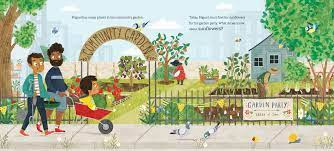
Miguel's community garden has many plants, and lots of volunteer gardeners. Today's the day to celebrate it with a garden party. He and his dads arrive with tools in hand, a wheelbarrow, and a gathering basket. Miguel is especially interested in finding the sunflowers. 

A narrator asks readers to share their knowledge about sunflowers. A double-page description, illustrated with precise detail, gives a clear look at the whole plant. Readers are then invited to help Miguel find one. The text begins with an apricot tree; the similar point is that it is a tall plant. On to artichokes which have petals, green not yellow. 

The trip around the garden moves from one plant to another; each has one of the sunflower's attributes. Still, each is slightly different. Learning about the various plants visited is informative and accessible. As Miguel moves forward, he is concerned they will not be able to find what he is looking for in time for the party. Can that be true? You know the answer to that! 

Samara Hardy created her colorful garden setting with hand painted ink and watercolor textures in Photoshop. Every double-page spread is inviting and provides background for the search. The final spread shows party guests enjoying a picnic comprised of the many fruits of their labor, followed by a most delicious-looking recipe for a sunflower seed salad. Excellent fare for learning about nature and its bounty. 

This is the second book in the Where in A Garden? series, following Amara's Farm (2021). 


Monday, May 3, 2021

The No-Cook Cookbook, by Rebecca Woollard. DK Publishing, Penguin Random House. 2021. $21.99 all ages


"CAULIFLOWER RICE BOWL

Rice bowls are usually made with sticky
sushi rice. This version uses finely-chopped
cauliflower instead, which means you 
don't have to do any cooking!
"

Only recently did I ask to see a copy of this new cookbook for review. It arrived in the mail this morning, and I spent some time pouring over the more than 50 recipes collected to be included; none of them need heat. What a treasure trove for any young cook who wants to learn more! 

In talking with my 7-year-old granddaughter this morning, she was telling me about the 'huevos rancheros' the family had for breakfast. The idea came from watching an episode of Beat Bobby Flay last evening. Her dad loves to cook breakfast, and that's what they decided on for their first meal of the day. She loves to cook, too. She will be delighted to learn that I am saving this copy for when she can visit next. 

As I paged through it, I found recipes that I will try for myself to see what I think. Many will appeal for their healthy ingredients, their ease of preparation, and the anticipation of tasting them. DK does an exceptional job of publishing books that have much to teach young readers about nonfiction. Their books are designed to make using them successful. 

The table of contents provides a detailed look for each double-page spread that will help a reader find exactly the right recipe to try. Through it they can find out how the book works, rules and tools of the kitchen, an equipment guide for keen gardeners, and finally a more detailed look at basic techniques of cooking. 

The first section considers breakfast foods: granola, overnight oatmeal, smoothies. How about a muffuletta for lunch, or any number of salads, a baguette sandwich, even cold soups? The list goes on to include ideas for healthy snacks and sauces, then further to supper meals, desserts, and other welcome suggestions.  There is a great variety in the choices that can be made.  

The design for each recipe includes a time frame, how many people each will feed, a list of ingredients, tools needed, and a step-by-step method for preparation. The photographs are, as always, full color and very helpful while also making the reader drool in anticipation.  'Growing your own' entries include tomatoes, lettuce, carrots, spinach, and strawberries. 

You can't go wrong with this book, if you want to encourage your children to try their hand at meal preparation, independence in the kitchen, and a sense of real accomplishment without the worry of having to use heat.                                                                                     


Wednesday, April 28, 2021

The Dog's Gardener, written by Patricia Storms and illustrated by Nathalie Dion. Groundwood. 2021. $18.95 ages 3 and up


"It's the bright time of year. 

The little house frightens me. It's dark
and dusty and full of sharp things. 
But she needs what's inside.
"

I've been thinking about dogs a lot lately. Not because I want one - not at all. I just know how much they mean to the people who have them, and love them. Consider that from the other side of the relationship; that is the premise of this story about a dog and its gardener. This dog loves garden days spent in the company of the quiet woman whose calm voice wakes him each day. 

Dutch patiently waits while she has breakfast. Her invitation to be outside together is exactly what he has been anticipating. It is warm in the sunshine. While he loves being there with her, he definitely does not like being near the little dark house that holds everything she will need for her day in the garden. He stays back. 

Now, the two can spend rest of their day together. While Dutch gambols in the grass and takes in all the smells of nature, the gardener works. Dutch does his duty - making sure that the holes she is digging for new plants are worthy of his approval. He considers the rituals of the day - hard work, planting, and the need for rest, and knows that this day will proceed as all others have. 

"From up here I see the beauty of all her work.
Oh joy! She's bringing out the water." 

It is the best part of their day together. As the sky darkens, the two return to where their day began ... together. 

This book is not filled with exciting adventure. It is an homage to the peace to be found in being together, no matter the day's work. The serene words are accompanied by glorious artwork done in 'hand-painted gouache textures combined with painting using a digital paint brush'. The images explore the beauty of the garden, while also creating an atmosphere of soothing comfort. Filled with light and shadow, they help readers see, from the dog's perspective, why it is he loves to be there.  What a lovely visual exploration it is.                                                                            


Sunday, April 18, 2021

My Nana's Garden, written by Dawn Casey and illustrated by Jessica Courtney-Tickle. Templar, Candlewick Press. Penguin Random House. 2020. $22.99 ages 4 and up


"My nana's garden
is full of seeds
with plenty of flowers, 
grasses, and weeds. 

My nana's garden is lovely and wild. 
"Blooming with life,"
Nana says with a smile." 

In this charming walk through the seasons that a young child spends with her nana, readers are invited to experience the joys and peace the two find there together. Abundance is evident from the opening spread. Flora and fauna find a home within its confines. Nana sees weeds as food for bees, shares rainy days gathering fruit from trees, and warmly welcomes all manner of wildlife. As the seasons and years pass, the two spend endless hours together. There is much work to do, and so much more to see as the garden changes from the early warmth of spring, to the abundance of summer, to cool autumn nights when stars sparkle in the dark sky, to the quiet of winter. 

Observant readers will notice that as the years go by, Nana needs more and more help. One winter, Nana's snow-covered chair sits empty and alone in the garden. 

"In my nana's garden, 
I curl up and cry. 
The sun doesn't shine
in the winter sky.
"

Nana's spirit lives on as the child and her mother welcome spring growth once again. They continue Nana's work through many seasons and years. The child is soon all grown up, with a child of her own. The two continue to find comfort in the legacy of love and growth inspired by a very special grandmother. 

The rhythms of Dawn Casey's simple, heartwarming words are matched by the beauty and affection shown in the double-page spreads created in watercolor and digital media. Delicate and filled with all that Nana and her family loved so much, they convey the touching loss of a loved one while honoring the legacy she has left.                                                                                       


Sunday, October 11, 2020

In My Garden, written by Charlotte Zolotow and illustrated by Philip Stead. Neal Porter Books, Holiday House, Penguin Random House. 2020. $24.99 ages 3 and up


"In the FALL what I love best in my garden 
are chrysanthemums. 

Of course there are other things I love in my 
garden - the tree turning red and golden brown, 
the wild wind blowing and the squirrels 
gathering nuts. 

But what I love best are the chrysanthemums, 
tangled and shaggy and smelling like spice. 

This lovely book was first published in 1960, and is an homage to the seasons and the pleasures they bring. There are two speakers. One is an older woman in a red raincoat. She speaks to the joys she finds in her garden as the seasons come and go. The other, a young child in a a yellow raincoat and red boots, loves each season for a different reason, all related to play. 

"In the fall what I love most to do is rake leaves. 
Of course there are other things I like to do 
in the fall - buy new sweaters and skirts and pencil
boxes for school, and pick the ripe golden pears
from my tree." 

Philip Stead has created amazing images. "The artwork for this book was handmade using oil-ink linotype techniques and carbon transfer printing." He places his characters in warm natural surroundings that speak to the peace and contentment they feel as they explore and enjoy their world. Young readers will pay full attention to the tiny black kitten that accompanies the young girl.  

In the following video, Mr. Stead describes the process he uses to bring these characters and their world to his readers.