Total Pageviews

Showing posts with label forest. Show all posts

Thursday, June 25, 2026

Mungo On His Own, words by Matthew Burgess and art by Julie Benbassat. Clarion Books, Harper. 2026. $24.99 ages 4 and up


" ... he remembered his mother 
and their summer days together. 

She showed him how to cross the creek, 
how to blend in with the underbrush,
and how to find a snack when hunger 
gnawed his belly.
"

Although Mungo and his mother are finished dinner, Mungo is still hungry. His mind calls up images of the red berries he so loves. He thinks he can set out to find them on his own, even in the cold and darkness of November. His mother agrees. It is cold, and Mungo has never gone foraging on his own. There are sounds that worry him as he makes his way through the forest. 

He splashes through cold water, climbs a nearby hill, and quickly crosses the road. Hearing a hooting owl, he tucks himself into an oak tree's hollow. He is scared and wonders about turning back; instead, he remembers all his mother taught him in the summer about being brave. On he goes, smelling all the smells with his nose pointed toward the berry bush he is looking for. The berries make his journey worth every step. As night falls and the cold swirls around him, Mungo makes a joyous journey through the newly-falling snow home. Mama is proudly waiting at their den door. Mungo is just in time to watch the night sky fill with stars from the warm comfort of the family den. 

Using pencil and charcoal for the linework and art colored using Procreate and Photoshop, Julie Benbassatt's illustrations are filled with warmth and emotion as Mungo travels the forest landscape in search of his treasured berries. Mungo's yellow eyes and orange fur keep him front of mind for young readers as he makes his dark and somewhat scary search. 

Helicopter parents, take heed. Our kids are capable of independence and bravery when given the chance to show us. 

Wednesday, June 24, 2026

The Mother Tree, written by Sybil Rosen and illustrated by Nancy Carpenter. anne schwartz books, Penguin Random House. 2026. $24.99 ages 4 and up


"At sunset they walk through what's left of the woods.
Raw stumps lie amid heaps of bent and broken smaller 
trees. Sadie doesn't have words to describe how forlorn
and ruined everything looks. 
The nearer they get to the mother tree, the more scared 
Sadie feels. Will her beech still be there?
" 

I have mentioned in previous posts that many published books for children today speak to them about the importance of our natural surroundings. A good many highlight trees, and what we are learning about their place in the health of our planet. 

In her book, Sybil Rosen introduces readers to Sadie and her mother who love to spend time walking in the forest that surrounds their home. They know these trees as friends who provide shade, homes for birds, and beauty at every turn. Sadie knows that trees and humans help each other when it comes to breathing. Sadie works in her notebook to note all they see on their daily walks. They often end up at Sadie's favorite tree: a two-hundred-year-old beech with a branch that offers a place for rest whenever the two stop to visit. 

Her mother answers Sadie's questions and shares new learning about how so much happens in the roots beneath their feet. When they notice that many of the trees have been marked with a red circle, Sadie is confused. She learns from her mother that the marked trees are destined to be cut down and sent to a lumber mill. Sadie is very upset when the loggers make their presence known by a terrible racket. As they get closer, Sadie shares her real concerns about her beech tree with Momma. 

Her mother wonders what Sadie would say to loggers if she could talk to them. Taking up her pencil, Sadie writes a heartfelt note. 

"Please do not cut down our mother tree.
The new forest will need her and we 
need the oxygen. 
Thank you very much.

Sadie"

After a long wait and a lot more cutting, Sadie and her mother return to the beech to find the loggers listened to one small child's voice. It's a start.  

The charcoal, watercolor and digital artwork is emotional in scope while showing Sadie's feelings about all that is happening to her beloved trees, and very helpful while sharing Momma's teachings about the nature of trees and that a mother tree plays a role of great importance. A note from the author provides more details for readers and some of the actions they can take to protect our forests.                                                                                      


Friday, June 5, 2026

Fiddlhead Forest, written and illustrated by Jana Curll. Greystone Kids, 2026. $18.95 ages 8 and up


"Millipedes are among the earliest 
known land animals. There were
millipedes before dinosaurs! 

They are super burrowers. 

They are mostly harmless and 
will often curl into a coil if 
threatened.
"

The eternal question about a tree falling in the forest gets a new lease on life when the author explains how the flora and fauna in the forest ecosystem come to the rescue. A new graphic novel in the Little Habitats series features a fern narrator who promises to keep the tree from becoming a log. Fern wants to see the forest get back to normal where trees stand tall. To that end, she will enlist the help of other creatures of the forest to help the tree stand again. 

The titles of each of the eight chapters make evident the use of wordplay in describing the efforts considered to ensure her promise is kept. Despite the ideas presented by Millipede and Slug and help from Moth, Lichen and Mushroom, there appears there is little to be done to ensure that tree will rise from the forest floor to its former glory. 

Information concerning the particular traits of each member of the forest community is infused with clever wordplay while also offering a clear look at each one. Ultimately, not one of the described forest inhabitants has what it takes to move the huge tree trunk. Only then does Fern recognize that the tree can now take on a very important new role in the ecosystem as a nurse log. The benefits of nurse logs in the forest cannot be overstated. It will provide nutrients, shelter, forest growth, and a surface for plants and even new trees to grow and flourish. 

"I guess we FERN-ally figured it out.

It was a LOG time coming." 

Combining fact and fiction (faction), Jana Curll will have her readers chuckling time and again with her storytelling. Not only does she share facts in an informational text, she also entertains with her word choice while doing so. What a way to learn something brand new! 

Monday, April 27, 2026

We All Belong, written and illiustrated by Gianna Marino. Philomel, Penguin Random House. 2026. $24.99 ages 3 and up


"Then Deer saw someone else. 

"That slender nose is similar to mine," said Deer. 
                   "It must be another deer!"

Fox looked at all the animals. 
"I am a fox," said Fox. 
"We are all similar 
in some ways."
"

Ms. Marino's story of acceptance and understanding begins with a lonely mule. Mule no one around, until he hears a chittering sound. Noticing the ears poking out of the ground, Mule wonders if it might be another mule. Rabbit pops up to assure Mule though the ears are similar, these definitely belong to a rabbit. When Rabbit hears a new sound, she notes that the teeth look familiar. Beaver debunks her claim by announcing that he is not a rabbit, but a beaver. 

From one animal to the next, six animals are quick to note the similarities shared one to another. After Beaver, then Duck, Deer, and Fox. While chatting about the ways in which they are similar, a further animal provides a distraction for Mule. 

""WHO IS THAT?" said Mule."

A double-page spread introduces a large, brown, furry animal unknown to the rest. What they do know about the new arrival is the ears, teeth, feet, tail, and slender nose are decidedly different from their own. Bear agrees she is different from everyone, and wanders off to find someone like her. Mule quickly stops her to explain that, although the rest have one similar trait, there are many things about them that are not the same at all. 

As they study Bear carefully, they find many things to like: round ears, fluffy fur, big paws, and big eyes. In fact, they quite love Bear. They may look different from one another; they know they 'all belong'. 

This makes for a wonderful readaloud and is perfect for starting conversations with kids of all ages. The charming artwork is a lovely complement to the story's tone and offers lots of details for little ones to observe and enjoy. 
                                                                                        

Sunday, April 26, 2026

Where I Grew, written by Jashar Awan and illustrated by Rahele Jomepour Bell. Norton Young Readers, Penguin Random House. 2026. $24.99 ages 4 and up


"To reach this land

In search of the 
   perfect place 

To put down 
        our roots 

And call home."

Oh, the setting is so gorgeous. Endpapers are filled with a detailed look at the forest, its flora and fauna. Bright colors accompany forest greens to invite readers to turn the page to see what is next. A hook, hung with a soft cap and a tote bag suggest outdoor adventure. The title page shows the owner with a satchel, all alone on a gray day.

The opening page returns readers to the forest, and two people venturing in where animals leap and birds sing. The older of the two, presumably a grandparent, is wearing the hat and carrying the tote bag, while a young girl holds his arm. She explains 'we come from all over'. As they walk on, there is joy in their being together in the beauty of their natural surroundings.

As they explore their environment, she tells how people got to the place they are now. In the past, they needed transport, and help to arrive safely in search of a new home. This is where she grew daily, through the seasons, and the years that have passed. She is proud to talk about community, her neighbors and their growing families, and wonders what the future holds for all. 

"As for me, 

This is where 
       I grew.

This is 
where I 
will stay. 

This is 
my home.
"

Ms. Jomepour Bell’s wondrous illustrations reveal the slow passage of time. Observant listeners will take note of the many details, including the pink beret and glasses the now adult has been wearing since childhood and her grandfather's tote bag that she carries so closely. 


Saturday, April 18, 2026

The Sweater: A Story of Community, written by Larissa Theule and illustrated by Teagan White. Viking, Penguin Random Houuse, 2026. $24.99 ages 3 and up


"Folks knew what to do. They remembered
when they were new and the things they 
had gone through. 

They gave what they could."

As Holly the raccoon heads out for her morning hike, she takes note of her many neighbors as they begin their day. The arrival of a tiny bird, with downed head and closed eyes captures her attention. She recognizes his sadness and his need for a safe space; she watches as he settles into the unused home of a woodpecker. Holly is happy to see him settled. 

She makes the decision to visit with her neighbors and let them know about the tiny stranger. As she visits, they share memories of what it was like for them when they were new to the woodland. Each offers what they can for the bird's comfort. Their gestures are kind, giving things of importance to them. Once she knows the bird is fine, Holly goes back home. 

The night turns cold; Holly knits on. The arrival of winter is swift and concerning. In the morning, Holly is happy to see the bird seems a bir better. Holly is concerned that the house he has found is not very sound. Their gift will keep him warm, and the community comes together to ensure he will be safe through the cold winter days before they return to the protection of their own homes. The winter is very cold, and long. The animals stay inside where they are safe, but they miss each other. Bird is anxious to share his gratitude with everyone. One morning when the day is not so windy and cold, Bird offers what he has to his new friends.

"His song. 

It was the clearest, sweetest song 
his friends had ever heard. 

Like a thread of sunshine, it looped around
their hearts and knit them together. 
And they knew they were not alone.
"

 The story is heartfelt and soothing; the artwork is gentle and calming. It is a perfect tale to share on a cold, wintry night before bed. 

Thursday, April 9, 2026

Hogbert, written and illustrated by Briony May Smith. Candlewick Press, Penguin Random House. 2025. $24.99 ages 3 and up


"Hogbert lifted his nose in the air
and took a big sniff. No wolf? 
He smelled leaves, sunny puddles, 
and in the distance ... 

a herd of deer?"

On their first foray into the forest with their mother, six boar piglets are offered important advice; they are told to steer clear of the Big Bad Wolf and to stick together as they forage for truffles and other treats on the forest floor. With his snout to the ground, Hogbert does just that. To his surprise, when he lifts his head from the prolonged search, he is all alone. 

Hearing a 'rustling' nearby, he remembers his mother's warning about the BBW. Before he has time to panic, Red, a small squirrel, pops down from the branches of a fir tree, on the lookout for nutritious food. Hogbert shares his worry about the wolf and explains that he is lost. At this point, young readers have another reminder of a familiar fairy tale, when the squirrel explains that her granny is not well and would love some of the food from the tasty treat trail Hogbert is following. 

The two wander on, good company for one another. A 'rumbling and grumbling' noise has both worrying once again about the presence of the BBW. Instead, they find a snoring fawn under a tree's branches. The tiny doe realizes she is also lost; she can use their help to find her family. They move on together, following the trail and enjoying each other's company until they discover a cave housing two tiny bunnies. One is the maker of the trail. A lonesome and too-close howl has all shaking with fear and moving deeper into the safety of the cave. With Hogbert's sense of smell, they find their way out at the spot right next to the tall tree Red remembered ... the assigned meeting place for finding family when all seems lost. 

And they lived happily ever after ... we can only hope. 

The warm and charming art will keep young listeners busy with observations during the reading. I especially loved the spread of a mama wolf howling for her little one above them, while Hogbert and his followers make their way through the cave below ground. This tale works and will be much appreciated at story time. Discussions concerning the many references to fairy tale lore will require that readers are familiar with the fairy tales themselves. 

An aside: did you happen to notice the 'frog prince' on a lily pad as the new friends pass a pond in the rain?           


Monday, August 11, 2025

How To Reach the Moon, written by Nicolas Schuff and illustrated by Ana Sender. Translated by Lawrence Schimel. amazoncrossingkids, 2022. $24.99 ages 4 and up


"Abuelo goes into the house and comes outside
wearing a backpack. 

'Shall we go?" he asks.

"Where to?" Emilio wonders out loud.

"To the moon, of course!""

The first Sunday of September is celebrated as Grandparents Day. To add to your collection of books about these cherished people who share the lives of their grandchildren, I want to tell you about this tale by Argentinian author Nicolas Schuff. The question about reaching the moon gives it the feel a folktale, and introduces readers to Emilio and his abuelo. 

Emilio's summer visit with his grandfather is highly anticipated. Life away from the city is calm and peaceful, as the two spend their days and evenings together in the quiet of the forest. Following dinner every evening, they blow out their lantern. In the darkness, Abuelo shares stories with his grandson. There are many. 

On the night of a full moon, while sharing a delicious dessert, Emilio has a question: 

"Abuelo, is it true that the moon 
has a face we never see?"

His abuelo suggests that the moon has many faces, and tells his grandson what he sees when he looks to the night sky. As the two bask in the quiet peace of their surroundings, Abuelo asks if Emilio would like to meet the moon. The boy's affirmative response leads to a walk in the moonlit forest. It is a place of wonder where Emilio's imagination takes flight. Expecting their path to lead directly to the moon, Emilio is surprised when they come to a stop at the edge of a ravine. 

There they find the reflection of the moon they seek. Together they prepare for a leap that will place them in the middle of the moon below them. What amazing sights welcome them underwater! A campfire, an overnight stay in the beauty of a star-filled night, and a sleepy trek back home in the morning brings an end to their adventure.

Ana Sender's muted digital artwork provides a perfect setting for this nighttime jaunt, while employing all types of light to complement the story.                                                                                   


Monday, April 7, 2025

Poo-Dunit? A Forest Floor Mystery, written by Katelyn Aronson and illustrated by Stephanie Laberis. Candlewick Press, Penguin Random House. 2022. $11.99 ages 3 and up


"OH, POOOOORCUPIIIIINE ... 

"Not mine," he said. 
"You've got it wrong. 
My poo is short! 
This poo is long. 

Ask Fox.""

Need I say it? Readers are going to love this book. It's easy to tell from the mouse's face on the front cover that its morning has not started well. What is that smell? It turns out that it is a BIG pile of poo. Mouse wants to know who the culprit is that left it so close to his burrow. 

Eager to solve the mystery, Mouse turns first to Squirrel. Squirrel is appalled and blames skunk. Skunk explains that its poo is thin, while this pile of poo is very thick. The questioning continues with Porcupine, Fox, Coyote, and Deer, who is quick to state it is much too messy to belong to her. Mouse is irate and determined to discover who left that poo at his door. 

There are some clues - must be big, hairy, and eat seeds and berries. Oh dear, it's Bear. Bear is happy to admit it. 

"A poo that no one can outdo! 

A poo that no one can out-poo!" 

Has Mouse found the offender? Apparently, not! Can you guess? 
Mouse is quite resourceful. Next spring brings a more pleasant odor. 

Back matter offers a game concerning whose poo is whose, and a brief explanation for the value of poo in the grand scheme of things.   


My friend Don and I have launched a new adventure. We have been presenting Great Books For Great Kids workshops for teachers and others for more than twenty years. We recently decided to give podcasting a try. Episode One is launched! You can find it here: 

Saturday, September 7, 2024

Mother Aspen: A Story of How Forests Cooperate and Communicate, written by Annette LeBox and illustrated by Crystal Smith. Groundwood Books, 2024. $22.99 ages 6 and up


"In the sunlight, Aspen's leaves produce sugar. 
Trees use sugar to grow wood and bark and leaves.
Like human children, young trees love sweets! 

Beneath the earth, fungi wrap soft cottony threads
around Aspen's roots. Fungi can't produce sugar,
so Mother Tree feeds them too.
"

The scientific research done by Dr. Suzanne Simard has inspired many writers to look closely at forest communities. Prior to her strong and steady dedication to proving that trees of different species loan needed sugars, it was believed that trees, in fact, competed for the food and water they needed to survive. Dr. Simard proved that forest ecosystems are cooperative, rather than competitive. 

In this homage to the Wood Wide Web, Ms. LeBox focuses her story on the aspen grove. While discussing the 'mother tree', she explains that warm earth in the spring allows the birch tree to send 'sprouts from her roots' down into the earth. There, the tree provides food for fungi that carry messages to the fir and pine trees close by. The messages are warnings for the coming days. When the forest trees need water during the heat of the summer, the fungi release water to help. Thus, they sustain each other. Scientists today are looking to see if the same thing happens between other tree species. 

While explaining what is happening underground, the author also tells the story of the trees themselves and how they provide much of what is important to forest life. Seasons come and go, and the needs of the trees change. Within the forest, wild animals find support, mushrooms grow, and the aspen trees prosper through the year's cycle. After many years of sharing and caring for the forest community, Mother Aspen has lived a good life. It is her time to breathe her last. 

"As the Mother Tree takes her last breath, 
she passes on her wisdom to the next generation. 

Fungi spread the news through her vast underground threads. 
Our mother is dead.
"

The true beauty of the forest is clearly shown in artwork created using digital paint and layered textures. The aspen grove comes to life through the seasons. Each illustrated page helps readers understand the science the author provides. 

Back matter includes an author's note that further explains the cooperation that exists through the seasons to keep forests vibrant and viable. On another informative page, she speaks to the importance of aspen groves because of their biodiversity, and the destruction created when companies do their best to destroy them. A list of print and video resources is appended. 

Tuesday, August 27, 2024

Wake Up, Little Pin: The Story of a Sleepy Sapling. Written by Loretta Garbutt and illustrated by Marianne Ferrer. Owlkids, 2024. $21.95 ages 4 and up


"That bright morning, Little Pin Oak stretched the tips
of his young limbs wide and reached as high as he could
with the top of his crown. After a long winter’s sleep,
the sun felt good. The young tree was wide awake now.
"

Before the story begins, Ms. Garbutt tells her audience: 

"When I first learned about the importance of mother trees
in the forest and how they helped their young saplings grow, 
I was amazed.
"

That was the impetus for this story about a mother tree and her sleepy offspring. When Great Mother Pin Oak awakens in the spring, she does what all do after a long sleep. She stretches and reaches as high as she can. At her side, Little Pin Oak is still asleep. 

Mother Pin has things to do. She satisfies her thirst while enjoying the early sun. Only then does she wonder why Little Pin is so quiet. She whispers gently to her sapling. Pin sleeps on. Knowing the wee tree needs help, she continues to encourage movement. Finally, she turns to the forest for help. 

She calls out to Red Squirrel for help to spread the news that Little Pin will not wake up. A meeting with Vole leads to Vole digging some extra tunnels to help nourishment reach Little Pin's roots. As signs of spring continue, birds and birdsong are sure to help wake the tiny tree. Melting ice drips water to provide a drink. Nothing seems to make the difference needed. 

"Mother Pin signaled to the dark, rich earth - 
her medicine cabinet and storehouse of goodness
right below her roots. "Fungi, we need your vitamins
and minerals to give Little Pin more strength. Some of 
my sugars will help, too."
" 

With the help afforded by fungi threads, a porcupine's scat, and warm sunlight, Little Pin gets just what is needed to finally awaken to the beauty of the season and the opportunity for growth. 

Digital illustrations, using green, brown and gray, fill spreads with welcome scenes from the forest habitat as spring awakens all that live and thrive there. Back matter adds further facts about forest life and offers a reading list for those who would like to know more.

Wednesday, August 14, 2024

On A Mushroom Day, written by Chris Baker and illustrated by Alexandra Finkeldey. Tundra, Penguin Random House. 2024. $24.99 ages 3 and up


"On a mushroom day, some brilliantly 
colored beings will catch your eye, 

teeny tiny red ones and big blue ones
dripping bright droplets.
"

Following the rain, an adult and child make a trip to a forest filled with some remarkable encounters with nature. The squishy ground is soft where they step, and allows them to explore the wonders of their environment as they listen to the sounds and react to the sights. It is a happy time, encouraging a sweet song about mushrooms. 

"On a mushroom day, you might 
smell apricots or maple syrup
or other, more mysterious aromas
wafting from the forest floor.
" 

The mushrooms discovered are easy to see. Once the two notice the first ones, they can't help but see more and more. As they go, the author assures that readers begin to understand and appreciate what mushrooms are, where they live, and how finding them above the ground reminds us of everything below ground that connects trees and other living matter. 

Their search leads them to discover 12 species that are very different from one another. As they are labeled, Ms. Finkeldey creates a dramatic look that gives life to those descriptive names. Imaginative and memorable, young readers are sure to recall some of them. Using photographs of mushrooms taken while visiting the forest, her images are accurate and can be easily identified. 

After gathering only those mushrooms that the adult deems delicious enough to cook, the two return home with 'a treasure or two' for their evening meal. The rest are left for forest foragers, and others who might visit on another mushroom day search. 

Back matter presents each of the mushroom species included in the book, with an accurate illustration and a short description. Further to that, Chris Baker encourages readers to get out and make their own discoveries as he and his family have done. He adds 'the facts on fungi', "tips for having your own wonderful mushroom day', a list for further reading, and other resources that might be helpful for learning more. 

 "Only knowledgeable adults should pick mushrooms to eat, and only those they can identify with 100 percent certainty." 

Monday, July 29, 2024

Looking for Peppermint: Or Life in the Forest, written and illustrated by Maxwell Eaton III. Neal Porter Books, Holiday House. Penguin Random House, 2024. $24.99 ages 6 and up


"The only other creatures that tangle with 
porcupines are fishers, but they're clever 
enough to avoid the quills. 

Porcupines can't climb down trees 
headfirst like a squirrel. 

So a fisher will approach from above
while the porcupine tries to shimmy 
down backward. It's a messy business.
"

Our young narrator is on a mission to find her pesky pup, Peppermint. She invites readers to follow along while she also introduces the woods where she lives. Leaving the chickens behind and crossing a log bridge, we are off. 

While she explains what readers are seeing, Peppermint is also having something to say in accompanying spot pictures. The first stop is in a grove of white pines, the tallest trees in her forest. After sharing what she knows about them, and completing a page in her journal, she is off to another spot where hemlock trees hold pride of place and provide shade for a passing creek and its trout. They also keep porcupines happy in all seasons. 

Her journal shows the memory of a run-in that Peppermint had with a porcupine in the spring. She also lets readers know that fishers are too smart to be a victim of a porcupine's quills. She would dearly love to see a fisher! And so the search goes ... from one part of the forest to the next. The journey is awash with memories, scientific facts and a love of nature. There is much to hold interest and to learn as we follow her lead from one place to the next. 

Many changes are explained for those interested in the area's growth over the years. Talking about them inspires further memories that reflect on what is being shown. From porcupines and fishers to sheep pastures and glaciers - always embellished with 'another quick story', readers are regaled with entertaining and enlightening information. She is a talkative one. 

In final pages, the search for Peppermint ends when he is found with his head stuck in a hole still trying to catch an elusive red squirrel. Wait! Can those be fisher tracks? The trek ends with a lovely surprise and a note from Mr. Eaton that explains this book is based on family experiences in the forest where he and his family live.  

There is a lot to digest as readers are introduced to the many wonders of the forest. The illustrations offer a sunny day in nature while also sharing many personal stories from the author's life. There's a lot to take in - all done through panels, speech bubbles, graphs and Peppermint's pop-up additions to the tale. 

Back matter includes a note from the author about his home and a map showing the Adirondack Mountains, sidebars about porcupines and fishers, and a list of “a few good forest books.”

"Well, thanks for walking with me.
 I always see something special when
a friend comes along
.” 

https://youtu.be/Eqg-LN3RukE?si=J2YoROqiKZWgV61J

Monday, November 8, 2021

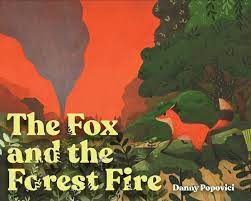
The Fox and the Forest Fire, written and illustrated by Danny Popovici. Chronicle Books, Raincoast. 2021. $23.99 ages 5 and up


"Then one morning it’s strangely quiet.

I see a plume of smoke off in the distance.

I hurry to warn my mother.

And I wonder if we will ever see our home again.”

Climate change is wreaking havoc on the world. As that happens, the number of devastating forest fires is rising every year. I can't tell you how many days our air was impacted this summer by fires burning both near to and far from where we live. It has never been as bad as it has been this year. The severe drought has increased the possibility of these fires burning out of control. 

What about the impact for families living right where these fires are burning? In a note, the author explains that he spent one summer working with a forest firefighting crew. While there, he came to love the natural world, and the animals that lived there. Being from the city, he had no idea the impact that summer would have on him. When a recent fire burned near his own home, he felt compelled to do something for the animals that are often forced to escape to a home in residential areas. So, he wrote and illustrated this book. 

It concerns a young boy and his mother, who have recently moved from the city to a new home in a rural area. He isn't impressed with the quiet nights, the loud mornings, or the problems that roots, rocks, and bugs cause during hikes with his mother. The lure of nature has a real impact on him. Soon, he is spending his time outside studying rocks, exploring new places, and helping the animals he sees. He especially loves his encounters with a fox. 

All is well, until the day he spies a plume of smoke. He rushes to warn his mom. As he runs, so do the forest animals, among them his fox friend. It is a long wait before they return from the city to find there is no house left. But they return with a plan. While the forest heals and the animals do the same, the boy and his mother begin building a new life in the place they love. 

Timely and topical, this book has a promising tone. Readers will find comfort in seeing that both child and fox have survived to move forward, after being affected by great tragedy.