Total Pageviews

Tuesday, March 3, 2015

SUPERTRUCK, by Stephen Savage. A Neal Porter Book, Roaring Brook Press, Macmillan. Raincoast. 2015. $14.99 ages 2 and up


"The city

is full of

brave trucks.

The bucket truck
fixes a power line."


When a blizzard stops the mighty trucks of the city from working, it’s SUPERTRUCK to the rescue!

It's hard to believe, living in Manitoba in the middle of the Canadian prairies, we have had to shovel very little snow this season. Each day we hear and read reports of storms that persist in other parts of the country. Today we are experiencing very strong winds and shivers because of them. But, our snow plows have experienced a pretty severe lack of work.

In the city that Stephen Savage creates for his hero, there are many trucks. Each has an important job to do! In graphic, boldly colored illustrations he shows us what those jobs are and the joy the trucks feel when solving problems for city dwellers. But, when the snow begins to fall and the streets become impassible, those trucks have little recourse but to sit idly by and wait for help. That is exactly when the bespectacled and innocent-looking garbage truck finds a secluded garage where he can turn into SUPERTRUCK!

Without his glasses, sporting bold square lines, and working under cover of darkness, he makes his way from one side of the city to the other. He does his work without any help and with great pride, clearing streets and leaving the other trucks to wonder the next morning about their new hero. We know what he is doing. I bet he can hardly wait for another snowstorm!

Appealing and clever, I am sure this is a book that you will share over and over again ... and I don't think you will mind.
                                                                            

Monday, March 2, 2015

Stop, Thief! Written by Heather Tekavec and illustrated by Pierre Pratt. Kids Can Press, 2014. $18.95 ages 5 and up

"He wasn't gone long
until he heard a strange
buzzing sound. He followed
the buzz to a small orange
carrot. On the orange carrot
there were some feathery
green leaves. On one of the
leaves was a tiny blue bug.
And the bug was chewing
the leaf!"


Max likes nothing better than to help where help is needed. So, when the farmer asks him to help catch a thief, Max is on it! The farmer explains:

"I don't know what he looks like," the farmer said, "but he's been stealing all the carrots, berries, beans and cherries. Go catch him before he eats my whole farm!"

Max is off in a New York minute, rope in mouth and the thief on his mind. It isn't long until he sees that blue bug. He knows he has managed to catch the culprit in quick time! The bug escapes and Max explains to a nearby munching bunny that the bug is the thief who's stealing food from the farmer. While the rabbit munches, he sends Max off in pursuit of the perceived thief. (Kids will be quick to admonish Max that he is missing the point!)

He sees the bug at every turn. Max can't get close enough to slow him down. A pig, and then a goat do their best to encourage Max to continue on, while munching berries and beans to their heart's content. Finally, three crows listen to Max's description of the thief and add their two cents' worth. When he assures himself that the bug is truly gone (missing another blue bug sitting on the fence), Max returns triumphantly to the farmyard. The animals prepare a party for the rural detective, leaving us with a perfect surprise ending.

 As I have mentioned before, the best picture books result from a perfect pairing of scripted and visual text. Pierre Pratt uses gouache to add another layer to this humorous and most enjoyable detective romp. His full page spreads have story going on the background as we trail Max on his search. This visually rich book shows his penchant for diagonal lines to show motion, his warm color palette and the expressive face of his main character. He also shows young readers exactly what is happening, while Max appears totally oblivious to the facts presented in the artwork.

Fun to read, and funnier to observe the actual goings-on, this is a book that should be shared ... and often!                                                                               


Sunday, March 1, 2015

Fish in a Tree, written by Lynda Mullaly Hunt. Nancy Paulsen Books, Penguin. 2015. $18.99 ages 10 and up

"Monday is vocabulary day, when Mr. Daniels goes over the new words for the week. As far as reading lessons go, this isn't so bad. All I have to do is listen as he tells us the word's meaning, and I can usually remember it because I make mind movies about each one and that helps me remember. I've always had one important rule in the classroom, which is to try to lay low."

I love and admire Ally Nickerson!
I love Ally's mind movies!
I love Ally's Sketchbook of Impossible Things!
I love her big brother, Travis!
I love her new teacher, Mr. Daniels!
And I love FISH IN A TREE ... let me tell you about it.

Ally has just started her stay at yet another new school. It's the seventh one in seven years, and that would be hard for any child. Her father is in the military, and that means that the family is often on the move. For Ally, her days here are the same as in every other place she has been. She works double-time to ensure that no one will see her real struggles with reading and writing. She acts the clown and disrupts the class to take attention away from what she cannot do, and to be sent to the principal. She hates school and we come to understand the many reasons for that. To avoid some of the pain of her many school failures she creates elaborate and vivid mind movies:

"I watch a mind movie of her taking a stick and drawing a line in the dirt between us under a bright blue sky. She's dressed as a sheriff and I'm wearing black and white prisoner stripes. My mind does this all the time - shows me these movies that seem so real that they carry me away inside of them. They are a relief from my real life."

When Mr. Daniels is hired as a substitute while the classroom teacher is on maternity leave, things begin to change. He sees Ally's strengths and focuses on those, eventually giving her the confidence to share her struggles with him, and to ask for help. All the while, we are completely aware of how bright, intuitive, strong and funny Ally is through her powerful first person narrative. She knows herself very well and is fully that her brain works differently when it comes to learning to read and write. She doesn't need others to know.

Mr. Daniels is not the only one who sees what is wonderful about Ally. She has two terrific friends in Keisha and Albert. They are strong secondary characters who want to be her friends, and who appreciate her sense of humor, her feisty responses, her incredible stories and eventually, her secrets. Travis is the big brother we all would want to have, or be. He gives her strength while struggling with his own learning problems. He shares his dreams, and he loves Ally unconditionally.
This portrait of dyslexia and its repercussions for one young and admirable girl is so well drawn. The shame felt and perpetuated by misunderstandings is clear through Ally's impeccable voice. In the end her story is hopeful, and a worthy follow-up to Ms. Hunt's first book, One of the Murphys. You should read both. They are books for your heart!

"Keisha laughs again. "One thing's for sure. We're not going to fit in, but we're going to stand out. All three of us. You wait and see. You're going to be a famous artist and Albert is going to cure cancer or invent talking fish or something." "Talking fish? What would they say? 'Please don't fry me?'" I push the door open, and her face is just like I imagined. "And you're going to have a big baking business, right?" "Maybe in my spare time. I'm also going to rule the world." I laugh. Then swallow hard. "Thanks for being my friend, Keisha."

Saturday, February 28, 2015

I Don't Want to Be a Frog, written by Dev Petty and illustrated by Mike Boldt. Doubleday, Random House. 2015. $19.99 ages 3 and up


"Because you're a
FROG.

I don't like being
a Frog. It's too
Wet.

Well, you can't
be a Cat."

Who hasn't wished, at one time or another, to be someone or something different? Thinner, taller, more melodic, younger, older ... the list goes on. Frog is no different from the rest of us. What he doesn't like about being a frog is that frogs are too slimy, too wet and eat entirely too many bugs. Other animals have a certain allure.

While reading a book about cats, he tells his father that he wants to be one. His father is patient in his explanation that his son is, in fact, a frog and cannot be a cat. Not to be undone, the little one changes his mind to an animal that has similarities - he wants to be a rabbit. He can hop! His father points to his ears as an explanation for another unwise choice. Poor son! Poor, beleaguered dad!

When a pig passes by, a third wish pops into his head. Again, his father explains why being a pig is not possible. And certainly not an owl. There are many reasons why that cannot happen. As they share their tasty bug sandwich, Papa nixes any change at all. To the rescue comes a huge, hairy wolf with a cautionary comment about his own personal diet. He loves to eat cats, and rabbits, and pigs, and even owls. In fact, he's pretty hungry right now. Luckily there is one thing he never eats!

Mike Boldt does a terrific job of creating a dynamic duo whose expressions and personalities are the ideal accompaniment to this funny story. The youngster, mouth wide open at all times, is the epitome of the ever-questioning child and the father, glasses intact and advice at the ready, is endlessly patient. They are pitch perfect. The colored speech bubbles will help early readers share read this funny tale, and then share it all over again using the other voices.
                                                                       

Who Wants a Hug? Written and illustrated by Jeff Mack. Harper, 2015. $21.99 ages 3 and up

"SMACK!

"Poor skunk," said Bear. 
"You look like you need
a hug."

"A SKUNK NEVER
HUGS!"
cried Skunk.

"It's okay," said Bear.
"I'll save  you one for later."

It's got to be tough being a skunk when there's a bear around who's constantly handing out 'bear hugs'. Skunk is pretty good at pretending that it doesn't matter much at all. In fact, he sets himself the task of making Bear smell just like him, or worse. He uses his case full of 'Super Stinky Tricks' to bring that un'bear'able hugger to his knees ... stinking to high heaven, and then being rejected by every single animal that ever begged, or cajoled, or just stood close enough to Bear to garner the warmth of one of his many warm embraces.

Every time Bear offers to hug Skunk he is rejected. Each time he is rejected he lets Skunk know that he will save him one 'for later'. The plotted stinky tricks backfire when Skunk becomes the object of his own chicanery. It is very funny for young readers (and listeners) to predict what is bound to happen and then, to giggle gleefully when it does. A dead fish catapulted directly at him misses when the engaging Bear bends to stroke a nearby earthworm, and the fish springs back from the tree it hits ... a direct SMACK to Skunk's face! There are two others, equally funny, that result in Skunk finally admitting defeat. He is dejected by it all.

Of course, Bear is right there to offer up consolation in the form of a hug. Skunk can no longer resist! The results for both animals play out in the final five pages, much to the delight of everyone who will share this story.

The characters are lovable, each in his own way. Jeff Mack fills the pages with expressive faces, funny situations and offers up perfect dialogue for his audience. Inadvertently, we might all realize that those old wooden clothes pegs still have some life in them!


Thursday, February 26, 2015

Charlie's Dirt Day, written by Andrew Larsen and illustrated by Jacqueline Hudon-Verrelli. Fitzhenry & Whiteside, 2015. $18.95 ages 4 and up


"Nannies and grannies
and moms and dads and
boys and girls and cats
and dogs and wagons and
wheelbarrows and
buckets and bowls and babies ... and now Charlie
and his dad, too!"

Charlie is enjoying the view from the balcony when he notices a hubbub in the street below. Calling to his dad to tell him that there is some excitement in the form of a parade, Charlie is surprised when the two quickly follow along.
Arriving at a nearby park, he is further surprised to see that the parade ends at a huge pile of black dirt. It's the mayor's annual Dirt Day Giveaway. There is  'free dirt for everyone.' But it's not just any dirt.

"It's the richest, dirtiest dirt you'll ever see. It's fresh compost. Your gardens will love it."

Charlie has questions for the man who is encouraging people to take some dirt home. From him, he learns how compost is made, and how people use it. A neighbor explains how he will use the compost ... and that the end result will be a delicious (and famous) spaghetti sauce.

Home Charlie goes with a little clay pot full of soil and one small seed. What will it grow?

Back matter includes further information on dirt, composting, gardens in the sky (rooftops and balconies), worms, and how to make your own 'compost in a cup'.

Let's keep our fingers crossed for warmer weather so we can all 'get growing'!

Wednesday, February 25, 2015

Hungry for Math: Poems to Munch On. Written by Kari-Lynn Winters and Lori Sherritt-Fleming, with illustrations by Peggy Collins. Fitzhenry & Whiteside, 2015. $ 18.95 ages 5 and up

"He was hungry for math,
always ready to munch.
Math for his breakfast,
math for his lunch.

He'd pig out on pie charts
and bar graphs galore,
binge on skip-counting,
and still ask for more."

In their second poetic collaboration (following aRHYTHMetic, 2009), Ms. Winters and Ms. Sherritt-Fleming put the emphasis on math and number concepts that include shapes, patterns, counting, symmetry, estimating, and measuring time.

It's full of fun with numbers and sure to please both teachers and their students with rousing rhythms and a connection to the math that is a part of everyday life. Patterns in the sounds of music, 2-D shapes seen everywhere we look, fifty rot-TEN dragons hiding in five groups of ten, and the symmetry in the shape of a bee are all incorporated into lively, rhythmic language sure to make enjoyable reading and learning in math class.

The Balanced Bee

Three circles, tall not wide.
Six legs - three per side.
Two plus two wings, on its back.
Bands of yellow, white and black.
Compound eyes to spy the view.
Antennae, not one - always two.
Now fold your paper.
It's plain to see.
Bees are balanced.
It's symmetry!"

So, fire up the math and get munching.

Tuesday, February 24, 2015

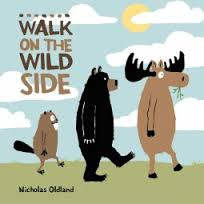
Walk on the Wild Side, written and illustrated by Nicholas Oldland. Kids Can Press, 2015. $16.95 ages 3 and up

"One sunny morning,
the bear, the moose and
the beaver decided it was
a great day to climb a
mountain. To get to the
mountain, they descended
into a valley ...
Walked through a grassy
field ...
ARE WE THERE YET?"

If you are a fan of the first four books in the Life in the Wild Series (Big Bear Hug, The Busy Beaver, Making the Moose Out of Life and Up The Creek), you will be delighted to join these three fast friends on yet another adventure. This time, they decide that climbing a nearby mountain might just be the perfect outing. Off they go!

They have a trusty map, a walking stick, a compass and a red bird. They love adventure, as you know; they are very competitive, as you also know. So, you have probably figured out that things will not go according to plan. You will also know that there is sure to be a laugh or two.

The first part of their trip involves a valley, a grassy field, a stream and a deep canyon (DON'T LOOK DOWN). As they reach the foot of the mountain they are about to climb, they sit for a snack and a chat. How to make the trek more interesting is the topic. Beaver knows ... they will race to the top. Oh, boy!

Moose is in the lead when he jumps out of the way of a boulder and falls over the side of the mountain. The bear is willing to try saving him. Inevitably, it is beaver to the rescue. The rest of the trip plays out as one of the recurring joys for this team of forever friends.

Nicholas Oldland's digitally created illustrations will be familiar and charming to fans. The characters are droll, and endearing. The setting is cleverly designed. If you want a book about friendship and being kind, this would make a perfect story to read aloud!        

Sunday, February 22, 2015

The War That Saved My Life, written by Kimberly Brubaker Bradley. Dial Books for Young Readers, Penguin. 2015. $18.99 ages 10 and up

"On crutches I didn't need a taxi, so we walked right down the main street. I walked down the street, bad foot and all, and nobody stopped me. We went into the shops and bought meat and veg and groceries. I went into the shops and nobody turned me out."

In another war story for today, we meet Ada who has never spent a minute outside the family's third-story apartment. Her mother will not allow it; she is ashamed of her daughter and her twisted foot. Ada sits at the window and waves to others, and longs to change the circumstance that keeps her trapped inside and crawling wherever she wants to go in the drab one-room living space.

Once she understands that only she can change how she moves about, she deals with the daily agony of learning to walk despite her twisted foot. She keeps this from her mother. When talk turns to the children in London being sent to the country to keep them safe from Hitler's bombs, her mother has no intention of letting Ada leave:

"What about me?" My voice came out smaller than I liked. "Am I going? What about me?"
Mam still didn't look at me. "Course not. They're sending kids to live with nice people. Who'd want you? Nobody, that's who. Nice people don't want to book at that foot."
"I could stay with nasty people," I said. "Wouldn't be any different than living here."

We learn in quick time that the resilience Ada shows in learning to walk is only the beginning of a fight for a better life for her and for her little brother, Jamie. They escape, without their mother's permission, to the safety of the train taking them away from London. A woman with no children, and no wish to have any or knowledge about caring for them, reluctantly takes them in. Crutches help Ada navigate the farm and its surroundings. Finding a horse that is rarely ridden, and learning to ride it is just one more obstacle she faces with grit and determination. It takes time; reluctantly, Ada accepts that Susan cares for them and is giving them a good life. There is so much for the two to discover in the safety of this new home.

Ada's first person narrative lends humanity to the people she meets, tenacity to the many troubles that must be faced, honor to the power of community and love. Her resolve is heightened knowing that there are those who will love her unconditionally,  and that makes all the difference.

This story is written beautifully. Ada is a fine and memorable narrator, the setting is realistic and dramatic, the characters are worthy of our admiration. You will not soon forget them!

Half a Man, written by Michael Morpurgo and illustrated by Gemma O'Callaghan. Candlewick, Random House. 2015. $19.00 ages 10 and up

"I couldn't help myself.
I had to look again at the
forbidden places. He had
three half-fingers on one
hand and no fingers at all
on the other. His top lip
had almost completely
disappeared, and one of
his ears was little more
than a hole in his head."

Not all of the scars of war are visible, as many of our returning military troops and their families know. In Michael's grandfather's case, the physical scars are all too visible. They do not in any way account for the internal scars that are also a part of each waking day for him.

Michael vividly remembers the nightmares he had as a child. One of the enduring ones seemed to coincide with his grandfather's infrequent visits. In the dream, he sees a great ship going down in flames, men on fire jumping into the sea, and his grandfather swimming in search of a lifeboat and a modicum of safety. No one will help the man who comes to the side of the boat and raises a pleading hand which has no fingers.

Before each visit, his parents warn Michael never to stare at the injuries his grandfather has incurred as a sailor on a merchant marine vessel during WWII. A torpedo sank the ship, killing many and leaving his grandfather with ghastly scars on his face and hands. When the time comes for Michael to spend summers with him, fishing and living at his island home, Michael learns a lot.

"He was silent, I discovered, because he liked to keep to himself. I'm a bit the same, so I didn't mind. He wasn't at all unkind or morose, just quiet. He'd read a lot in the evenings, for hours, anything about boats - Arthur Ransome, C.S. Forester, and Patrick O'Brian. He didn't have a television, so I'd read them too. I think I must have read every book Arthur Ransome wrote during my summers on Scilly."

It is not until Michael is 18 and out of high school that his grandfather shares the full story of the horror that changed his life. He explains that his disfigurement and the choices he made following his return led his wife to leave him, taking his daughter (Michael's mother). He says that he understands:

 “No one wants a monster for a husband. No one wants half a man….”

His death, and a note left to his grandson asking that the family gather to scatter his ashes in the sea he so loved, is the catalyst for some healing. This is an emotional tale told with the grace we have come to admire in Michael Morpurgo's powerful writing.
                                                                        

Last Stop On Market Street, written by Matt De La Pena and illustrated by Christian Robinson. G.P. Putnam's Sons, Penguin. 2015. $

"They sat right up front.
The man across the way
was tuning a guitar.
An old woman with curlers
had butterflies in a jar.
Nana gave everyone a big
smile and a "good afternoon."
She made sure CJ did the same.
The bus lurched forward
and stopped, lurched forward
and stopped."

Do you find yourself often wishing for something more? One of the real pleasures of growing older for me is that I know I have more than enough ... and really don't have much on  my wish list. That is not to say that others should feel the same way. I want to be 'just like Nana' in this wonderfully brilliant new story from two superb artists.

CJ and his Nana have been to church and are now waiting at the bus stop.

"Watched rain patter against the windshield of a nearby car.
His friend Colby climbed in, gave CJ a wave,
and drove off with his dad.
"Nana, how come we don't got a car?"

It is the first of a number of querulous questions from a grandson to his patient grandmother. As the bus pulls up and they climb aboard, they happily greet the bus driver, and the people who are sharing their ride. CJ is filled with questions and comments about how lucky his friends are not to have to ride this bus, and about the people on board. He sure feels sorry for himself. As new passengers climb on, Nana is welcoming. She encourages her grandson to see the beauty in the diversity of the world around them. Rather than coveting the music player and earbuds that two other young passengers have, why not listen to the guitar-playing singer across the aisle from him. Will CJ feel the magic?

"He saw sunset colors swirling over crashing waves.
Saw a family of hawks slicing through the sky.
Saw the old woman's butterflies
dancing free in the light of the moon.
CJ's chest grew full and he was lost in the sound
and the sound gave him the feeling of magic."

At the 'last stop on Market Street' the two disembark and stroll toward the soup kitchen which is their weekly destination. Along the way, CJ manages to see through his Nana's eyes the possibilities in the world and the people that surround them.

"I'm glad we came."

In a pairing that shows just how perfect an illustrated book can be, we are witness to the beauty of  'story'. Matt De La Pena's tale is wondrous and magical, loving and lovely. Christian Robinson's seemingly simple 'acrylic paint, collage, and a bit of digital manipulation' illustrations are flawless in depicting the Nana's community that is so inspirational and uplifting. Because of their collaboration we are 'a better witness of what's beautiful.'

 There are days when it does seem difficult to find beauty in the world ... even for adults. Would that we all had CJ's Nana to stand by and remind us how truly lucky we are, and how grateful we must be.

How thrilled was I that, on the day I received a copy of Last Stop on Market Street, I heard a short interview with Matt De La Pena and Christian Robinson on NPR Morning Edition? In the interview they were asked if the experience they were sharing came from their own lives. Both said that it did. Their grandmothers had been instrumental in their upbringing, and both had encouraged the boys to be thankful for the each of the blessings in their lives.

Here's the link to the interview on NPR:
 http://www.npr.org/player/v2/mediaPlayer.html?action=2&t=1&islist=false&id=383856887&m=384223120&live=1

The Bus Ride, written and illustrated by Marianne Dubuc. Kids Can Press, 2015. $16.95 ages 4 and up

"This is the first time
I'm taking the bus by
myself.
Mom packed me a
snack - and had me
bring my sweater in
case I get cold."

This is the first of two books about buses today. Each helps us to see how truly diverse our world can be!

I love the way this book is designed. Opening to the first page gives the reader the feeling of riding a bus, with its long horizontal lines and the opportunity to include so much in the artwork on the double page spreads. We watch as the bus pulls up to where a small girl and her mother are holding hands at the #18 stop. Clara gets on board, waves to her mother from the window, and promises to be good.

Her companions on this first solo bus ride are numerous and varied; with each stop those passengers change. In a strong first person narrative, Clara lets us know that she is well prepared for the ride - she has a snack, and a sweater. As they roll along, the action is non-stop and certainly in need of our attention. Each double page spread is filled with details about her fellow passengers. As we go, she gives us a play by play of the outside world as well.

The setting changes are evident through the windows of the bus, and include a short, somewhat scary pass through a dark tunnel. We watch as passengers get on and off the bus, each illustration adding telling vignettes of their lives and family. A goat offers a small flower from a large bouquet, the sloth sleeps, the mole mother is distracted by her exuberant family of three little ones (who seem to have enough energy for several more), the sloth sleeps, the turtle tucks in every time the action becomes too much for his quiet personality, a woman with a newspaper full of telling headlines remains faceless, the sloth sleeps. Each character has its own distinct personality.

There is no being alone on this bus ... and that is the delight of it! Adventurous and full of charm, with illustrations that will have little ones wanting to pore over it again and again, we are reminded of Little Red Riding Hood but never feel threatened by the animals who share Clara's space as she makes her first trip alone to Grandma's house. Imagine the stories she will have to tell her grandmother of the community of fellow travellers she met along the way!


Wednesday, February 18, 2015

Jasper John Dooley, written by Caroline Adderson and illustrated by Ben Clanton. Kids Can Press, 2012-2015. $16.95

"Jasper was surprised that Ori was late. Ori lived across the alley and one house down from Jasper. Jasper lived closest to the school, and Ori the second closest. Ori never got the lates the way Jasper did. Jasper got the lates about twice a week, even though he lived just one block away. But not today. Today Jasper was the Star ..."

I started reading this bright and funny series on the recommendation of my friend Jane who loves them, as do the kids in the school where she is an enthusiastic and informed teacher-librarian. There are four so far, and I will hold out hope that there will be at least four more ... or many more than that! I love it when a series works so well!

Jasper is a force to be reckoned with ... in the first, it's finally his turn to be Star of the Week! It has meant long endless days of barely contained enthusiasm for the world that will be his for a whole week. His relish for the job at hand may not meet up to those lofty expectations. Jasper rarely lets anything get him down. His best friend Ori has a new sister, and she is a real distraction from Jasper's celebration for the week at school. In fact, because of Plum (so named for the color she turns as she wails night and day), Jasper finds himself longing for a sibling. His parents are not so gung-ho about his request. So, he builds his own.

The dialogue is wonderful, the humor made me laugh out loud. The black-and-white illustrations are a perfect complement to the text that is sure to encourage those young readers wanting to branch out into a chapter book format. Jasper is so charming and real that they will be glad to share his everyday ups and downs. Then, they will reach for the next book in the series ... Jasper John Dooley: Left Behind.

In the second book we learn how much Jasper loves his Nan, and feel his pain when she goes on a week-long cruise. He likes that he spends Wednesdays with her. She picks him up from school. They do things together that make him happy, not the least of which is playing Go Fish for jujubes. While she is gone and Jasper is pining her absence, he becomes entangled in a series of unusual 'doings' ...
a story stapled to his stomach, trying to build an exact replica of Nan's cruise ship from unused lumber, dealing with a bossy friend, taking the class hamster home for the weekend and losing it. His life is impossible without Nan in it. Has a week ever lasted so long?  You will be smiling as you pick up Book 3: Not In Love!

Jasper and Ori have often played 'babies' for Isabel and Zoe; they only do it when the rewards are worthwhile treats at the end of the embarrassing play. The girls are persistent, especially Isabel who has her eye set on marrying Jasper. To that end, she has their mothers arrange a playdate. Jasper is not impressed, but reluctantly attends. Once there, Jasper is surprised that Isabel doesn't want to just sit around brushing his hair. She has a TRAMPOLINE! Jasper is bewitched by it, and that transfers into his thinking he might be as  'in love' with Isabel as she is with him. He realizes he is mistaken and asks advice of his Nan. In a series of plans gone awry in response to Isabel's attention, Jasper is finally able to take control and looks to Ori for all the friendship he really needs! Now, we are on to Jasper's newest escapade: You're In Trouble.

Bad is the name of the game for Jasper and trouble is his middle name in the latest addition to the series. Following a soccer practice, Jasper he uses the change his father has given him to buy a drink from the nearby vending machine. With the machine beeping and flashing instructions, he mistakenly selects a BAD drink...one of those power drinks filled with sugar and a whole lot of caffeine. He knows he has done wrong, and hides the fact from his father. Taking little sips before they head home, then saving the rest of it at the back of the fridge in hopes that it won't be discovered, means that he is able to drink from the can for few days in a row! Each time, he is like the Energizer bunny gone wrong and is quite delighted by the BAD choices he makes about what underwear to wear, riding his bike too fast, tickling soccer players during game play. It is pretty embarrassing. It is also hilariously funny for those reading his story. Ori tries to intervene with good food meant to lessen the effects of all that sugar. Jasper can't eat it ... he hates celery! There are consequences; luckily they are not long lasting.

Engaging characters, pitch-perfect dialogue, humorous everyday experiences ... this series has everything to attract young readers. Perfect for those wanting to read more complex text on their own, and absolutely wonderful to read aloud to your family or your students. Bring on #5, please!


Monday, February 16, 2015

The Flat Rabbit, written and illustrated by Bardur Oskarsson. Translated by Marita Thomsen. Owlkids, 2014. $17.95 ages 6 and up


"Good grief! Would you look at her!" said the rat when she spotted the rabbit. "Um ... yes. I was just wondering what she was doing there," replied the dog, a bit startled. It had been so quiet until the rat came along. "She is totally flat," said the rat."

Dealing quietly, yet profoundly, with death is the subject matter for this beautifully designed book. A dog walks nonchalantly along a city street, looking skyward with admiration. As he rounds a corner, he is surprised to see a rabbit splayed out on the road. A rat comes along and makes a remark about the flatness of the rabbit.

"Do you know her?"

"Well," said the dog. "I think she's from number
34. I've never talked to her, but I peed on the gate
a couple of times, so we've definitely met."

The two ponder the rabbit's plight and cannot think what to do with her. Off they go to the park to spend time in quiet contemplation. When dog finally has an idea, he shares it with the rat. They go back, and protectively peel the rabbit from the roadway, then work through the night to put their plan into action.

In the morning sun, we see that the rabbit has been meticulously taped to a brand new kite. Back to the park they go, with the kite in hand and their plan in place. As the work to get the kite airborne, we watch as well.

The watercolor illustrations are spare, but tell their story with the same simplicity and grace as do the words. The changing perspectives help us to see how tiny the animal protagonists are in terms of their world. The kite's-eye view presented to end the book leaves readers with a feeling of comfort and a need to talk.                                                                           

Sunday, February 15, 2015

The Madman of Piney Woods, by Christopher Paul Curtis. Scholastic, 2014. $18.99 ages 10 and up

"It was hard to tell what this boy would look like on a day that wasn't so hot, but with his bright red hair and freckles, it made me think someone had lit a match, then as a joke dressed it in knickers, a suit jacket, and a necktie.
He gave me a little smile.
"Hot enough for you?"
For a second I wondered if he said this because he was being racialist."

We are back in Buxton, Ontario. It is a town, as you will know if you read Elijah of Buxton (Scholastic, 2007), that was settled by those who opposed slavery and by runaway slaves. It is now forty years after the memorable events of that first tale.

The two main characters are Benji Alston and Red Stockard. Benji is a black boy, and lives in Buxton. Red is of Irish descent, and lives in Chatham. Their towns are separated by the Piney Woods. Both have heard scary stories of a wild man who lives in those woods.  Their stories are told in short alternating chapters, with humor and with a sense of adventure that will keep readers moving to the place where those stories make a connection.

Full of suspense and not a little worry that the boys might get themselves in real trouble, I powered through the reading in one sitting. It is intense and engaging. Yet, at every turn, I felt hopeful that life would be enriched by their meeting. Together, they work to solve a mystery.  As we read their separate stories we have a real sense of what life in Canada was like in the early twentieth century. We meet secondary characters, whose presence will cause readers to wonder about their families and their troubled lives. Curly and Petey are not soon forgotten. Nor is Grandmother O'Toole!

The 'madman' is Cooter, a Civil War survivor, whose story is heartbreaking and a testament to the horrors of the trauma unleashed during combat. His need to live in the solace of the woods has fueled the stories of a wild thing lurking there to terrorize and hurt anyone who might come near. As this story unfolds we learn more about both Red and Benji. Red is missing his dead mother, his father does his best to show warmth and affection in light of the fact that Red's angry, bigoted, tragic grandmother is living with them to help out. Benji lives with strong support and a loving family. Both have heard the terrifying stories of a mysterious 'monster' living close by.
 
When Benji and Red find Cooter dying in the woods of a gunshot wound, it is up to them to get help. Red stays with Cooter while Benji does his best to find his way out of the darkness that has enveloped the Piney Woods. Only after they have successfully brought him out of the woods and into a warm, safe place do they learn Cooter's full story:

"Cooter always did look younger than he was, so 'stead of enlisting him as a soldier, they took him on as a drummer boy. He joined up with the Sixth Regiment United States Colored ... He never would talk about it, but he had some times in that war that no one should ever have to go through. No one. Especially not one as kind as Cooter."

I laughed and I cried with these remarkable characters. Once again, as I have been with each and every book written by Christopher Paul Curtis, I am in awe of his storytelling. He writes with power, and an uncanny ability to keep us always moving forward with hope despite the feeling of being reticent to find out what might happen next.

Brilliantly plotted with exceptional characters and a fine story to tell, it a book that should be shared and discussed in middle years classrooms.

Saturday, February 14, 2015

A CRANKENSTEIN VALENTINE, written by Samantha Berger and illustrated by Dan Santat. Little, Brown and Company, Hachette. 2015. $19.00 ages 3 and up

"You would say,
Happy Valentine's
Day, My Love!

Crankenstein would say,
YECHHHH!

You would say,
Look who got brand-new
HEART UNDIES!"

Before Crankenstein spoils your day, or makes you laugh just a little too hard, let me wish you a very happy day full of family love and laughter. HAPPY VALENTINE'S DAY everyone!!!

You can't get past the front endpapers filled with candy hearts without knowing just exactly how Crankenstein feels about the day: SOUR PUSS, WHATEVER, NOT GOOD, SNARL, P.U., BUH-BYE! Little ones will want you to read them again and again. Crankenstein's attitude about life remains unchanged since we were first introduced to this champion of grump (Crankenstein, Little, Brown, 2013). Imagine how the sweetness and overpowering love of a day such as today only ramps it up! YECHHHH! is evidently his very favorite word as he awakens to a world awash in red, and an expectation for taking a teacher gift, accepting a smooch on the bus, and eating a lunch that reeks of hearts and love!

When time comes to create a valentine for someone else, Crankenstein complies:

"Roses are red.
Violets are blue.
Valentine's Day stinks.
Seriously. P. U. "

No matter where he turns he is offended. Well, there might be one exception.  Lucky Crankenstein!

Appropriately, the hearts on the back endpapers match Crankenstein's feelings when the day is done:
LOVE LIFE, HEY BUDDY, SMILE, AWESOME, I HOPE, HIGH FIVE!

This is the second collaboration between Samantha Berger and Caldecott winner Dan Santat.  Ms. Berger gives readers license to use drama and a raised voice to bring Crankenstein to life on this most repugnant day of his year. Dan Santat weaves humorous details onto every page. Crankenstein's expressions are endlessly fascinating. His monstrous demeanor, and his companion character will have kids howling. Irreverent, yes! Solidly entertaining, oh, my yes!!!
                                                                                   

Thursday, February 12, 2015

Finding Serendipity, by Angelica Banks. Henry Holt and Company, Macmillan. Raincoast Books, 2015. $19.50 ages 8 and up

"It doesn't matter whether you write on a fancy laptop or an old typewriter or, for that matter, with a pen on a paper napkin. All of that is beside the point. The point is that stories want to be told. Stories have a power of their own, and they choose their writers carefully. But you can't write a story until you've felt it. Breathed it in. Walked with your characters. Talked with them."

Oh, I know some readers who are going to LOVE this new fantasy! Tuesday McGillycuddy is beside herself with excitement now that school is done for the summer. Eight weeks to spend with her parents and her dog, Baxterr. The only hitch may be that her mother, the famous author Serendipity Smith, has not yet put the finishing touches and the End to her latest Vivienne Small adventure. The family will have to wait to celebrate until it is completed.

"Sitting at the kitchen table, Tuesday wondered what her mother and father had planned for this holiday. A summer sojourn, her dad had said. Perhaps that meant the beach, but it might equally mean walking in the mountains or sailing on a yacht, which Tuesday had never tried, although she dearly wanted to. Or it might mean a tropical island with palm trees and a long white sandy beach and a little house with a thatched roof."

Later that day when her mother doesn't come down from her top story writing room, Tuesday is concerned. Her father suggests that she might tiptoe up and see if she can hear anything from beyond the door. Nothing. Her father decides that he too will investigate. When they get no response, he quietly opens the door ... the window is open, Serendipity Smith is gone! Dad Denis shows no anxiety, assuring his daughter that her mother is bound to be home before breakfast.

But, Tuesday gets no rest. She returns to the studio and finds a silver box which contains a delicate thread that spells The End. Those two telling words will not stick to her mother's manuscript. Tuesday decides to begin her own story - that is when the real adventure begins, as well. The words lift off the page and carry Tuesday and Baxterr out the open window. Off they go to the land where all stories are written.

Imagine her surprise when another silver strand of words belonging to The Blake Luckhurst appears in the sky nearby. The name seems a bit familiar. Blake explains:

"... he continued, "First published at twelve. Million books sold by the time I was thirteen. Two films in the making. Jack Bonner - my hero - bestselling action figure last Christmas, in case you've been living on the moon."

As if meeting a self-assured teenage author isn't enough, Blake introduces Tuesday to the Librarian. She is a much respected and helpful character for Tuesday, while also being demanding and quire inflexible with her expectations of writers. In this author's world Tuesday is lucky enough to meet her mother's character Vivienne Small,  and asks her to help find Serendipity. Their wild adventure conjures up characters from her mother's fictional world, and a whole lot of trouble!

Inventive, funny, fresh, and fast paced, this book is an homage to the power of the imagination and the written word. It will be especially loved by those who love adventure, a touch of magic and a feisty heroine who plods on despite obstacles until all is right in her world again. You know the ones!

Wednesday, February 11, 2015

28 Days: Moments in Black History That Changed the World. Written by Charles R. Smith Jr. and illustrated by Shane W. Evans. Roaring Brook Press, Macmillan. Raincoast Books. 2015. $21.99 all ages


"Day 11

June 15, 1921

Bessie Coleman
receives her pilot's
license in France
since no American
flight schools accepted
women or blacks."

What an important and celebratory book Charles R. Smith Jr. has penned in honor of Black History Month. In his introductory note, he tells his audience that he has always had concern -'a love-hate relationship' - for sharing black culture only one month of the year. He explains what he wanted to do in this new book:

"I wanted to bring Black History Month alive. I wanted to go beyond the familiar names and faces I saw every year without new additions. I wanted to show the variety of accomplishments black people have achieved, not just in the long ago past, but in recent times and present day as well. Ultimately, I wanted to provide a wealth of information for teachers and students alike all in one book."

When his editor, Neal Porter, asked him to consider a book that was focused on the 28 days in the month of February, Mr. Smith set about finding stories. He made the decision to start in 1770 with Crispus Attucks , and then move forward to the present, and President Barack Obama.

"... A slave,
a sailor,
a patriot was he,
Crispus Attucks struck
the first blow for liberty.

First to defy,
first to die,
Crispus Attucks sacrificed
for the flag we hold high."

Following the poem, there is a short, detailed paragraph concerning Crispus' life and his place in black history. With each turn of the page, the author and illustrator provide text and context for those chosen to tell the rest of the stories. Some of the subjects chosen are lesser known than the more famous men and women many of us have come to know. I was inspired to learn their roles in the many events showcased here and to learn of their sacrifices, despite being often faced with hatred and cruelty. There was so much I did not know!

I did know about Bessie Coleman and Madam C.J. Walker; I had read exceptional picture book biographies about them (Fly High, Borden, Simon & Schuster, 2001, and Borrowed Names, Atkins, Henry Holt, Macmillan, 2010). The research is clearly exceptional. What a terrific way to get children and adults talking about bravery, strength, endurance, loyalty, self-confidence, and personal dreams and goals.

Shane Evans creates brilliant artwork to accompany each poem, using collage and oils. The colors are bold and the images powerful, totally in keeping with the power of the poems shared.

The final poem, Day 29, is for today and every day!

"What will today bring,
what will today be,
will today be the day
you make history?

Will your thoughts evolve science,
will your skill earn gold,
will your life story be
one worth being told?" 

http://youtu.be/lKrcRdcTscw


Tuesday, February 10, 2015

When Emily Carr Met Woo, written by Monica Kulling and illustrated by Dean Griffiths. Pajama Press, 2014. $19.95 ages 5 and up

"The small creature perched
on Emily's shoulder as she
walked home. A sea breeze
ruffled the monkey's fur. The
air smelled of kelp and salt
and faraway places.

"Woo-woo-woo!" she
shrieked.
"I will call you Woo," said
Emily."

Emily Carr is not an easy artist to introduce to a young audience, unless you appeal to their love for animals and share her story with a focus on those animal companions she so loved. Emily was eccentric, of that there is no doubt.

"She lived with all sorts of animals - dogs, cats, a parrot
named Jane, and a rat named Susie. She walked around
town pushing a baby stroller filled with puppies."

It wasn't only her penchant for the menagerie of pets who shared her home; many people found it difficult to understand the art she created. A visit to a local pet shop brought her face to face with a lonely monkey. Emily could not leave him there. So, she traded one of her puppies. She and Woo became great friends. Woo loved to make trouble: for the other animals, and for Emily's sisters who often visited. But, Emily loved her.

As Emily prepared for another trip to the forest to work on her art, Woo collected treasures. One was a tube of paint that Woo ate:

"Woo lay quietly on the floor. Her eyes were closed and she whimpered.
Yellow paint covered her mouth and paws.
"Oh, Woo, what have you done?" sobbed Emily.

A long night followed with Emily holding Woo and praying for her recovery. As luck would have it, Woo made it through that night. Together, they left on their trip to the forest where more of Emily's stunning and iconic art was created. 

An author's note follows to allow readers a chance to know more about Ms.Carr. It includes an archival photo, as does the front cover of the book. Three of her paintings are represented on the back cover. Dean Griffiths uses mixed media to give Emily's love of animals prominence. Monica Kulling tells her story in a way that ensures engagement for her young audience.   
                                                                              

Monday, February 9, 2015

Threatened, by Eliot Schrefer. Scholastic, 2014. $19.99 ages 12 and up

"I kept yelling, to keep noise coming out. It was having an effect: Drummer reared, repulsed, like I was spraying him with water. He started backing from the clearing, still barking, but more quietly now. Then, with a crashing of foliage, he disappeared into a thicket and was gone. Mango squeaked in panic and fear. Again I lay low, palms upturned ... "

Luc is s street boy when we meet him, searching for family and a home. He is an orphan, indentured to a local debt collector to pay off his mother's medical bills that grew exponentially more expensive as she lost her battle with AIDS. Now, he works for Monsieur Tatagani to keep from starving to death.

A fortuitous meeting with the Prof, a researcher for the National Geographic Society, soon has Luc accompanying him into the jungles of Gabon in search of a large group of chimpanzees for observation and study. The Prof wants the world to know more about their threatened existence. The research team is small - the Prof, Luc and the Prof's vervet monkey Omar. Soon after they set up camp they begin to meet with the family of chimps that live in the neighborhood. Their first encounters are frightening; together they must set the boundaries for the relationship that they establish.  As they come to understand one another, Luc notes that the chimps are very humane. They protect each other with aggressive posturing, and also prove to be kind with very unique and distinct personalities. Luc spends many hours observing, developing lasting relationships with the mock men, and helping to  protect them from hunters and other dangers.

This book is so beautifully researched and wonderfully written that the reader feels drawn directly to the Inside (the jungle) where humans are not supposed to be. The deep wild of the jungle that eventually embraces the Prof and Luc is a wondrous place and the community they forge with the chimpanzees is the first to have real meaning for Luc.

I was drawn from page to page with alarming speed; at times, I had to put the book down to take a breath and slow my heart rate. The characters, both human and chimpanzee, are intricately drawn so that we feel an empathy toward each and we root for them to forge lasting relationships and a peaceful community. Through his characterization of the chimps that become an important part of Luc's life, we see how closely they do resemble humans, in kindness and in hostile, destructive behavior.

Character driven and fast paced, this is a survival story that is certain to win new fans for Mr. Schrefer and might lead those who haven't read his other works to find them at the library and get busy!  It is a most worthwhile pursuit.