Total Pageviews

Showing posts with label novels in verse. Show all posts

Tuesday, July 28, 2026

Eureka, written by Victoria Chang. Farrar Straus Giroux, Macmillan. Raincoast, 2006. $25.99 ages 10 and up


"I used to stand on top 
of Telegraph Hill and look 
down on the wharf
at the great ships
that went back and forth, 
but I never thought 
I would be on one, 
sailing in the wrong direction
away from home,
away from San Francisco, 
away from Ma Ma and Ba Ba.
"

Mei Mei lives with her parents and loves her life in San Francisco. The year is 1884. As an immigrant, Mei Mei cannot attend a public school; rather, she goes to Chinese school in a church basement. As well as school, Mei Mei helps her father run the family store. She loves playing with her best friend Hua Hua, while also spending a great deal of time with Ma Ma who is housebound because of her "little lotus feet", which have been tightly bound since Ma Ma was a child. 

As San Francisco becomes more dangerous for the Chinese; brokers who provided passage for Mei Mei's family from China threaten to take Mei Mei as further payment. Her parents are frightened and decide to send Mei Mei to her aunt in Eureka, which is far away from the danger. They want her to be safe and to go to a public school there, as has been promised. What happens cannot be further from the truth. Upon arrival, her aunt puts her to work in the Bobbit family home, and takes most of her pay. 

Mei works with Mrs. Yu in the kitchen; the two become friends. Sara Bobbit is the kind daughter, in an unkind and wealthy family, who offers to teach Mei Mei and another servant named Tom how to speak and read English. When racial unrest rears its ugly head in Eureka, Mrs. Yu, Mei Mei and Tom are forced to leave and find their way back to San Francisco. Their journey is not without complications; but it is a success.  

This verse novel is narrated by Mei Mei, and wrought with many emotions: joy, fear, disappointment, sadness, love, longing, and hope. It is authentic and brave, and readers will find people to champion as they read. 

Back matter offers an author's note that illustrates the plight of many Chinese immigrants as they tried to build a new and better life for themselves, and a list of interesting facts about Chinese life in America. 

Monday, July 6, 2026

Wombat Waiting, written by Katheine Applegate. Storytide, Harper. 2026. $25.99 ages 8 and up


"A community is a living thing,
a group of people 
knit together by need or friendship, 
belief or purpose, 
even worn around the edges, 
like a household of grumpy relatives.

But when something bad happens, 
it comes together, stronger than ever, 
ready to start anew.
" 

Meeting Wombat is a joyous and heartwarming experience. She is a stray dog with stubby legs and silly ears, who is a survivor. She needs to be one as she feels the Santa Ana winds in Southern California blowing and takes note of a fire she can see in the distance. After an upsetting dream, she begins to hear an internal voice telling her to go THAT WAY. Her concern is that it is sending her toward the fire. Having no one, and no home, Wombat does as she is told. 

A chance meeting with a canine friend named Silas. When she tells Silas about the voice, he shares a sympathetic opinion. 

"Oh, you poor pup,
Silas sighed. 
You're one of them, aren't ya?

One of them? Wombat asked. 

You're a destiny dog, said Silas. 

He offered a toothless smile. 
Congrats. 
And condolences
."

Being a destiny dog means Wombat is bound to find her person. It's a convincing observation; Wombat will follow the voice's mysterious instructions, despite the dangers. Soon readers meet Henry, a young boy who lives with his two moms and little sister in the path of the wildfire. He loves the bats at the rehab center where Mama Ro works. He and Barnabas, a fruit bat, must find shelter from the fire wreaking havoc everywhere around them. Henry is uncomfortable around dogs following a scary encounter when he was very young. 

As luck would have it, Wombat and Henry cross paths at an emergency shelter. Immediately, Wombat recognizes Henry as her destiny. Henry is wary of any contact. With endless patience and her helping nature, Wombat begins to realize she can offer hope to the displaced people at the shelter. Just as Wombat finds solace in the helping, Henry proves himself to be a willing worker who makes a real difference, too. The bond between the two unfolds as days pass by. Patience is the key to finding each other in the loveliest possible way. 

As the chapters shift from one character to another, readers feel strong empathy toward both. The verse format is perfect for early middle grade readers.Well chosen words balance the terror and acute sadness felt by both as their situation engulfs everyone. It's a story told with gentle caring and quiet humor. So hopeful and endearing. It will be the first book Chelsea and I read in July. We can't wait! 

Friday, July 18, 2025

AND THEN BOOM! Written by Lisa Fipps. Nancy Paulsen Books, Penguin Random House. 2025. $24.99 ages 10 and up


Reading this book took me straight back to reading Starfish, my first encounter with Lisa Fipps' remarkable storytelling. It's hard to find the right words to tell you about it. So, as I did then, I 
will include a few of the passages that made me gasp. I started reading, and could not put it down. 

 https://www.blogger.com/blog/post/edit/7130079189010543417/9068845498303028036

Joseph Oak's life is filled with sudden and inexplicable change. He immediately introduces the people in his life who make it bearable, for the most part. 

"I do have one thing in common
with superheroes.
 
I have an origin story. 
So does Grandma, who's from England, 
Mom, who gets The Itch, 
my best friends, Hakeem and Nick, 
Uncle Frankie, who's not really my uncle, 
and my sixth-grade teacher, Mrs. Swan. 
Each of us has an origin story, 
the story of how we became who we are.
"

Meeting them, but for Mom, will fill your heart. What a phenomenal community they provide for each other. Joe's life with Grandmum is happy, if not easy.  Grandmum cleans houses and offices, owns the home she lived in with Grandpa, and manages to feed the two with food stamps. All that changes when Joe's often-absent mother is arrested, and Grandmum uses the house to pay her bail. When Mom jumps bail and leaves without warning, they lose the house and end up living in their old car, which has seen its best days. 

"We all have at least 
one day,

One day, 
I'm gonna be the world's best chef
at my very own restaurant, and 
the food's gonna be so good
that when Michelin reviews it, 
it'll create a fourth star just for me
, 
Hakeem says. 

One day, 
I'm going to find a cure for depression, 
Nick says. 

One day, 
I'm going back to my beloved old England.
Everybody longs for home, 
Grandmum says. 

One day is 
a hope, 
a wish, 
a dream that gets you through 
ordinary days, 
hard days, 
the worst days. 

One day, 
I'll never be filled with 
the ache of hunger again.
"

With help from the generous, creative and kind Uncle Frankie, they are able to find an old mobile home to rent. Life is turned upside down when Grandmum dies, Mom returns, and then soon leaves. Joe is now fully on his own, and not wanting anyone to know. His best friends are always there for him, but don't know the depth of his poverty or the true nature of the life he is living. 

Being able to find the perfect words to tell this story in verse with emotion, humor and hope is Ms. Fipps' superpower. I will forever remember every character, every scene, every bit of courage displayed by Joe as he navigates unsteady ground at every turn. Using his journals and the lessons he has learned from his superheroes gives him a way to keep his head above water. AND THEN BOOM ... a tornado! 

"It's amazing 
how long you can live 
without anyone realizing 
how you live"

Thursday, June 1, 2023

The Door of No Return, by Kwame Alexander. Little, Brown and Company, Hachette. 2022. $22.99 ages 11 and up


I read this book weeks ago. Then, I read it again. Yesterday, I read it once more. I am one of those readers who is constantly mesmerized by the stories Kwame Alexander tells. This is a book that leaves an imprint on your heart, and many scenes from it in your memory. It will not be forgotten; I promise you that. My daughter would confirm that I am not a person who rereads book. Erin often rereads those she calls her favorites. Despite reading it three times, once so recently, I do not find it easy to find the right words to tell you about it.  

It is a historical novel, written in verse and prose. It is both mesmerizing and exceptional. It is the story told of Asante villager Kofi Offin, an 11-year-old living with his family in their home village in Ghana. His days are spent with friends doing what young people do: going to school, working hard to learn English while he speaks Twi at home with his family, values, and history. He is with Ebo and Ama constantly, and is just beginning to feel an attraction to Ama. He recognizes that his friend Ebo feels much the same way. 

After being bullied, he challenges his cousin to a river race. That river holds a special place in Kofi's life. Named after it and spending many happy hours there, Kofi doesn't pay much attention to village stories that tell of beasts that can be found thereat night. It isn't until he sees the snares placed near the shore meant to capture humans. Caught in one of the snares and sold into slavery, Kofi starts down the terrifying path that leads him to the door of no return. 

Because Mr. Alexander's clear and moody writing gives voice to Kofi and all of the emotions as his story moves forward, readers have a real stake in what is happening and empathy for his plight. The story moves forward quickly because of the verse format, and the writer's ability to tell a story in words that speak volumes. Although lengthy (398 pages), I had little choice but to keep going. My lack of knowledge concerning Asante culture was greatly improved while living alongside Kofi, his family, and friends. I learned about entertainment, storytelling, language, food, and village and family life. 

And I met Nana Mosi, Kofi's grandfather who is the village storyteller. He has a real and present role to play for all villagers. 

"Though he is nearly eighty now
and seldom speaks, 
when he does, 
I hang on to all his words, 
the lulls in between, 
and I remember 
the stories
like a pigeon remembers
its way home.
"

Thoughtful and ample backmatter includes acknowledgements, a Twi glossary, a legend for Adinkra symbols, and a list of real locations used in the telling of this remarkable, memorable story. In those acknowledgements, Kwami Alexander explains his reason for writing: 

"because people need to know that the middle was not our beginning. I wanted to speak the truth about the history of African Americans, because while most of us are aware of the American part, it’s time for us to know more about the African part, right?" 

Here's the best news for fans and new readers of Mr. Alexander's work. This is the first book in a trilogy! My eyes are peeled. 

Tuesday, December 27, 2022

Moonwalking, written by Zetta Elliott and Lyn Miller-Lachmann. Farrar Straus Giroux, Macmillan. 2022. $22.99 ages 10 and up


"EXTRA CREDIT

even countries
have fathers
so why not
me?

why don't 
we study the 
nation's founding 
mothers?

they're the 
ones who hold
life inside

and make 
the world in 
the womb

plus

mothers are 
the ones 
who stay "

Pie and JJ are boys growing up in the early 1980s. Their stories are shared with honesty in this plucky, powerful verse novel.

Pie's home life is not easy. He and his little sister are in the care of their mother, who suffers with mental illness. Pie has never met his father. His sister Pilar's father Tony is out of the house due to domestic abuse toward their mother. The uncertainty that comes from not being able to count on their mother creates numerous issues for the children. A gifted student and an aspiring graffiti artist, Pie wants to know more about art and is encouraged by his teacher to attend an after-school art program being given at a local museum. 

JJ struggles in school, but finds solace in his music. He spends time learning to play guitar and write punk rock songs. His father is a Polish immigrant who has no work. He, too, is abusive. His treatment of his son makes JJ's life difficult and heartbreaking. 

As luck would have it, the two become friends. Their lives are not simple. Politics and racism are huge issues, felt by so many. Pie knows that his skin color affects how he is seen, and how his love of graffiti as his medium is not readily acceptable. JJ is quiet and one of the only white kids at their school. His father, a union supporter, deals with a different kind of discrimination, as does his sister. As Pie sees life through art, JJ sees it in music. Their friendship is not an easy one, but it grows into something special. An encounter with police shows just how hard it will be to maintain it.  

Two brilliant writers, in alternating voices, create a story of a precarious friendship that will speak to many middle graders. It requires careful thought and attention. The essence of the issues explored are not much different today than they were 40 years ago. Painful, but heartfelt, it will find many fans. Deservedly so! 

Friday, September 30, 2022

Fly, written by Alison Hughes. Kids Can Press, 2022. $21.99 ages 12 and up


"THE MEASURE OF A MAN

He wields his 
power
with a flick of his
shaggy brown hair,
a sly smile, 
a sarcastic comment
and his aura of 
lawless 
recklessness. 
He rides 
effortlessly 
on the strong waves
of his popularity.
There's never an empty seat 
beside him." 

Felix Landon Yarrow (aka Fly) is the first-person narrator for this powerful story. Fly has cerebral palsy. How he looks allows others to make assumptions about his mind, and about his abilities. His constant companion is his copy of Don Quixote, whose story of courage, fairness, and integrity holds him up when he has had enough of the world that surrounds him. 

This outstanding book is written in free verse that draws the reader from page to page, chapter to chapter, with a narration that is both compelling and authentic. Fly's concern for Daria (his crush) amps up when Carter shows he is taken with her. Anyone in middle or high school will know a Carter. He holds sway in hallways, classrooms, and outside of school. This Carter is a bully and a drug dealer, whose disdain for Fly, his physical disorder, and his virtual invisibility within Carter's circle makes it easy for Fly to literally be a 'fly on the wall'. No one suspects that he is learning anything from what is going on around the school. That is where they are so wrong! 

Fly is determined to protect Daria from Carter and his nefarious ways. His plan to show the world the real Carter is wily and well-planned. Felix proves to be clever and cynical, as he keeps readers aware of who he is and his ability to plan and carry out Carter's takedown. Action and emotion make Felix an empathetic character worthy of great admiration. This book reveals his 'quest/ for a noble life'.  

"and that I'm
to blame, 
I still feel a 
traitorous
rush
of exhilaration. 

Because she's 
looking right at me, 
yelling at me. 
At me. 

As though I was 
anyone, 
a regular person,
someone 
deserving of anger - 
worth a yell.
"

Saturday, February 26, 2022

Starfish, written by Lisa Fipps. Penguin Random House. 2021. $23.99 ages 9 and up


"I also eat slowly because 
I keep thinking about stereotypes. 
People stereotype me
all the time, too. 

They think fat people are dumb. 
I'm at the top of my class. 

They think we're slobs.
My room is spotless. 

They think we're unhappy. 

That's true. 

But they think I'm unhappy
because I'm fat. 
The truth is, 
I'm unhappy because 
they bully me 
about being fat.
"

There's a part of me that just wants to stop right there, and let Ellie's words sink in. Maybe how she really feels is all readers need to know. I am concerned that if I did that, I might not be able to convince you that this is a book you need to read. It makes me wish I were teaching in a middle years classroom, and could read it aloud to the kids in my class. I know there would be those who want to read it again as soon as the book is closed. It is that good - believe me! 

In her debut novel, Lisa Fipps grabs the reader's attention in the opening scene. From then on, I could not put it down. Writing it as a verse novel was an inspiration. She gets right to the heart of what is happening to Ellie, and has been since her fifth birthday. 

"Cannonball into a pool, 
drenching everyone, 
and wear a whale swimsuit
to your Under the Sea birthday party
when you're a chubby kid
who grows up to be a fat tween
and no one will ever let you live it down. 

Ever."

The nickname Splash begins with her older siblings. She was FIVE! Ellie could not get the words out to let them know how it made her feel. Had she been able to voice her sadness, they would simply have suggested that the teasing would stop when she lost weight. 

And so, Ellie begins her Fat Girl Rules list. 

"Fat Girl Rules 
I learned
at five:
No cannonballs. 
No splashing. 
No making waves. 

You don't deserve 
to be seen or heard, 
to take up room, 
to be noticed. 

Make yourself small."

Ellie was five! 

Now, she is 11 and the narrator of this beautifully written book. Ellie is fine with how she looks, and her story is very personal. She has a powerful voice and a healthy wealth of humor which keeps her story from being dismal. With help from a therapist, and support from her best friends and her father, she learns how to speak up for herself. 

"I starfish. 
There's plenty of room
for 
each
and 
every 
one of us
in the world."

Starfish? What a concept! That's it. If I haven't convinced you to find this book and read it, I have not done the job I wanted to do. 

Friday, February 18, 2022

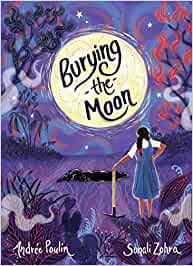
Burying the Moon, written by Andree Poulin and illustrated by Sonali Zohra. Groundwood Books, 2021. $19.99 ages 10 and up


"It's so hard

to stay silent

when you have

important things

          to say.

Important things

  that everyone

      stays silent

          about."

Life for 11-year-old Latika, and the other girls and women of her Indian comunity, is very different than what happens for the boys and men. She is not free to enjoy free days; rather, she spends much of each day taking long walks for water. In the evening, she and her sister weave baskets to be sold. They also join the females of the village on a walk to do their business in a darkened field where no one can see them. There are no toilets for them. The moon feels like an enemy, as its light illuminates their Shame, and Latika would like to bury it. 

Latika can still attend school where she finds much joy. Her time is running short, as the day she turns twelve she will no longer be welcome to attend. She longs for changes that will bring some happiness to her family members. No one talks about the Shame. So, when a government engineer arrives to discuss digging a well, Latika realizes that change can happen. Courageously, she finds a way to speak to Mister Samir. He agrees to listen to what she has to say. 

Once the well is dug and providing the life-giving water needed, the government workers move on. Later, when least expected, other engineers return to the village with the materials they need to build toilets. Mister Samir has recognized the villagers' needs thanks to Latika's bravery and intelligence. Life changes for everyone. 

This awe-inspiring novel-in-verse imparts information to its readers about the struggle that 4.2 billion people around the world face, concerning proper health and hygiene. It is an issue that can be changed through education, concern, and money. Not that much money, actually.  What do we, who have so much, do to change the circumstances for so many? Awareness is the key. 

Sonali Zohra's digital illustrations are bold in color and setting, adding depth and context for the story told. Beautiful!                                                                                        


Wednesday, January 19, 2022

Home Is Not a Country, written by Safia Elhillo. Make Me a World, Penguin Random House. 2021. 23.99 ages 12 and up


"I know something happened on the news again
because my mother has stopped wearing her scarf
to work    & instead tucks each strand of her hair
into a knit hat   the nape of her neck new
& tender in the light   she who once said 
I will never be ashamed of where I come from 
I will never let you be ashamed of who we are
seems to have changed her mind    & I wonder
if this means I should feel ashamed too
"

Nima has never felt comfortable being who she is. Her father died before her birth. Her mother chose to leave family and friends for a new life. Nima doesn't feel at home in this new life in America., and doesn't feel any real connection to her culture. She has one friend ... Haitham. Following his hate-crime beating and while he is recuperating, she has no one. Her days are spent with no social contact and little communication with her mother. The reality of this life where she is bullied for not speaking English without an accent, the poverty that is the life of a single mother raising a child alone, the hate for Muslims at the time, and her inability to speak with Haitham while he is in a coma lead her to a belief about what life could be, if only she knew about her home country and heritage. 

Her dreams offer a different way of life; the kind of life she has never known. In that other reality, her father is still alive, her extended family is large and welcoming, and her mother has time away from work to spend with her. Her dream world, and Yasmeen, lead her to take risks she might never take in the real world. Yameen could be her other self, the one who knows what her life might have been. 

The narrative voice in this novel in verse is authentic, and often heartbreaking. The fantasy that allows a life of belonging and love in the land of her birth soon collapses, and points Nima toward a new appreciation for what she does have and who she is. Gaining that perspective makes for a hopeful conclusion to her story.  

Sunday, February 28, 2021

Being Toffee, written by Sarah Crossan. Bloomsbury, Raincoast. 2020. $24.50 ages 14 and up


"I am not who I say I am,

and Marla isn't who she thinks she is.

I am a girl trying to forget.

She is a woman trying to remember."

Allison has taken enough of her father's abuse. His latest girlfriend, Kelly-Anne, has moved on. In a fit of rage, her father burns Allison's face. She no longer has anyone there to protect her. So, she runs away - she wants to find Kelly-Anne and live with her. But, Kelly-Anne is not where she is supposed to be, and Allison must find a place for herself. She finds it in a house that she thinks is empty. It is not. 

Its owner is an elderly woman who has dementia. Upon meeting her, Marla thinks that Allison is a childhood friend, Toffee. She invites Allison to stay. In the beginning, Allison pretends that she is Toffee. She doesn't want to be Allison anymore. The two get along for the most part. Marla is generally happy with the company; Allison has found food, money, and a place to stay. She hides when a negligent caregiver visits and also when Marla's mean son is there. Allison is appalled at the way they treat her new friend. That helps her make the decision to stay and make Marla's life worth living. 

Allison's memories of her previous life are presented to help readers understand what has brought her to this place, and to make understanding the connection between the two more evident. The sympathy and love that is established is mutual and will have a strong impact on teens who read their story. Telling the story in verse, with compact and powerful words, has real impact. The ability to do so, as Sarah Crossan does so well, is quite the remarkable feat. 

Though filled with excruciating pain, bawdy humor, kindness, mutual admiration, and uncertainty, its poignant ending is hopeful. I will reread it; the next time more slowly - now that I know Allison and Marla's story - to savor the brilliant words and to learn more about each of them. I know I missed much as I tore through it that first time.  

"Single Ladies

Marla and I are giggling, 
clinging to each other, 
swaying, spinning to 
Beyonce singing out 
from the radio's tinny speakers. 

Now like this! Like this! I tell her. 
I hold one hand aloft and twirl it
like any single lady would, 
and Marla copies the choreography - 
         hands in the air, 
         hands on hips, 
         fist punching forward, 
         hair flicked back.
"

Monday, January 11, 2021

Becoming Muhammad Ali, by James Patterson and Kwame Alexander. Illustrated by Dawud Anyabwile. Little, Brown and Company, Hachette. 2020. $22.99 ages 10 and up


"This is what he said:

"I'd like for them to say, he took a few cups of love, 
he took one tablespoon of patience, one teaspoon of 
generosity, one pint of kindness. He took one quart 
of laughter, one pinch of concern, and then he mixed
willingness with happiness, he added lots of faith, and 
he stirred it up well. Then he spread it over a span of a 
lifetime, and he served it to each and every deserving 
person he met.
"

Novels in verse tell amazing stories in a way that makes them accessible to all readers. Choosing the right words at every turn takes remarkable talent. Anyone who reads this blog will be aware of my admiration for Kwame Alexander's ability to tell a compelling story, most often in poetic form. For this biography, he teams up with James Patterson to share Muhammad Ali's early life as Cassius Clay. 

They choose to tell about Clay's activism, boxing career, and family life in a series of 'rounds' which act as chapters that share the events that shaped his life from his first fight in 1958. In alternating voices, readers hear Cassius's friend Lucky (in prose) speak of Clay's life in Louisville, Ky, his family, his many experiences at school and in his community. Each of these experiences led to his success in the ring, and his drive to be what his grandfather told him he could be. 

"know who you are, Cassius.
And whose you are.
Know where you going
and where you from.
"

The other narration, in free verse, belongs to Cassius, who shows readers the drive he felt to be the best, his magnetic and winning personality, and his work ethic. Supported by his family in a segregated neighborhood, he felt the sting of racism every day. Both he and his brother had a dream for better things. They wanted to be like Joe Louis. It was as a young boxer that Cassius began to proved himself.  Not only did he fight with grit and passion, he had a gift for words. 

Alexander's poetry, Patterson's prose and the full-page, telling, black-and-white illustrations present a time in history when social mores often determined a life's path. This book celebrates being black: 

"I am from Sunday fried chicken and chocolate birthday cakes,
from Levy Brothers’ slacks and shiny white shoes,
from Cash and Bird,
from storytellers and good looks,
from don’t say you can’t till you try.”

We are left to hope that the next chapter in this story will be told by the same team. 

Saturday, October 3, 2020

Before The Ever After, written by Jacqueline Woodson. Nancy Paulsen Books, Penguin Random House. 2020. $23.99 ages 10 and up


"Too many of them, Mama says, 
are going through some kind of thing. 
Headaches and rages, memory loss
and fainting spells. Zachariah isn't the only one
suffering. And yet, Mama says. 
setting her coffee cup down hard,
the doctors act like this is new. 

I'm not the only football wife out here, Mama says, 
who thinks they're lying."

I will admit that I have never read a Jacqueline Woodson book that I have not loved. She is a stellar poet who writes with clarity, feeling and absolute perfection. So, I was thrilled to read about this new verse novel that centers on a hidden health epidemic among many sports stars. This book concerns football, and the rising numbers of young (and older) football players dealing with chronic traumatic encephalopathy. 

The first part is set in 1999, when ZJ's dad, 'Zachariah 44', begins to show symptoms that something has gone definitely wrong with him. ZJ Senior is a revered football player, an attentive and loving father and husband, and a faithful and caring friend. The many concussions he has endured are ending his career and the life the family has known together. ZJ has three very special friends who are also loyal, supportive, and see him for himself, not as his famous father's son. 

As the headaches, memory lapses, and angry outbursts intensify, ZJ and his mother are frightened. The many doctors they see have no answers, and offer no real treatment. 

"There's not a name for the way

Daddy's brain works now. 

The way it forgets little things like 

what day it is and big things like 

the importance of wearing a coat outside

on a cold day. There's not a name

for the way I catch him crying 

looking around the living room like 

it's his first time seeing it."

Written with impact through ZJ's first-person narration, this heartbreaking story includes exceptional and caring friends and family members who give support and love to a family dealing with the tragic effects of brain trauma. It has only been in the past few years that the NFL has begun to recognize the lasting effects of football injuries on many of their layers. Still, this does not read like a warning; instead, it is an introspective look at loss and the longing a family feels about that loss. It is also a testament to the hope felt by even a tiny flicker of hope.  

Thursday, September 17, 2020

All He Knew, written by Helen Frost. Farrar Straus Giroux, Macmillan. Raincoast. 2020. $24.50 ages 12 and up

"Mama knits a sweater,
   two pairs of mittens,
     and a stocking cap.
Molly helps her make a fruitcake.
   Papa decides that he will buy
       a sack of peppermints.

Molly draws more pictures
   for them to take to Riverview:
       Snowball's three kittens,
the bonfire they had on Halloween,
   and another picture of their table  ... "

In this verse novel set in the 1930s and 40s, readers meet Henry and his family: his mother, his father, his older sister Molly. On the Christmas Eve when he was four and a half years old, Henry developed a high fever. As a result, Henry lost his hearing. 

"Henry could see that people's mouths were moving,
     he could feel his own mouth making words,
          but it sounded to Henry like everyone
was speaking
     from another room
        with the door closed.

That was when Henry and his family
     found out
            that Henry couldn't hear."

Once Henry was old enough for school, problems arose. A school for the deaf was suggested, meaning Henry would have to leave home to attend. When a test there determined Henry to be 'unteachable', an even more difficult decision had the family taking to him to Riverview Home for the Feebleminded. Henry and the two special friends he has there find ways to be together, and to help each other through living in that bleak setting and the abusive treatment they must endure.

Then readers meet Victor. He is a WWII conscientious objector. Because he will not fight in the war, he is sent to Riverview to do community service. Things begin to change for Henry and the other boys. As more of the men who have been in charge leave to fight in the war, Victor has more control over what is happening with the boys in his care. Victor recognizes Henry's intelligence, and eventually works with Henry's family to have him return home.

Told from two points of view, this poignant story has Molly sharing her brother's story, while Henry describes the endless days of confinement in a place he does not want to be. Based on a family story from WWII, an author's note explains the inspiration for telling it and includes poems written at the time. It is both heartbreaking and hopeful, and will leave readers more aware of a time in history that is rarely discussed.

Saturday, November 23, 2019

White Rose, written by Kip Wilson. Versify, Houghton Mifflin Harcourt, Raincoast. 2019. $23.99 ages 12 and up

"I have nothing
more to say,
Herr Mohr has nothing
more to ask,
and yet the next
time he summons
me, he throws
me a lifeline.

You can still save
yourself, Fraulein
Scholl."

I have written about the White Rose resistance against Hitler in an earlier post, We Will Not Be Silent Clarion, 2016). This new book is another compelling story, and heartbreaking. At its core, it is also a story about uncommon bravery and an unwavering belief in doing what is right.

A debut novel, written in verse, tells of a time in Germany between 1935 and 1943. We know from the first few pages that February 18, 1943 is a gruesome day in Sophie Scholl's life. For, it begins with "The End".

"They swing
the door shut, unlock
my handcuffs, order
me to sit, rush about with
coats, hats, cases, papers
as I try not
to give in to the
overwhelming
            sickening
knowledge spreading through me:
the two of us are trapped
in this net because
of me." 

The scene quickly shifts to 1935 when Sophie is only 14. She is not Jewish, and lives a very comfortable life with a happy, supportive family. That changes with Hitler's decrees against anyone who doesn't comply with his political views. When Sophie's older brother Hans is arrested for disloyalty, and Hitler continues his egregious attacks on the Jewish people and other countries in Europe, Sophie cannot be silent. Her rage eventually leads to her working with Hans and others to rebel against the government, and to do whatever the resistance can do to disrupt the continued persecution. The distribution of pamphlets calling for resistance is considered an act of treason, and the search to find and punish those responsible lead to devastating results for the Scholl family.

Sophie's first person voice alternates between "Before":

"It aches
to be so far away
from the life
I once knew,
from the life
I hope to lead,
from the life
everyone around
us deserves.

Like the winter relief
collection, my role working
for this Reich is part of what
allows this regime
to continue.

Every day I serve it
makes me want to fight it
all the more."

Then, after her arrest, the shock of "The End":

"I pause then,
trying to suppress
the panic growing inside me,
hoping at the very least
that I've placed
               most
of the blame
               on my brother and me.

His face hard, his eyes harder,
Herr Mohr asks
if I have anything to add.

I did the best I could 
for my country. I don't regret
what I did and I'm ready to accept 
the consequences for my actions.

With these words
I finally
silence
Herr Mohr."

The poems provide a clear look at life in Germany at the time. They are emotional, and telling. These succinct passages allow readers to follow Sophie from early adolescence until she is faced with execution for her actions. The shifts that take readers back and forth in time have unrelenting emotional impact as they move from her early untroubled family life, through growing anguish and desperation, to activism and eventually to capture and interrogation.

Back matter enriches the story itself with a list of dramatis personae, a glossary of German words, an author's note and a extensive list of selected resources.

Monday, November 11, 2019

It Rained Warm Bread: Moishe Moskowitz's Story of Hope. Story by Gloria Moskowitz-Sweet and poems by Hope Anita Smith. Illustrations by Lea Lyon. Henry Holt and Company, Macmillan. Raincoast. 2019. $22.50 ages 11 and up

"Our Polish neighbors watch, too,
but only for a moment.
They must make a choice:
Bury their heads in the sand
or pick up a fistful and throw it at us.
The Nazis devise a plan
to make it easier to find their prey.
By candlelight,
my mother sews yellow patches
on our jackets and coats.
We are stars,
but we do not shine."

As she has done before and will do again, Hope Anita Smith writes painful and poignant poems that speak to our hearts. Moishe's daughter shared her father's story with Ms. Smith and the result is this heartbreaking, yet hopeful, story of the fear he felt and the lessons he carried with him following the Nazi occupation of Poland. Life for Jewish people was alarming before the occupation; it became even more terrifying and evil with the arrival of the Nazis.

"No playing.
No light at night.
No conversations.
I no longer go to school,
and still,
I have mastered a new subject.
I have learned to be invisible."

Too soon, the family is forced to leave their home. A ghetto becomes their prison, before murder or deportation to the concentration camps. Moishe's family is lost to him. His life over the next years is one of horror, hunger, and eternal hardship. There are brief moments of kindness, never forgotten. He carries with him the love given and lessons taught by his family, and Moishe does not give up while he still has air to breathe.

"And as my father would say,
"Where there is hope, there is life."
I tote them around with me everywhere,
the weight of their memory
never so heavy that I would set them down.
I never stop thinking of them.
I carry them.
And because I carry them,
I feel each of them, in turn, reaching out their hands
to lighten my load.
I carry them
and that makes my burden
easier to bear."

So beautifully written, and absolutely heartbreaking. To know that Moishe, at 91, is alive and well, recently retired from the family business, enjoying his grandchildren, and spending time speaking to middle grade students about the war and his experiences is testament to the courage and bravery he has shown since he was 13 years old.


Thursday, November 7, 2019

Caravan to the North: Misael's Long Walk, written by Jorge Argueta and illustrated by Manuel Monroy. Translated by Elizabeth Bell. Groundwood, 2019. $16.95 ages 10 and up


"For over a week
we’ve walked.
We’ve ridden in trucks
and buses.
We’ve slept in parks, in streets
and in shelters.
In some places
people are glad to see us, they help us.
In others they chase us away.
I don’t know where the North is."

If you want a clear picture of the plight of the El Salvadoran people and their 2018 caravan, listen to this story told in the voice of a 9 year old child who must leave his much-loved home and community to head north. There is nothing left for them where they live ... no employment, constant terror and violence, nothing left to sustain a family.

Misael, his mother, father, and brother reluctantly join the 'caravan' that will take them on a journey north. They travel with a very large group of migrants, all looking for a better life. The road is long, and the conditions are less than ideal. If they are together, they think they will be safe. None know what the future holds for them. They have hope for a better life.

"When we get there,
I'm going to have an apartment
with water you can drink.
I'll bathe in warm water
and have a washing machine.

"I just want to work
and send money to my mom.
She's really old and has no pension,"
says a boy
who is walking by my side.

"I'm going to start college.
Maybe I could be a lawyer
or a teacher or a doctor.
Well, I'll settle for just getting there
and then we'll see," says another boy."

Misael's voice is heartbreaking as he observes and shares the stories of those who walk with him. They all experience both fear and hope. That is what guides them through exhausting days and endless nights. Only in hearing Misael's voice as he describes the 4,000 km trip can we begin to understand why they would risk their lives to find asylum.They carry what they can on their backs, are encouraged by kindness as they pass through El Salvador, Guatemala and Mexico. Upon reaching the United States border, all that changes. They are met with the threatening presence of the military and border police, batons, tear gas, protesters, chaos, barbed wire, and a wall ... and reason to fear for their lives once again. The border is closed.

That night Misael dreams:

"I fell asleep and I dreamed.
I dreamed I was flying.
I dreamed I was a song,
I dreamed I was a butterfly,
I dreamed I was a fish
and a wave.
I dreamed
the sweetest dream of all.
Instead of going to the North,
I went back to El Salvador."

It is not the Misael's dream to leave his beloved country; it is a necessity if he wants to live a more peaceful life. Would we not want the same?

Choosing to tell his story in spare verse, Mr. Argueta creates real emotional impact. Manual Monroy's back-and-white drawings perfectly match the crushing sadness of Misael's tale. In an afterword, Mr. Argueta explains why he chose to tell his story:

"I've written this text in my eagerness to share the voices of hope, of anguish, of the thousands of immigrants from Central America who abandon our countries because of all the violence and the lack of opportunities. In their midst, I saw people who were hard workers, humble, desperate and tired of suffering.

“It’s up to us to change things. I believe in the gentle power of reading. I believe reading changes the hearts, spirits, and minds of people.” —Jorge Argueta

Friday, June 14, 2019

Finding Baba Yaga: A Short Novel in Verse, by Jane Yolen. Tor, Macmillan. Raincoast. 2018. $!4.50 ages 12 and up

"The longer I am in these woods,
I learn words.
I become cornucopic
with language
which rolls around my mouth
like dark chocolate,
like butterscotch,
like peppermint.

There's no one to caution my tongue,
no one to soap my mouth,
no one to bridle my brain."

I have always been drawn to Jane Yolen's writing. Some of her books remain favorites, and have a permanent place on my 'keepers' shelf. When I read about this verse novel, I knew that I would like to see a copy. Thanks to Fernanda at Raincoast for sending it to me.

As she has done before, Ms. Yolen blends traditional folklore with present-day sensibility to bring readers an engaging story about Natasha, a runaway whose emotional journey leads her to Baba Yaga and her little house with chicken feet.

An opening poem tells readers this is a not the story they think it is going to be.

"Stories retold are stories remade.
A sorrowing girl in a house.
An old witch with iron fillings.
A hut in the wood,
in the meadow, in the hood.

This is a tale
both old and new,

borrowed, narrowed,
broadened, deepened.

You think you know this story.
You do not."

What an invitation to jump right in and be immersed in this old story, told new. In a series of chapters, readers learn what life is like in a house that has no peace. A domineering and abusive father makes life so difficult that Natasha sees no solution but to run away to find herself and some peace.

"If I'd made a plan
it wouldn't be this one.
If I'd packed a bag,
it wouldn't be my backpack.
If I'd left a letter,
I couldn't have written a word.

See, it all begins and ends
with that.
A word.
But which word:
love,
regret,
good-bye?"

Leaving is difficult, and frightening, and even peaceful. Eventually, she finds herself at Baba Yaga's door. The house invites her in; the meeting with the Baba is a revelation; and there are numerous jobs to be done if she intends to stay. Baba Yaga, it turns out, likes 'feisty gitls'. Boys? Not so much.

"Boys, on the  other hand, she devours whole,
spitting out the little finger bones.
Even if they can dance and sing.
Even then."

When Vasalisa arrives, Natasha meets a new best friend. Their differences soon cause strife. Vasalisa's departure to marry a prince is a blow. Natasha stays on, always learning from the witch. This is a her family now, and she will continue her life in this new role, taking over for Baba in the future. 

"She promises me I'll be the Baba ever after.
For now that's quite enough."

Beautifully written in language that is smart, sensitive, magical, and memorable. This is not the only time I will read it!

Wednesday, June 12, 2019

Other Words for Home, by Jasmine Warga. Balzer & Bray, Harper. 2019. $21.00 ages 11 and up

"There is an Arabic proverb that says:

She makes you feel
like a loaf of freshly baked bread.
It is said about
the nicest
kindest
people.
The type of people
who help you
rise.

I just spent a perfect day in the warmth of the back porch reading to my heart's content. One of the books I read was this novel in verse that shares the journey of a young Syrian girl and her pregnant mother from their war-torn homeland to a new life in the United States.

Jude's life in Syria has become increasingly dangerous. She lives there with her parents and her 'superhero' older brother. Political unrest in their homeland is causing strife within their own family. Issa is not content to sit back and do nothing. The family fears that his activism may create an even more dangerous existence for their family. He wants to go to Aleppo to help those in need. Baba, Jude's father, decides that Jude and her mother must move to Cincinnati to live with family there. Baba will stay and look after their store; Issa will not leave when he is needed to fight the oppression that threatens Syria.

Life in America is quite a culture shock for Jude and her mother. They do not speak the language, the pace of life is chaotic and loud. Their life with Jude's uncle and his family is tenuous to begin with, although her uncle is welcoming. It takes time for all to accustom themselves to a new reality. Jude's aunt is excited to have her husband's family with them. Jude's mother is reticent. Jude's cousin Sarah, in middle school as is Jude, doesn't want to garner attention for this new person in her life.

"I love the way Aunt Michelle
greets me every morning with a plate of pancakes. grader
The way she speaks slowly
so that I can understand her,
and always smiles like she understands me,
even when I know my accent is thick
and I have put the words in the wrong order."

Once school starts, Jude begins to make friends. Her ESL class offers the support of a welcoming and patient teacher. There are four students, with varying abilities with the English language and they know exactly how Jude feels. Her abiding interest in the movies and music provides Jude an opportunity to audition for the school musical. Her daily walks in the neighborhood lead her to a Middle Eastern restaurant and a new friend, Layla.

Treatment of Muslim people is not always fair and right. Jude is the object of some racist comments. Despite that, she learns to love her new home, while still holding Syria in her heart. Jude's strong poetic narrative allows readers a close look at the emotions felt as she navigates all that is happening to her. She is initially apprehensive, always brave, sometimes scared, righteously angry, and still willing to do the work it takes to find a new life with her mother and baby sister.

There are powerful moments, both uplifting and heart-wrenching. Through it all, Jude proves she has what it takes to make the best of the cards she is dealt and to find support from family and new friends.

"I shake my head and
blink away my tears.
I tell her I was thinking of Issa.
She squeezes my shoulder again.

He's going to be okay, 
and he would be so proud of you.
Her eyes wander around the room
and find Mama, who is surrounded by lots of friends.
New friends,
American friends.

He'd be so proud of all of you."

In an author's note Ms. Warga reminds us:

"I will
show that you don't need to be afraid of these children
who are fleeing from a war zone. That they want the same
things all of us do - love, understanding, safely, a chance at
happiness.

We're in a period of human history where empathy is
needed more than ever. As the mother of two little girls,
I'm constantly trying to teach them the idea that no one
every grows poor from giving. That sharing what you have
does not make what you have worth any less. I guess that's
what this book is really about - the ever-growing need for
generosity."

Thursday, January 10, 2019

Ebb & Flow, written by Heather Smith. Kids Can Press, 2018. $17.99 ages 10 and up

"The Truth Was

Sometimes, being bad
felt good.
Like the time
Junior and me
ordered ten pizzas
in our teacher's name
and had them sent to the classroom.
Afterward, Junior called me
his partner in crime."

This is such a powerful, yet tender, free verse novel about a boy (and his rotten bad year) and a summer spent with his grandmother. Readers know from the opening lines that he accepts responsibility for all that happened. It takes a while before his whole story is told.

Things during the time leading up to the summer visit have, obviously, not gone well. When his father goes to prison as a result of a terrible drunk driving accident, Jett and his mother move to a new place, a new school, and a shameful friendship with Junior. Junior has troubles of his own, and Jett is a willing participant in some pretty contemptible behavior. Jett is mad and vents that anger through those actions.

Throughout the summer, it is evident that Jett loves his grandmother and she loves him. She works quietly to calm his anger, and boost his self-esteem, which is at an all-time. Her support and the comfort he has always felt in her company lead him to share the events of the past year.

"Bad Thing

After the movie
we went out to eat.
I sat in the booth
of the old-fashioned diner
staring at the seeds
on my hamburger bun.
Grandma said,
That was a real tearjerker, huh? 
And I said,
I did a bad thing this year. 
Grandma said,
I know."

Full of heart and hope, this beautifully written first person narrative shares the regret Jett feels for what he has done. His love of language is shared by his grandmother, and provides some needed humor for those reading his touching story. Both main characters are deserving of the reader's attention and admiration. Their relationship is strong; the change doesn't come easy but is worth the hard work. In the end, Jett hopes to find forgiveness from the man he has hurt so badly. Maybe then he will finally be able to forgive himself.

Saturday, November 17, 2018

The Poet X, written by Elizabeth Acevedo. Harper, 2018. $21.99 ages 14 and up

"I should be used to it.
I shouldn't get so angry
when boys - and sometimes
grown- ass men -
talk to me however they want,
think they can grab themselves
or rub against me
or make all kinds of offers.
But I'm never used to it.
And it always makes my hands shake.
Always makes my throat tight."

https://youtu.be/YH4gIM6TZkQ

I really don't need to say much more than Elizabeth Acevedo just said about her brilliant debut  ... but, I will! I don't want you to miss reading this important, powerful, meaningful and courageously written novel which just won the 2018 National Book Award for Young People's Literature. Lucky I am to share it with you. It is a book I read in the summer, and it continues to find its way into my heart and my head. It certainly does not speak to my own experience; rather, it informs, enlightens, and opens my heart to Xiomara Batista and the amazing young woman she is, and the many other young women she represents through her compelling, poetic voice. . 

Although a twin to Xavier, the two have little in common but their love for each other. X is tough, outspoken, and 'one who is ready for war' (as is the meaning of her given name).  Her controlling parents wish it were not so. As she nears her confirmation in the Catholic church, she begins to ask questions - it is not a popular stance with her parents, her brother, or her best friend. She must constantly reject attention from her male peers and the older men in her neighborhood. She is intrigued by her lab partner Aman. His interest in X has little to do with how she looks. The two are attracted to one another, and keep it a secret.

It is only through poetry that X is able to clearly express her thoughts, feelings, hopes and dreams. Readers will be drawn to her story through that poetry, and will feel the undeniable emotions she is able to share there. There is so much love - for her parents, her brother, her best friend and for Aman. Her story is also awash with misunderstanding, secrets, rebellion, a growing sense of self. A teacher's invitation to join the poetry club is enticing, but fraught with difficulty. If she joins, without her mother's approval, will she ever be able to share the poems that speak to her heart and who she really is. 

"Every Day after English Class

Ms. Galiano asks me to read her something new.
With five minutes between classes,
I know I need to pick the best and shortest pieces in advance.
But every day I pick a new poem and I have learned:
to slow down, to breathe, to pace myself, to show emotion.

The last day before winter break
Ms. Galiano tells me I'm really blossoming."

Brilliant, forceful, heartbreaking, and full of impact on every page, you should read this book and then share it with others.

 “It almost feels like
 the more I bruise the page
 the quicker something inside me heals.”

Bravo and congratulations!

https://youtu.be/ha3awWZtifM