Total Pageviews

Showing posts with label endangered animals. Show all posts

Wednesday, October 8, 2025

Hello, I'm a Loris, by Hayley and John Rocco. G. P. Putnam's Sons, Penguin Random House. 2025. $23.50 ages 4 and up


"I'll tell you a secret: I am the only primate 
in the whole world that is venomous! If I 
feel scared or threatened, I release a toxic 
oil from special glands on my upper arms. 
When I lick it up, it mixes with my saliva 
to make a potent venom. Then I can deliver 
a nasty, painful, and sometimes even 
deadly bite.
"

There was so much I did not know about the loris. Granted, I will not likely meet one since they live in southeast Asia and some parts of Africa. Nonetheless, I know more today than I did yesterday. That is what I appreciate about the Roccos' Meet the Wild Things series. This is the sixth in the series which includes the sloth, pangolin, quokka, axolotl and toucan. I have learned a lot about these animals, mostly unfamiliar to me. 

The first-person narrative and conversational style of the writing, and the realistic images of both animal and setting have made these books fan favorites for kids who love animals and want to know more about them. The familiar design and opportunity to answer questions asked rewards their interest and ups the learning for all. 

All animals included in the series are endangered species. If we want kids to care for the environment and the loss of many of nature's animals, it is imperative to provide them with books that pique their interest and offer ways to help animals in peril. 

Let me offer just a few things I learned about this pygmy loris, whose beseeching eyes look straight at the child reading this book. It is nocturnal, which explains the need for big eyes that help it see at night. It is a primate, just as humans are. It helps trees in many ways. It is endangered because of habitat loss. It does not like to be frightened, and needs its own space. Do you feel that way sometimes? 

In back matter, Ms. Rocco adds a bulleted list of other facts about the loris, an explanation for why it is endangered, and a list of organizations that are working to help them. 

Thursday, July 13, 2023

The Late, Great Endlings: Stories of the Last Survivors, written by Deborah Kerbel and illustrated by Aimee van Drimmelen. Orca, 2022. $21.95 ages 8 and up


"Until the 19th century, the passenger 
pigeon was the most plentiful bird in 
North America, its population numbering
in the billions. Historical accounts describe
migrating flocks so massive they darkened
the sky for hours as they passed overhead. 
Humans' overhunting quickly and 
drastically reduced their numbers, and by 
1914 only Martha was left.  She died at the 
Cincinnati Zoo, at age 29.
"

An endling is the last known surviving individual animal of a species. As we hear more and more about the species we are losing at an often-unprecedented rate, it is important to read about those amazing creatures we have already lost. They act as a reminder for the fragility of animals and their ancestors.

The author begins by mentioning the dodo, the great auk, and the dinosaur. Then she moves on to more readers many not recognize. Each endling is named and introduced in a short rhythmic poem. Along with mentioning the noted date of their becoming an endling, the author provides an informative paragraph concerning the reasons for their loss. Endlings presented include the passenger pigeon, the heath hen, the Pinta Island tortoise, the Carolina parakeet, the Tarmanian tiger, the Pyrenean ibex, the Polynesian tree snail, the Rabb's fringe-limbed tree frog, How many do you know? 

Dignified, realistic watercolor paintings were created using photos and preserved exhibits, and provide a face for these last known survivors. How many more will there be, and how can we help? It gives readers pause to think about the state of the natural world today. 

Final pages suggest the animals now threatened and perhaps extinct by 2050. By 2120, it has been suggested that '50 percent of all species on Earth now could face extinction'! Biggest threat? Habitat loss ... Finally, a list of seven ways kids can make a change to make a difference. Let's do it!  


Saturday, September 24, 2022

If Tigers Disappeared, written and illustrated by Lily Williams. Roaring Brook Press, Macmillan. Raincoast. 2022. $24.99 ages 8 and up


"In 1900, there were an estimated one hundred thousand
tigers in the wild, but from 1900 to 2000, tiger populations declined by 96 percent. As human populations expand, tigers lose more and more of their natural land. Today, due to habitat loss and poaching, fewer than four thousand tigers remain in the wild.

As she has done in previous books about sharks, polar bears, elephants and bees, Ms. Williams helps her readers understand what life on Earth would be like without tigers. Although I have only seen a few in captivity, I cannot imagine a world where these giant, majestic cats have no place. 96% lost in the past 100 years! If scientists were not tracking their presence and discussing that loss, who would believe that fact to be true? Of course, they are in danger of extinction. 

A map clearly shows where the six existing tiger species can still be found ... the Bengal, Malayan, Sumatran, Indochinese, South China, and Siberian. What a shame that less than four thousand remain in the wild. As apex predators, they play a crucial role in the natural balance within the forests where they live. 

Large herds of mammals that tigers feed on, when left to flourish unchecked, would alter waterways and plant growth. When forest environments change, the creatures making their homes there would not have enough to eat and would perish. All world patterns change when such loss happens. 

"This ripple effect, called the trophic cascade, can spill out across the world, affecting all forms of life. What might feel like a threat to a single animal population far away can actually have effects that reach your ecosystem as well.

Luckily, there are indigenous communities who worship the tiger and seek to protect them. It is up to people of the world to learn from their ways. We all can learn more about the tigers' importance to ecosystems everywhere by asking questions, following advice and caring about their existence whether we live near them or not. 

Digital illustrations add interest and understanding for all readers. Endpapers are filled with images of the six remaining tiger species. A glossary, and a note about the troubles that plague tigers bring an end to the book.                                                                                  


Wednesday, January 5, 2022

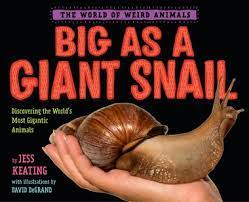
Big as a Giant Snail: Discovering the World's Most Gigantic Animals, written by Jess Keating and illustrated by David DeGrand. Alfred A. Knopf, Penguin Random House. 2021. $23.99 ages 8 and up


"As the largest members of the deer family,
moose have a leg up on their smaller 
cousins. Or rather, several feet up! Some 
MOOSE tower more than ten feet tall, 
and their massive antlers can be nearly 
two yards wide."

You already are aware of two of the most gigantic animals included in this amazing new entry for The World of Weird Animals series: the moose and the giant snail. Quick! Name five more, and see if you made the right guesses once you get down to reading. I'll wait!   

As they have done so successfully before, Jess Keating and David DeGrand offer a plethora of animals that fit the bill for this book about gigantic animals. They offer clear information through careful research on a handful of such animals that will be familiar to their target audience: blue whale, polar bear, elephant seal, capybara, giant anteater, and red kangaroo. Others perhaps are not as well known: Malabar giant squirrel, cassowary, atlas moth, harpy eagle, kakapo and the goliath birdeater. 

A note for readers, before meeting any of the noted animals, allows that true size is measured in bananas (each being about six inches long). Thus, a moose is 14 bananas high, while a polar bear is 20 bananas long. It helps if a young reader has a banana at hand to do some measuring as the book is read. 

Each double page spread is designed to provide many pertinent facts. A clear and titled photo faces a factual, short paragraph, a cartoon image, an information splash that offers one distinct peculiarity, and a sidebar that provides species name, size, diet, habitat, and predators, and other threats to the animal presented. 

Back matter includes The Handy, Dandy Banana Scale which provides a comparison chart of sizes from the biggest to the smallest. Readers are invited to measure themselves using bananas and then compare themselves to the chart. Where would they fit on it? A glossary of useful words is the final entry.  

"Not all animals are scary - some are downright adorable! The KAKAPO is the world's heaviest parrot and also happens to be the only species of parrot that can't fly. But who needs flight when you've got excellent hiking, climbing, and jumping abilities?"

Thursday, December 3, 2020

Last: The Story of a White Rhino, written and illustrated by Nicola Davies. Tiny Owl, Publishers Group Canada. 2020. $25.50 ages 4 and up


"I've looked and looked, 
but I've never found 
another like me. 

Long ago in the old place, 
there were others. 
Big ones fighting, 
little ones playing.
"

This is the first book that Nicola Davies has written and illustrated. It is no surprise to me that it is heartfelt and informative. She is an exemplary proponent for the environment and what must be done to protect it. 

This is the story of the last Northern White Rhino, named Sudan. He died in 2018. Telling his own story in personal and powerful words, readers learn that the hippo is housed in a very grey and bleak zoo enclosure. Alone and always searching for another animal like himself, he shares memories of an earlier life. In that life, he lived in close proximity to his mother each and every day and night. When a hunter shot her, life changed dramatically. 

Captured, boxed, and transported to the place he now inhabits ... there is no grass, no flowers. It a place filled with 'lasts'. Nothing to do, nowhere to go. 

"Where are the others for us?
What has happened to the world?
"

It takes someone watching and caring for the plight of the animals to make a change. That change is a game preserve where finally he meets another rhino - perhaps the two can ensure they are not the 'last'. 

The artwork is as impressive as the story told. The contrast between the gray days of captivity and the lush greens of a return to a natural habitat have tremendous impact for young readers. A note from Ms. Davies about the art introduces the story, and an endnote mentions Sudan, the inspiration for this book. 

 “I believe that the world can change for the better, but it will change one heart at a time. Change your heart, change the world."