Total Pageviews

Showing posts with label social justice. Show all posts

Thursday, June 5, 2025

Nibi Nigomon: Nibi's Water Song, written by Sunshine Quem Tenasco and illustrated by Chief Lady Bird.Translated by Tina Nottaway. Scholastic, 2025. $8.99 ages 5 and up


"No problem. Thirsty, thirsty Nibi went back 
to the house with the green roof and knocked 
and knocked and knocked ... and knocked some
more. Nobody opened the door this time. 

Kan-nigotisanon. Nibi pagonadim, kigiye koki
migwam kak ka osawanik ogidabik. Ki papowage ...
kawin awik ogi cebadosin.
"

Do you remember the last time you had no water to drink following a water shutoff? I surely do. Until that happens, we tend not to think much about our dependence on water for daily living. Can you just go the kitchen tap and get a glass of water anytime you feel thirsty? I suspect that your answer is an affirmative one. 

That is not the case for Nibi and her community. When Nibi comes inside for a drink of water to quench her thirst, she is distressed to learn there is no clean water. There is no clean water next door, or down by the river. Everywhere she looks, the water is brown and undrinkable. Perhaps there will be clear, clean water in the next town. Knocking on the door of a big, shiny house, she asks for water. The lady living there offers a bottle and sends Nibi away. 

That water is soon gone; Nibi returns to the same house for more. This time there is no answer to her knocking. The same happens at every house she visits in town. So, Nibi makes a sign that says Water Is Life. She holds it aloft as she dances and begs for the water she needs. Her friends at home want to help. They dance for water with her; some of the townspeople come outside in support of Nibi's need. By working together, attention is finally given to the plight of those who don't have clean water to drink, proving one small voice can bring change when heard. Bravo, Nibi. 

Originally published in 2019, this book is being re-released as a dual language publication. Six years later, it would be wonderful to think that Nibi's song was the beginning of changes for many communities that still have no clean water. Chief Lady Bird has created colorful, appealing illustrations to help young readers with understanding the dilemma shared here. Nibi's story offers a chance for discussion and understanding about a lack of water in Indigenous communities. 

Notes from the author, illustrator, and translator are placed before the book's text. A Let's Talk about Clean Water brings the book to a close. 

"This needs to change. You can be part of the solution. 
If you think everyone should have clean tap water, tell 
your friends, tell your family, tell your teachers - tell 
everyone, just like Nibi.
"

Wednesday, October 2, 2024

A Little Bit Super: With Small Powers Come Big Problems. Edited by Leah Henderson and Gary D. Schmidt. Clarion Books, Harper. 2024. $23.99 ages 8 and up


"First, I crossed my fingers and thought about 
a world where flying cars that didn't rely on fossil 
fuels were a normal thing that everyone had. Our 
car didn't rise into the air after a few seconds, so 
that was probably too big a wish. Next, I crossed 
my fingers as we approached my dad's favorite 
doughnut shop, hoping he'd want to treat himself 
and we'd get the benefit. Sure enough, he put on 
his turn signal. "It's Tuesday, why not?" he said.
"

If I were teaching in a middle years classroom, I would love to share these stories as a readaloud at some point of each day. There are 13 short stories and one graphic tale that connects each of those. The kids whose stories are shared are dealing with the same issues that many middle schoolers face: identity, responsibility, social justice, relationships, and their place in the world. What is unique is that they have a small superpower they can use to make a difference in the lives of others, or in their own. What they learn about themselves is equally compelling.

Written by esteemed authors, they are told with humor and compassion in diverse voices that offer imagination and engagement for readers. There are two sections: The Power of Discovering Who We Are and The Power of Being Who We Are. Their powers range from time-jumping to matchmaking, shape-shifting (only on Monday and only one part of her body) to telepathy, even the ability to sense when avocados are ripe. 

The stories cause readers to pause and think. The graphic entries by Jarret Krosocczka introduce River whose superpower is imagining every one of the upcoming stories in her drawings. As she draws, she learns about these superheroes while using her artistic ability for good. The entries do not have to be read in order, except that River's drawings offer an introduction to the upcoming story. 

This book begs these questions of readers: what is your superpower, and how can you use it to change your part of the world? 

“Because everyone has a power, and that power matters, no matter how small or inconvenient it may seem.”

Tuesday, July 16, 2024

The Kids Book of BLACK HISTORY in Canada, written by Rosemary Sadlier and illustrated by Arden Taylor. Kids Can Press, 2024. $23.99 ages


"The Black Californians were determined to 
succeed on Vancouver Island. Most stayed in 
Victoria and opened new businesses. The finest 
restaurant in Victoria, Ringo's, and the best 
barbershop were both owned by Black 
businessmen. 
John Sullivan Deas was another Black 
entrepreneur. Trained as a tinsmith, he took 
over a salmon factory on the Fraser River and 
shipped thousands of cases of salmon to Britain 
every year.
"

This exploration of Black history in Canada begins in 1604 when Mathieu Da Costa, the first known African to come to Canada, arrives on Canadian soil. It continues forward to the present day, and the Black Lives Matter movement. The struggle for justice remains, despite the progress that has been made. Black Canadians have made many significant changes and contributions to Canada's story. 

Matters presented inspire middle grade readers to think about the issues of slavery, racism, prejudice and representation. Each is clearly described in short paragraphs relevant to the subject being discussed. Profiles, quotes, songs, did you know? sidebars offer the history of Black Canadians as they settled across Canada. Short information boxes introduce readers to those who are part of their proud history. 

This book is an update to The Kids Book of Black Canadian History that was first published in 2003. It is filled with revealing and engaging text sure to hold interest and offer food for thought in these trying days. It is a proud history and should be celebrated and discussed in classrooms where it is pertinent to learning. 

Dr. Sadlier is an eminent scholar whose work includes other books for children. The overview she has  is written mostly in chronological order. The chapters are short, making the book accessible for most middle grade readers. It will result in thoughtful conversations that concern diversity, equality, and inclusion. Once again, knowing more allows each one of us a chance to make things better. Back matter includes six pages of profiles of important Black figures in the arts, sciences, sports, politics and more, as well as a glossary of key terms and an index. This new edition has something for everybody and excellent illustrations that add appeal to the information presented. 

Sunday, January 21, 2024

I'm Gonna Paint: Ralph Fasanella, Artist of the People, written by Anne Broyles and illustrated by Victoria Tentler-Krylov. Holiday House, Penguin Random House. 2023. $24.99 ages 9 and up


"But in the 1940s, Ralph's fingers twitched
and tingled, possibly from arthritis. To help 
with the pain, a friend handed him a pencil 
and paper. "Draw something." Ralph drew
for the first time when he was thirty-one 
years old. 

Then he couldn't stop drawing."

Young readers will very much enjoy this upbeat look at Ralph Fasanella's life from his early days as a kid growing up in the 1920s in New York. He was a brave and daring child, wandering the streets of the big city all day long. He had no need for school. He taught himself to read by perusing any newspaper he could find. 

Ralph's family was large; their apartment was small. Dinnertime conversations were lively, often led by his mother who shared big ideas like the benefit of unions. He attended union meetings and her workplace with her. Ralph paid careful attention to what was happening there. He also followed his father as he delivered ice to his many customers. 

Ralph found himself in trouble, after being caught selling stolen goods. He was sent to reform school for his misdeeds. He longed for the dinnertime conversations at the family table. Following his four years there, he worked running errands, and taking whatever work he could get. He joined a union, finally becoming an organizer. 

Drawing became a passion when a friend suggested he try it. As he had learned to read on his own, now he learned everything he could about art and artists. His own paintings were filled with memories of his life, and the events that were happening around him. 

"He painted ordinary people, city streets, everyday working life." 

Though he wasn't making a living being an artist, he continued painting until a folk-art dealer decided to show his work. Ralph then took time to do valuable research, and ultimately create eighteen paintings reflective of workers fighting for their rights. Fame led to his art being shown in museums around the world, and in places where people could see themselves in his paintings and be proud of the work they did.

Back matter is extensive; it includes further information about Ralph, archival photographs, reproductions of two of his paintings, a time line of his life, a list of his paintings that capture historical events, and a list of other artists whose work was focused on ordinary people (social realism), with the title of a picture book biography written about each one,  Finally, it includes a bibliography of books, print articles, video, web articles and exhibition catalogs to provide what is needed should a reader want to know more. 

The endpapers are stunning. 


Sunday, July 16, 2023

No Horses in the House! The Audacious Life of Artist Rosa Bonheur, written by Mireille Messier and illustrated by Anna Bron. Orca, 2023. $21.95 ages 4 and up


"One day, while scouting the city for new 
animals to draw, Rosa discovered the horse 
market. Here, in the messy, smelly place, 
she found many fascinating breeds of horses. 
Some were breeds Rosa had never seen before. 
She was thrilled. 

"Hey! Girls can't be in the market!" snarled 
a merchant. "It's too dangerous."

I knew nothing about Rosa Bonheur before I read Mireille Messier's tribute to her talent, tenacity, and refusal to do what was expected of her as a young woman living in the 1800s. Rosa loved animals, and she especially loved to draw their pictures. She mostly drew cats, dogs, birds and cows. They were fine; Rosa loved to draw horses. No other animal held the appeal that those majestic beasts did. 

Her mother wanted her to learn to read; all Rosa wanted to do was draw. When pushed, she compromised by printing the alphabet while adding the image of an animal whose name began with each letter. Sewing and doing other 'girl' things were not for her, and she was not good at them. Drawing was different. Reluctantly her father gave her lessons - happiness was hers. 

Friends and neighbors were not impressed. Rosa continued learning to be the best artist she could be. Days were filled with constant work to get things exactly right. A visit to the horse market raised alarm bells. It was not 'ladylike' for her to be there. They dragged her away. Donning a disguise to help her look like her brother, back she went. She was recognized! 

After much pleading and pushing for change, Rosa earned a permit that allowed her to dress any way she wanted to dress. Her art won praise at the Salon de Paris. Patrons loved her work, but were not impressed at her lack of real training. Perseverance and practice won out.  Rosa became an acclaimed French Realists.

Appealing illustrations allow readers a chance to experience the setting and time for Rosa's life. They add contextually to the story of a confident and accomplished young woman facing unreasonable societal obstacles. An author's note is added, as is a timeline of her milestones.                                                                          


Wednesday, September 21, 2022

Maya's Song, written by Renee Watson and illustrated by Bryan Collier. Harper, 2022. $24.99 ages 7 and up


"How To Build a World

Words poured out of Maya and she felt revived. 
A whole world of words had been growing inside. 

She believed people became what they said, 
so she chose words carefully, 
planted powerful affirmations in her world. 

Words like forgive, like kind.
Words like brave, like powerful, like phenomenal.
Words like faith, like dream, like free.
"

This tribute to a truly powerful voice in American literature is both moving and memorable. From her birth in 1928 through 1993 when she read her 'poem for the nation' as a special request from President Bill Clinton at his inauguration, Ms. Watson's free-verse poetry chronicles the momentous events of a life of love, hurt, and courage.  

Her loving family moved from St. Louis to California for a better life, which was forever changed when her parents' marriage ended. Sent to Arkansas to live their grandmother, life was mostly happy. A return to their mother proved traumatic when Maya was abused by her mother's boyfriend. What followed was a period of selective mutism when Maya said not a word for five years. 

The children were returned to their grandmother, whose love and compassion meant everything to them. A family friend gave Maya the courage to try her voice again ... and the rest is history. Words bottled up for too long poured from her. Her life took another turn when she gave birth as a teenager to a son, and had to find ways to provide for him. She turned to performances in singing and dancing, and traveling the world to entertain others. 

Her life in Harlem allowed her voice to be heard, and close friendships with James Baldwin and Martin Luther King Jr.to flourish. They wrote, they organized, and they worked for change. A move to teach in Ghana became home before returning to America once more. 

"Maya knew that home was never one place, with one kind of people.
Home was anyplace her voice could be heard. 
Home was anyplace there was love.
"

The assassinations of Malcolm X and Martin Luther King Jr. led to a short period of keeping her words inside once more. Her friend Jimmy Baldwin pushed her to tell her stories, to write them down, to let the world hear what she had to say. She did that and so much more. 

Watercolor and collage artwork by the brilliant Bryan Collier provides portrayals of Maya at every stage of her life. Using light, pattern and telling imagery he fully complements the book's words. Each spread is significant and worthy of careful examination as her story is read and revisited. 

A timeline, and personal notes from both author and illustrator conclude. 

Sunday, March 27, 2022

Dragon Bones: The Fantastic Fossil Discoveries of Mary Anning. Written by Sarah Glenn Marsh and illustrated by Maris Wicks. Roaring Brook Press, Macmillan. Raincoast. 2022. $26.99 ages 5 and up


"They called the fossilized shells and bones 
"curios," short for "curiosities."

Mary hated to sell the curios. She longed to 
slip a few treasures into her pocket to study 
alone later. She knew they contained forgotten 
stories and hidden secrets." 

Spring books bring an assortment of new and intriguing picture book biographies. I have read others about Mary Anning: Dinosaur Lady (Sourcebooks, 2020), Stone Girl, Bone Girl (Frances Lincoln, 2006), Rare Treasure (HMH, 1999) and Mary Anning's Curiosity (Groundwood, 2017). There are others, of course. 

This one is focused on Mary's childhood, and her early penchant for hunting treasure. The family lived near the sea, and storms would often force them from their home because of flooding. The aftermath of those storms led the family to search the cliffs for any treasure to be found there. 

Mary, her brother Joseph, and their father would work diligently to see what the storm had left in its wake. Mary always wanted to be first to find treasure. Once found, the treasures all had to be sold to support the family through hard times. Reluctantly, those many finds were sold with Mary wondering all the while what they were giving up. 

The three made quite the team. When Mary's father died, it was left to the children to continue the family's work. Mary led the way, always imagining that one day they would find something very special. Her brother made quite an amazing discovery. When her brother grew tired of the work, it was left to Mary to continue working to unearth a giant crocodile. It made the news. 

As the years passed, Mary continued making many more important finds. She pursued new learning at every dig, and making discoveries ... all on her own. A big find led to many scientific papers. Not one mentioned Mary. Mary faced discrimination as a scientist in a world that took little stock in women who proved themselves worthy of attention for their fine work.  Mary persevered, finally opening her own shop where she could show others what she had discovered. She never gave up looking for more. 

Back matter includes further information about Mary, her dragons, and guidance on how to become a paleontologist. Finally, a selected bibliography is shared. 

Engaging, accessible, and accompanied by excellent digital art, this is a book that readers are sure to experience with a sense of awe for Mary's perseverance through some very hard times.                                                                                    


Friday, March 18, 2022

A Fair Deal: Shopping for Social Justice, written by Kari Jones. Orca Book Publishers. 2022. $14.95 ages 9 and up


"By the mid-1900s, many people around the world
were upset at the way trade was happening. People 
didn't want to buy soccer balls made by a kid in 
Pakistan or chocolate from a poor farmer in Peru. It 
just didn't make sense. Instead, they came up with 
another system, and they called it Fair Trade.
"

Young people today are very aware of the precarious state of the Earth in response to climate change. They want to know all they can in order to make some needed change. Being able to provide them with books in the Orca Footprint series can go a long way in providing pertinent information and encouragement to make a difference. 

This book concerns fair trade, which is meant to help developing countries by getting a fair price for those items that are being made there. Ms. Jones writes about the history of trade, and how it has not always been fair at all. She encourages readers to learn as much as they can about the products and services offered where they live and to make a concerted effort to be part of such a system. Those systems are not always equal. There are, however, ways to make things better for families in world communities. 

This is just the thing that many young people today are seeking. They want equality, better ways to spend their money, and a drop in the amount of goods they purchase. Many look to second-hand stores to find items that are perfectly good for their needs. As they read this book, they learn about the successes of free trade and the ways in which it improves conditions for many. 

 “ ... fair trade products are now sold in more than 120 countries.”

Fair trade is not an impossible goal. It is already in practice in many places, and can be expanded to many others. The pages of this book provide photographic evidence of successful projects, numerous FAIR TRADE FACTs, and a number of personal stories from the author's experiences with fair trade. It encourages readers to think seriously about how buying fair trade products makes a difference to many people. 

"Fair trade is not about spending more money or buying more 
 stuff. It's about bringing justice to people around the world. 
Fair trade projects are based on the idea that people need to 
protect their environments, their families, and their homes.
"

Kids can make a difference by encouraging others to learn more. The author includes simple ways to help throughout the book. In back matter, she lists both print and online resources, a glossary, and an index. 

Saturday, February 19, 2022

Chasing Bats and Tracking Rats: Urban Ecology, Community Science, and How We Share Our Cities, written by Cylita Guy and illustrated by Cornelia Li. Annick Press, 2021. $14.95 ages 10 and up


"In Toronto, there are more than 350 species of 
native bees. Some, like the Virginia carpenter 
bee, can grow to the size of a quarter and make
their nests in soft wood (you can hear them digging
if you listen close enough). Others, like sweat bees, 
are bright green and tiny. And some, like the 
common eastern plasterer bee, which often appears
first in the spring, dig their nests in the ground.
"

This is Cylita Guy's first book of nonfiction, and she does it up right. In it, she and ten urban ecologists like her are highlighted for the work they do in studying how a variety of species have adapted to life in cities. There is a reason for that. As the numbers of people living in cities around the world continues to grow, more and more natural spaces are lost. The animals, insects and plants that once inhabited these spaces are forced from their homes. Some do not survive; others are able to thrive. 

Each scientist, whose work is highlighted, shares stories, research, and adventure. They also offer a challenge for readers, encouraging them to get out into nature, listen and learn, watch and record what is going on where they live. There are eight chapters, and each one of them ends with a new and doable challenge. 

"Find a garden somewhere. Take a look 
at the flowers. What kind of insects do 
you seen visiting them? Can you snap a 
picture of one? You can use this picture 
to try and find out what species it is using
books or the internet." 

Their stories are funny, terrifying, intense, and even racist. They offer good advice, entertain, and inform. Questions asked require critical thinking, and discussion. Can city bees help us learn more about climate change? Through observation and further research, changes can be made to makes cities healthier for all that live there, not just people. Sidebars offer many additional facts concerning the research being done and the knowledge being gained.  

This is another book that encourages getting out into nature to begin to understand ways in which interaction can be beneficial and peaceful. Meant for older readers, it provides sensitive recognition for the idea of acceptance and understanding for those creatures who want to survive in new environments since they have been stripped of their old ones. 

Cornelia Li's mixed media artwork interprets the interactions between scientists and wildlife. Rich colors and eye-catching silhouettes offer visual details for the work being done, and add context for the encounters.  

The closing resource list is extensive and encourages further investigation. The included index is useful when wanting to return to something of particular interest. 

"Learn more about animals and plants 
not included in this book. Get involved 
in a local volunteer or community science
project. Find out what you can do to help
conserve the species that live in your city.
" 

Friday, February 18, 2022

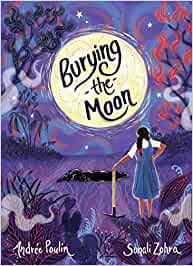
Burying the Moon, written by Andree Poulin and illustrated by Sonali Zohra. Groundwood Books, 2021. $19.99 ages 10 and up


"It's so hard

to stay silent

when you have

important things

          to say.

Important things

  that everyone

      stays silent

          about."

Life for 11-year-old Latika, and the other girls and women of her Indian comunity, is very different than what happens for the boys and men. She is not free to enjoy free days; rather, she spends much of each day taking long walks for water. In the evening, she and her sister weave baskets to be sold. They also join the females of the village on a walk to do their business in a darkened field where no one can see them. There are no toilets for them. The moon feels like an enemy, as its light illuminates their Shame, and Latika would like to bury it. 

Latika can still attend school where she finds much joy. Her time is running short, as the day she turns twelve she will no longer be welcome to attend. She longs for changes that will bring some happiness to her family members. No one talks about the Shame. So, when a government engineer arrives to discuss digging a well, Latika realizes that change can happen. Courageously, she finds a way to speak to Mister Samir. He agrees to listen to what she has to say. 

Once the well is dug and providing the life-giving water needed, the government workers move on. Later, when least expected, other engineers return to the village with the materials they need to build toilets. Mister Samir has recognized the villagers' needs thanks to Latika's bravery and intelligence. Life changes for everyone. 

This awe-inspiring novel-in-verse imparts information to its readers about the struggle that 4.2 billion people around the world face, concerning proper health and hygiene. It is an issue that can be changed through education, concern, and money. Not that much money, actually.  What do we, who have so much, do to change the circumstances for so many? Awareness is the key. 

Sonali Zohra's digital illustrations are bold in color and setting, adding depth and context for the story told. Beautiful!                                                                                        


Wednesday, February 2, 2022

When We Say Black Lives Matter, written and illustrated by Maxine Beneba Clarke. Candlewick Press, Penguin Random House. 2021. $22.99 ages 6 and up


"When we whisper 
Black Lives Matter, 

we're remembering
the past. 

All the terrible things
that were said and done, 

we're saying they
trouble our hearts.
"

Astute readers will notice on the title page that a Black family is going to have a baby. Following the wonder of its birth, the parents speak a love letter to their child. They remind the child that there are numerous reasons for repeating and acknowledging that Black Lives Matter. There is nothing but love displayed page and page through words and art. 

Vibrant colors, done in watercolor pencil and collage, carry their assurances from page to page. The emotions are evident in the words spoken and the scenes created to match those words. Life for their child will always be filled with love and lived with purpose. Yes, there will be conflict as history has proven; there will also be great joy. It is a story that begins at birth and ends with graduation and hope for the future (and a peace sign). 

"Darling, when we sing that 
Black Lives Matter, 
and we're dancing through 
the streets, we're saying: 

fear will not destroy our joy, 
defiance in our feet.
" 

Filled with powerful words and marvelous illustrations, it is a celebration of Black children and their communities. It does not shy away from the many challenges of the past and present. There are many  reasons for the movement itself. Attention is needed. It is an important book for all children, and for their families and friends.   


Sunday, January 30, 2022

The Good Fight, written by Ted Staunton and illustrated by Josh Rosen. Scholastic, 2021. $16.99 ages 9 and up


"SIDNEY!
What's with the sour puss?
C'MERE, you look like you 
need to HIT something. 

I hear there was some doings 
on the BOARDWALK last 
night. You weren't THERE
were you?
"

August 1933 in Toronto is wrought with many difficulties for its residents. The Depression has led to long breadlines for people needing food to survive, and unable to afford it. Racial tensions are out of control as those who agree with the Nazi regime concerning Jewish people are brazenly sharing their views. In the midst of the chaos, two best friends, Sid Klein and Plug Venditelli, are doing their best to earn enough money to exist and to help their families do the same. Their methods are many; running errands, selling newspapers, picking pockets, busking, even catching cockroaches for money. 

Baseball games are perfect for picking pockets. Their gang, poor and desperate Jewish and Italian immigrants, is known to police. When they are caught, the police offer a way out. They need the boys to steal a paper from a man they believe to have communist tendencies. The boys agree, putting their plan in action at the next baseball game. A riot caused by Nazi supporters creates havoc. In the midst of it all, Sid sees what they have stolen. It is a list of people who are doing their best to organize unions meant to improve working conditions. Sid sees his father's name there, as is Plug's mother's. Sid does what he thinks is right. 

I knew nothing about the Christie Pits Riot in Toronto, despite being very interested in Canadian history in high school and at university. This is a story needing telling - this graphic novel gives readers a picture of a dark time in our history. It is a very compelling and appropriate read for middle grade students. The illustrations stand out in presenting the fears of the time and the sense of foreboding that permeates. They absolutely place readers in the middle of the action - both time and place.  

Sunday, November 28, 2021

Red and Green and Blue and White, written by Lee Wind and illustrated by Paul O. Zelinsky. Levine Querido, Raincoast. 2021. $23.99 ages 5 and up


"When it got dark, Teresa 
flipped the switch, and her 
house glowed Red and Green. 

Across the street, Isaac lit his 
family's decorative menorah, 
and his house glowed 
Blue and White.
"

It is quite wonderful what kids can do when they set their minds to making a difference in their world. The story opens on a dark night where a community of homes is ablaze in the Red and Green lights of Christmas. Wait! One house shines in Blue and White. 

Two families living across the street from one another have prepared those homes for the coming season. Isaac and his family have placed their menorah in the front window in celebration of Chanukah. His best friend Teresa and her family are just finished decorating their Christmas tree. 

The two friends spend their days together doing what they love to do. Each night their houses glow with light. One night, after dark when everyone is sleeping, someone throws a rock through Isaac's front window, knocking out the menorah's light. 

"Isaac's mom asked, "Should we 
light the menorah again?" 
If they didn't, Isaac knew it would 
be like hiding they were Jewish. 
That didn't feel right.
"

Wanting to show support for her friend, Teresa puts a hand-drawn picture of a menorah on the front window and labels it for Isaac. It glows blue. Isaac is excited, and from that small act of kindness an idea grows. Soon, wherever you looked in their community, pictures and banners were placed in a show of support for Isaac and his family.    
 
Paul Zelinsky's uses digital media and variety in perspectives to fully fill every spread with bright colors, and the beauty of both darkness and light. Endpapers, both front and back are created in the four colors of the title and bordered by a ring of people standing in solidarity for community. So lovely, and inspiring. Back matter features an author’s note that provides information concerning an actual event that happened in Billings, Montana in 1993, and was the genesis for his book.                                                                                                      


Wednesday, March 31, 2021

We Wait for the Sun, written by Dovey Johnson Roundtree and Katie McCabe and illustrated by Raissa Figueroa. Roaring Brook Press, Macmillan. Raincoast. 2021. $25.99 ages 5 and up


"It grows cooler as we enter the forest, and darker.
"Dovey Mae?" Grandma calls out. 
"I'm right here." I answer. "Right over here."
"The darkness isn't anything to be afraid of, child. If 
you wait just a little, your eyes will learn to see, and 
you can find your way. Hold on to my apron, now."
"

This captivating childhood memory of a grandchild for her beloved grandmother, is adapted from an adult book written by Dovey Johnson Roundtree and Katie McCabe, Mighty Justice (2019). The epilogue explains the evolution of this book.

"The girl in the story, DOVEY JOHNSON ROUNDTREE, was born more than one hundred years ago
in Charlotte, North Carolina. During a time of racial inequity in America, she grew up to become a 
legendary civil rights lawyer, fighting for justice. No matter how dangerous the fight was, she refused to quit. She believed that a better day was coming for African American people, because that was what she had been taught by her bold and brave grandmother, Rachel Bryant Graham. Dovey loved to tell stories of her Grandma Rachel. The story Dovey loved best is the one you are about to read."

Their day begins before dawn. The two find their way through darkness to the woods where they will pick blackberries. Others join them, all slipping secretly along a planned path. They are friends with the same mission. The child stays close to her grandmother, fearful of the night's sounds and the dark. As dawn nears, birdcalls break through the silence and guide the berry-picking group to their destination. 

The picking begins, and continues as the heat builds and the sky lightens. The promise of rich, moist berries to be eaten throughout the day keeps them at the shared task. Tasting is approved and appreciated. Grandma teaches Dovey all she knows about picking. 

Suddenly, the two and stand together in a warm hug. 

""Here she comes!" Grandma whispers. 
She draws me to her, and together we
watch the pink turn to red, the red to gold.
"

Together they watch the sunrise ... a memory that Dovey will cherish until the day she dies. 

The imagery of the story told is perfectly interpreted in digital artwork that has a luminous touch. The soothing comfort of nature and her grandmother's presence are all Dovey needs to forever recall this very special moment in her life. 

Back matter shares the importance of the relationship between the two. It also includes an authors' note, a timeline, and a bibliography.                                                                                


Saturday, March 6, 2021

No Vacancy, written by Tziporah Cohen. Groundwood, 2020. $18.95 ages 10 and up


"It's Sunday. We open tomorrow.
Dad is yelling bad words at the computer
at the Reception desk. Mom is shouting at 
Sammy, who doesn't want to put on his 
clothes. When I told her I was going over
to the diner, she shouted at me too, handed 
me a broom and told me to sweep the 
upstairs balcony and the walkway in front
of the first-floor rooms.
"

This is a terrific middle grade novel that introduces readers to Miriam and her family, and the wonderful people of their new community. They have recently purchased, and now moved to Greenvale, New York to be the owners of the Jewel Motor Inn. The family has an enormous amount of work to do to get ready for their first guests. Miriam would rather be back in Manhattan where she was happy. Despite much hard work and a lot of help from Maria, the motel's maid and Uncle Mordy, the new business venture seems doomed for failure. 

This is the story of community, friendship and diversity. Miriam's family is Jewish, her new friend Kate is Catholic. Kate's family runs the diner that is next door to the motel. It is famous for her grandmother's grape pie. It draws customers off the highway for a quick stop. The motel does not have the same draw. When it looks as if all is lost, the two friends come up with a plan to attract more tourists. It works. The motel is filled with guests, the diner is very busy, and everyone is delighted. Will Miriam's worry about the lie they are telling cause her to spill the beans? Why is her mother reluctant to invite people to share their Jewish traditions?  

A hate crime has Miriam and Kate questioning the whys of the action. Wise advice come from Father Donovan: 

"At its worst, religion can make us hate each other, make us suspicious of people who believe differently from what we believe. But at its best, I believe religion can bring out the good in all of us." 

Filled with thoughtful, masterful writing, No Vacancy offers readers a wonderful cast of characters, a chance to consider what is right or wrong, to look at differences with tender care and concern, and to look at racism as it exists in society. There is a lot of tension here; there is also quiet understanding and a great deal of kindness. 

Friday, February 26, 2021

I Am Every Good Thing, written by Derrick Barnes and illustated by Gordon C. James. Nancy Paulsen Books, Penguin Random House. 2020. $23.99 ages 4 and up


"I am a brother, 
a son, 
a nephew, 
a favorite cousin, 
a grandson. 
I am a friend. 
I am real.
"

I once read a quote from the incomparable Walter Dean Myers that read: We need diversity because kids who never see themselves in a book will eventually become kids we never see with a book. I immediately printed it on a card and tacked it to the bulletin board in front of my desk. I read that observation every single day. We are doing better, but there is a long way to go yet. 

Books as wonderful as I Am Every Good Thing show that we are supporting Black writers and their amazing work. The team that celebrated Black children with Crown: An Ode to the Fresh Cut (2017) return with another book that honors the boundless imagination and endless joy of a young Black boy. 

This boy shows readers that he is full of confidence and energy. His first-person voice makes his story ring with truth and bravery. He tells the audience that he is a product of his ancestors' dreams for him, and that he is worthy of all those same things that every child in the world deserves. 

"I am good to the core, like the center
of a cinnamon roll. 

Yeah, that good." '

He shows the world around him that he is the same as other boys his age. He has the same hopes, feels the same pain, loves learning, and treats people with respect and kindness. Despite all this truth, he will face obstacles in our world. That sometimes makes him feel afraid of what people might call him, what they might think of him without knowing him at all. It is a sad truth. 

Still, he says: 

"I am brave. I am hope. 
I am my ancestors' wildest dream.
I am worthy of success, 
of respect, of safety, of kindness, of happiness.
"

Mr. Barnes uses remarkable, uplifting language to share this welcome and needed look at the experience of Black boys. His words are definitive and empowering. Mr. James provides exceptional images in textured oil paints of many young Black boys who deserve the same love, admration, and honor that all children do. They are, for certain, Every Good Thing. It is a beautiful book to read aloud in any K-5 classroom and beyond.

Dedicated by the author to Tamir Rice, Trayvon Martin, EJ Bradford, Jordan Edwards, Michael Brown, Jordan Davis and Julian Mallory, and by the artist to his son Gabriel, this book deserves a place in every school, family and public library. 

I would like to end with another wise observation from the same interview with Walter Dean Myers quoted above -

Books transmit values. They explore our common humanity. What is the message when some children are not represented in these books?                                                                            


https://videopress.com/v/b7x27Dul

https://youtu.be/azN5desiTTM

Monday, February 15, 2021

Louis Riel Day: The Fur Trade Project. Written by Deborah L. Delaaronde and illustrated by Sheldon Dawson. Theytus Books, Orca Book Publishers. 2021. $19.95 ages 8 and up


"When Louis's faithful followers
Were forced to fight again,
They battled at Batoche
But lost to Middleton's men.

Riel was called a traitor, 
A defender to the end. 
His deeds would live forever - 
In time hearts would mend.
" 

The young Metis boy, whose story is told here, is surprised when his teacher assigns a project about the fur trade. He is not too impressed with the need to learn about the past. His teacher suggests working with a parent. Because his mother works, he turns to his grandfather for help. 

The two search for information on his computer, making discoveries about the fur trade and its importance. As they continue their learning, they travel back in time to become part of the story. They learn about the Metis, and help with their work. They watch the trappers leave in their canoes. Then watch as Lord Selkirk brings settlers to live on Metis land. 

They learn about the buffalo hunt, the greed that led the government to take that land, and the anger the people felt when their questions about ownership were not heard. Louis Riel was asked to help them keep their land. To no avail. The Metis people were forced to move to a place that could not support them, with no help from the government or the people who settled their on what had been theirs. 

They kept their spirit, their traditions, and their family histories. They also honored Louis Riel for his legacy through his List of Rights. After learning so much with his grandfather, the boy is happy to return to school and present his poem. He reminds his audience: 

"I didn't think the past important, 
That brave deeds a hero make. 
I learned that history teaches us. 
Don't repeat the same mistakes.
"

It is an important message. 

Today, Manitobans honor Louis Riel as the Founder of their province, and celebrate his contribution to their province with a holiday in his name. Sheldon Dawson's illustrations provide both contemporary and historical scenes to help readers have a clear understanding of the life and times of Louis Riel and the Metis people.  

Monday, January 11, 2021

Becoming Muhammad Ali, by James Patterson and Kwame Alexander. Illustrated by Dawud Anyabwile. Little, Brown and Company, Hachette. 2020. $22.99 ages 10 and up


"This is what he said:

"I'd like for them to say, he took a few cups of love, 
he took one tablespoon of patience, one teaspoon of 
generosity, one pint of kindness. He took one quart 
of laughter, one pinch of concern, and then he mixed
willingness with happiness, he added lots of faith, and 
he stirred it up well. Then he spread it over a span of a 
lifetime, and he served it to each and every deserving 
person he met.
"

Novels in verse tell amazing stories in a way that makes them accessible to all readers. Choosing the right words at every turn takes remarkable talent. Anyone who reads this blog will be aware of my admiration for Kwame Alexander's ability to tell a compelling story, most often in poetic form. For this biography, he teams up with James Patterson to share Muhammad Ali's early life as Cassius Clay. 

They choose to tell about Clay's activism, boxing career, and family life in a series of 'rounds' which act as chapters that share the events that shaped his life from his first fight in 1958. In alternating voices, readers hear Cassius's friend Lucky (in prose) speak of Clay's life in Louisville, Ky, his family, his many experiences at school and in his community. Each of these experiences led to his success in the ring, and his drive to be what his grandfather told him he could be. 

"know who you are, Cassius.
And whose you are.
Know where you going
and where you from.
"

The other narration, in free verse, belongs to Cassius, who shows readers the drive he felt to be the best, his magnetic and winning personality, and his work ethic. Supported by his family in a segregated neighborhood, he felt the sting of racism every day. Both he and his brother had a dream for better things. They wanted to be like Joe Louis. It was as a young boxer that Cassius began to proved himself.  Not only did he fight with grit and passion, he had a gift for words. 

Alexander's poetry, Patterson's prose and the full-page, telling, black-and-white illustrations present a time in history when social mores often determined a life's path. This book celebrates being black: 

"I am from Sunday fried chicken and chocolate birthday cakes,
from Levy Brothers’ slacks and shiny white shoes,
from Cash and Bird,
from storytellers and good looks,
from don’t say you can’t till you try.”

We are left to hope that the next chapter in this story will be told by the same team. 

Monday, January 4, 2021

Lubaya's Quiet Roar, written by Marilyn Nelson and illustrated by Philemona Williamson. Dial, Penguin Random House. 2020. $23.99 ages 5 and p

"Lubaya hardly ever raises her hand, 
even when she knows the right answer.
She watches the hand-waving picked kids stand
in the light of classroom admiration.
"

Lubaya is an artist. She is also an introvert, and a dreamer. She doesn't mind not speaking up at school, even when she knows the answer. She is happy to play video games with her brother, until her own imagination carries her off to other thoughts and pursuits. She rarely pays attention to what is happening in school sports although she is a chosen team member. Lubaya is happy with her own company, and the art she creates on the backs of protest posters that belong to her parents. While her parents and brother are occupied with what's playing on their television set, Lubaya seeks solitude behind the family sofa. 

A startled cry one evening brings her out from that quiet spot to learn protests are happening once more. Her parents will need their old posters for the march. A surprise awaits. Lubaya's artwork becomes the focal point for marchers; her images of a dove with an olive branch, children's hands linked around the world, the Statue of Liberty, children of different races holding hands in play, and a family marching together for a cause offer an eloquent message to all who see them.  

Paintings created in oil paint and crayon are bold and filled with purpose. They show the diversity within families and communities and provide a bold backdrop for the story. 


Friday, January 1, 2021

Love Is Powerful, written by Heather Dean Brewer and illustrated by LeUyen Pham. Candlewick Press, Penguin Random House. 2020. $22.99 ages 5 and up


"Mari ran to the window and put her nose 
to the glass. Far below, people walked in 
different directions. Buses, cars, and 
taxis honked and grumbled down the 
busy street."

Mari is interested in what her mother is doing on her computer. Her mother explains that she is working on a 'message for the world.' As Mari looks out to see the many people marching past her building, she wonders about that message and how the world might hear it. Her mother explains it has to do with the power of love. They continue working on their signs, while people around the world are doing the same. 

This book about the 2017 Women's March was inspired when the author saw Mari perched atop her mother's shoulders as many thousands of people marched together to bring attention to the messages they wanted the world to see. Mari is not sure that a small, individual sign will make a difference, but she is more than happy to be a part of a crowd so meaningful. She raised her sign in hopes that people would see her 'Love is Powerful' contribution as important, too. Mari yelled her message with gusto, delighted that others were hearing and repeating it. 

"This time, when the crowd called back, 
Mari's message rumbled down the street
and echoed off the buildings. It was as loud
as breaking waves."

LeYuen Pham perfectly captures the positivity of the crowd as it marches, peacefully and powerfully, through busy urban streets with a common purpose. The colors are bold and appealing, the faces diverse and happy, and the messages are clear. 

This is a book sure to charm its young audience as it shows a city bound together by a common belief in love and equality.