Total Pageviews

Sunday, December 4, 2011

Belle, The Last Mule at Gee's Bend, written by Calvin Alexander Ramsey and Bettye Stroud, with illustrations by John Holyfield. Candlewick Press, Random House. 2011. $18.00 ages 6 and up

"But we must have scared the white folks in Camden, because the next thing we knew, they shut down the ferry. The white sheriff was a big bully who wanted to keep us in our place. He told reporters, 'We didn't close the ferry because they were black. We closed it because they forgot they were black."

My list of picture book biographies grows daily and I am pleased to be able to add this well-told of Belle to that growing collection. Children love animal stories, and are especially keen when they know that they are about real life characters.

My interest in Gee's Bend was piqued when a good friend took me to a showing of some of their quilt works at a gallery in Indianapolis a few years ago. Since then, my interest has stayed strong and I was most interested in seeing this new book about a little known moment in American history.

Alex is finding the time long as he waits for his mom to make her purchase of a Gee's Bend quilt. As he sits and waits, his attention is drawn to an old mule who has his chompers in the collard greens of a garden across the road. And old woman sits down beside him, and Alex is brave enough to ask about that mule. Miz Pettway is only too happy to share her story.

Seems that Belle plays an important role in the town's history. An inspiring visit from Dr. Martin Luther King set the wheels in motion for the people of Gee's Bend to take the ferry across the river to Camden. There, they could register to vote. The white folks in Camden did not want that to happen so they closed the ferry to all traffic. Not to be deterred after having their hopes boosted by Dr. King's remarkable rhetoric, the Benders found another way to get to Camden.

They loaded up their wagons and the mules took them the long way around. Belle was one of those mules; but that was not her most notable trek. When Dr. King was assassinated the people of Gee's Bend were asked to provide the mules that would pull his coffin through the streets of Atlanta:

"They wanted to use our mules, not fancy draft horses. Mules take their time, work hard, and they never back down. Mules aren't pretty, but they are somebody!"

Belle and Ada were loaded up for the trip to Atlanta and encountered some roadblocks along the way. When the path was finally cleared for their participation., they slowly and steadily made their way along the funeral route before delivering Dr. King's coffin to Ebenezer Baptist Church.

Now, Belle lives her life as heroes should...free to eat all the collard greens she can handle, and providing fodder for a worthwhile story between Alex and Miz Pettway.  The dialogue is free and easy, making the it great for reading aloud to a young audience.

In a note follwoing the text, the author shares the real facts of this story, with details about Dr. King's request 'for mules to pull the farm wagon that would hold his burial casket.' And on April 9, 1968 Belle and Ada did just that...an archival photo is included showing the mules and the many mourners who made the final trip with Dr. King.

Saturday, December 3, 2011

A New Year's Reunion, written by Yu Li-Qiong and illustrated by Zhu Cheng-Liang. Candlewick, Random House. 2011. $18.00 ages 4 and up

"On the second day of New Year's, the sky is gloomy, and it looks as if it's going to snow. Papa gets busy fixing the windows, painting the door, and changing the lightbulbs - and the whole house brightens up."

As we begin the preparations that lead to an annual family celebration for many, it is imperative to remind ourselves just how blessed we are. At the end of this glorious book the author adds a note that helps us realize it is so:

"The family in this book is a fictional one, but there are in reality over 100 million migrant workers in China., many of whom work hundreds or sometimes thousands of miles away from home, returning only once each year, for just a few days, at New Year's."

Maomao is part of one such family. When her Papa returns home for his yearly visit, she barely recognizes the bearded man who has been away from her for so long. As Papa settles in (a trip to the barber helps), life becomes happy once again. He brings gifts for both Mama and Maomao. More importantly, he helps with preparations for the celebration. It is in these little things each day...lights and decorations for the house, making sticky rice balls together (one with a coin that is sure to bring good luck), sharing the comfort of a family bed, visiting friends and family, catching up on household chores and watching the dragon dance...that the family finds contentment and comfort.

When Maomao discovers that she has lost the fortune coin (which she earlier found in her sticky rice ball). she is heartbroken. Nothing soothes her until the coin falls out of her pocket and lands beside her bed. Upon awakening the following morning, she helps Papa pack once more, offering her coin to the gentle man she loves so. They will use it again next time Papa is home.

To say that the exceptional artwork plays a role in the telling is a colossal understatement. Zhu Cheng-Liang's illustrations bring light and life to the family's loving bond. Children will pore over the details that are included on every page, all the while knowing the love shared as Mama, Papa and Maomao celebrate being together while welcoming a new year.

January 23, 2012.....Xin Nian Kuai Le! and Gong Hey Fat Choy!

Harness Horses, Bucking Broncos & Pit Ponies, written and illustrated by Jeff Crosby and Shelley Ann Jackson. Tundra, 2011. $21.99 ages 6 and up

"But because the focus of this book is the history of horse breeds, the forty-three breeds you will read about here are organized by original purpose, beginning with the horse's oldest job and progressing to the most modern. You will see how each breed's history has influenced the way it looks and behaves today."

For anyone who has a passion for horses, you may have found the perfect Christmas gift! In well-researched text and carefully designed illustrations this husband and wife team share their love of these stately creatures and their journey through history to create a book that is sure to have wide ranging appeal for anyone interested in either or both.

The introduction begins with a quick look at the role that horses have played since as early as 10,000 BC and moves forward to this century when more than two hundred breeds are recognized. Often they are grouped by size but, in this book, the authors have chosen to divide the text into five chapters which allow young enthusiasts to glean information about the purposeful lives many of these horses have lead...rapid transit, military advantage, horsepower, equine entertainment, and feral horses.

Finally, the conclusion offers this tidbit:

"There are over fifty-eight million horses in the world today. They show great variety in shape, color, size and specialized features. From tiny miniature horses to massive draft breeds, humans have shaped the way horses look, act, and live."

Add to that a bibliography that sites book titles, a variety of articles and a host of  websites for further learning and you may be able to stroke one more name off your gift list.

Friday, December 2, 2011

Naamah and the Ark at Night, written by Susan Campbell Bartoletti and illustrated by Holly Meade. Candlewick Press, Random House. 2011. $19.00 ages 3 and up

"As rain falls over the ark
at night,
As water swirls in the dark
of night,
As thunder crashes
the seams of night,
As Noah tosses in
dreams of night."

Many of us have heard stories of Noah and his patience for offering a haven and then loading the animals of the world onto the ark. If we think about the chaos that must have greeted Noah and his family once the ark was full and the animals were busy doing what each one did best, we cannot fathom the cacophony of sound.

In her new book, Susan Campbell Bartoletti gives free rein to her imagination in fashioning a story that tells her readers about life on the ark, once the doors were closed and the storm ensued. If you know animals and people, you know that they become restless and uneasy when a storm arises.

To the rescue comes Naamah, who is Noah's lovely and gentle wife. Naamah is a songstress and she uses her music to calm everyone aboard their floating home. She soothes with her calm countenance, singing a tender lullaby throughout the night. She does not falter until all is peaceful and serene. It is only as dawn approaches that she takes to her bed for well-deserved slumber.

Holly Meade graces its pages with her signature collage work, using inks to add detail. Her palette changes as the lullaby is sung...cool, watery blues to depict the continuing storm, silhouettes to give life to the gentle darkness of the night and the warmth of oranges, greens and browns as the animals first ramble and then succumb to the soothing lyrics of the songs sung.  

In an author's note, Susan Campbell Bartoletti explains the form chosen for her lullaby:

"The ghazal is a very old and extremely disciplined Arabic form, dating back to at least the seventh century. Its strict form, usually used in poems about longing and love and loss, requires each couplet to end with the same word, preceded by a rhyming word."

It is a story that begs to be read aloud at bedtime and would make a gorgeous and very appropriate baby gift.

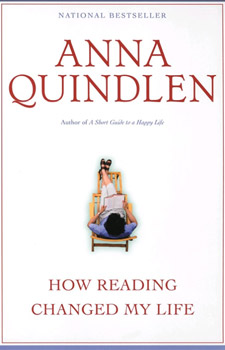
How Reading Changed My Life, written by Anna Quindlen. Ballantine Books, Random House. 1998. $15.00 all ages

"It was still in the equivalent of the club chairs that we found one another: at the counters in bookstores, at the front desks in libraries, at school, where teachers introduced us to one another - and, of course, in books, where book-lovers make up a lively subculture of characters."

As you may have guessed, and I am sure that you feel the same...I love books that talk about the power of reading. I cannot imagine a life without it. Yet, I know that many people live without knowing that power.

I have always read and been awed by Anna Quindlen's writing. Her ability to put words together is enough to convince me that I have no talent for it. Yet, I pore over her essays and her novels, taking from them ideas, influences, and great satisfaction. I get her characters and love to discover the ways they find connections to each other.

In this extended essay she imparts so much wisdom about reading. She tells of her wishes and dreams, and her travel through the books that she reads:

"Yet there was always in me, even when I was very small, the sense that I ought to be somewhere else. And wander I did, although, in my everyday life, I had nowhere to go and no imaginable reason on earth why I should want to leave. The buses took to the interstate without me; the trains sped by. So I wandered the world through books."

I totally relate to that. I have been to New York on so many occasions I cannot keep track of them, I have travelled to Australia, Africa, Victorian England, India, Italy, France...to mention but a few of the places that stories have taken me. I wonder if that is what makes me happy to be at home with no real hankerings for worldwide travel.  And I continue to visit other places on the seven continents through the choices I make for my reading life. Ah, it's bliss!

Anna Quindlen talks about the connections that people make in their reading groups, the reasons that books will be forever with us, and offers gems of importance to me on almost every page. I will lend this book to friends; they will have to deal with all the places that are highlighted. It might change their reading experience as those particular lines may have resonance only with me.

"It still seems infinitely mysterious to me that there are some of us who have built not a life but a self, based largely on our hunger for what are a series of scratches on a piece of paper."

There is so much here to savor. I wish I had written this book. What I can do is keep it beside me on my desk, and know that I can turn to it whenever it pleases me to read it again...and then again. Thank you, Anna Quindlen for saying what I can only dream of saying.

Thursday, December 1, 2011

The Invention of Hugo Cabret, written and illustrated by Brian Selznick. Scholastic, 2007. $27.50 ages 9 and up

“As I look out at all of you gathered here, I want to say that I don't see a room full of Parisians in top hats and diamonds and silk dresses. I don't see bankers and housewives and store clerks. No. I address you all tonight as you truly are: wizards, mermaids, travelers, adventurers, and magicians. You are the true dreamers.”

I don't often take the time to reread a book. My TBR pile just keeps growing rather than getting any smaller. But, I loved Hugo the first time and I was determined that I would read it again before I got the chance to see the movie! Since I have no idea when the movie will reach our theatres, I will just savor that repeated experience until I see how Martin Scorcese (with input from Brian Selznick) envisions Hugo and his world. Truthfully, I can hardly wait...I am looking at it as an early Christmas gift!

What an amazing book this is! And what a surprise to the reading world, and to children's literature specialists when it won the Caldecott medal in 2008. Many thought of it as a novel; but, is it a novel, or is it a picture book, or is it graphica? There will always be differing opinions about that. What does it really matter?

Brian Selznick honors French filmmaker Georges Méliès and his early 20th century movies, with his black and white illustrations that are as integral to the telling as the words he writes. This is adventure at its best. Hugo is a twelve, living on his own in a train station, maintaining all of its clocks (a trade he has learned from his uncle), and trying to survive. He steals what food he can, and manages to stay under the radar of the station inspector and the merchants of the station. He wonders at the world as he watches it from behind one of his clocks:

“Sometimes I come up here at night, even when I'm not fixing the clocks, just to look at the city. I like to imagine that the world is one big machine. You know, machines never have any extra parts. They have the exact number and type of parts they need. So I figure if the entire world is a big machine, I have to be here for some reason. And that means you have to be here for some reason, too.”

Hugo's father is dead. Prior to his death, he and Hugo had been working on reconstructing an automaton. Now, Hugo is obsessed with returning it to working order. He uses a toy shop, with its many gears and repair parts, to help him with needed elements to complete his work. When he is caught by the toymaker while stealing from him,  Hugo sets a chain of events in motion that lead to the discovery that the old filmmaker Georges Méliès is alive. He also meets Isabelle, the toymaker's young goddaughter. She becomes a foe, and finally an ally as the pair seek truth and understanding about their lives.

The plot is complex and handled with dexterity and aplomb. The characters, the events past and present, the intricacies of their convergent paths are dramatic and mysterious. Yet, it works like a charm! There is mystery, charged adventure in the chase scenes, movie history, and wondrous storytelling. Secrets, inventions and dreams find their place in its pages and in our hearts:

“In that moment, the machinery of the world lined up. Somewhere a clock struck midnight, and Hugo's future seemed to fall perfectly into place.”

Wednesday, November 30, 2011

Hound Dog True, written by Linda Urban. Houghton Mifflin Harcourt, 2011. $18.99 ages 10 and up

"I will spare you a description of the pain I then endured and the vocabularic offenses I thus unleashed, but I will tell you that with all my yelling and cursing, I also unleashed Stella, who tore off into the woods and -" There is a buzzing sound, and Uncle Potluck pats his shirt pocket, searching for his cell phone. Mattie finishes his sentence. "And that's how you got your traitorous knee."

Mattie is going to be the new kid in school, an all too familiar challenge for the very shy and sensitive ten year old. She is unbearably nervous about meeting new people and detests finding things to do at recess while everyone else is with friends. Quincy lives close-by; but, she is older and Mattie is tentative about developing a friendship with her. As we watch Mattie, we see that she is learning to open herself up to new experiences quietly, and slowly. It is a lovely transformation, though gentle and ongoing.

Mattie is a writer. She knows that. However, she harbors a worry about teasing, as she has experienced it in a previous school. That encounter is fresh in her mind whenever she tries to write anything new. Her sensitivity does not allow her to brush off the memory. It takes maturity and a measure of confidence for her to move forward with her dreams.

Just as Mattie is quiet, this is a quiet story whose characters will make you laugh and make your heart ache for Mattie for the many insecurities that she feels. Linda Urban has fully developed Mattie's personality so that she becomes very real for her readers. Uncle Potluck is the uncle that every child should have. He's funny, thoughtful, and full of wisdom. He talks to the moon, for heaven's sake. He encourages Mattie and helps her realize her strengths. I love his stories, and your listeners will love them, too. True? Only Uncle Potluck knows that for sure!

If you were a shy kid, or ever felt shy about anything, you will find yourself here, in the elegant words of this talented and caring author.

Tuesday, November 29, 2011

Coral Reefs, written and illustrated by Jason Chin. Roaring Brook Press. 2011. $18.99 ages 5 and up

"Over hundreds of years, the coral piles up and spreads across the seafloor, eventually forming a living mountain called a coral reef. Corals may be small, but they are incredible builders. Coral reefs are the largest structures built by any animal on earth - the Belize barrier reef is over 180 miles long!"

What's that about the cover of a book being our invitation inside its pages? I would be very surprised if readers are not filled with questions when they see this young towheaded girl floating happily in ocean waters while a huge building graces the background? What is she doing? What is that building? Where is she? So much to talk about before even turning to the endpapers.

They too are filled with images to delight and inform. Black and white pencil drawings of many of the inhabitants of a coral reef are there, with labels and added details about size. Turn the page and we see the young miss taking a book from the appropriate section of the library shelves at the New York Public Library. Look closely at nearby book spines to prove that fact true...you will see such titles as Caribbean Reefs, Shipwrecked, Coral of Australia. I think if you look closely, you might even recognize another of the library's patrons. I wonder if he still has a copy of Redwoods in his possession.

Only now do we begin to learn about the subject of this glorious new book from Jason Chin:

"For more than 400 million years, corals have been building reefs in the earth's oceans. Corals may look like plants, but they are actually animals. Some are soft and sway back and forth in the water, while others, called hard corals, are rigid. Corals are made up of polyps, and most have hundreds of tiny polyps on their surface."

And so begins our shared lesson. As the young girl reads, she becomes a part of the ocean that preserves the reefs. As she 'swims with the fishes' we keep the library in our sight and learn much about the relationships that sustain this beautiful habitat. There is learning to be done about the food chains, adaptations, survival, the protection that the reef provides, the food that is available to nourish its many inhabitants, and the role of lagoons in keeping the reef healthy. There is much to know about these amazing ocean environments:

"Coral reefs, on the other hand, are like oases in the desert. They are teeming with life and provide the feeding grounds for visitors. The largest fish in the world, the whale shark, visits the Belize barrier every spring to feed on the microscopic eggs of spawning reef fish."

As she nears the end of her reading, the city becomes more visible. When she finally lands on the library steps, wet and delighted with her adventure, she willingly shares her book with other interested children. You might recognize the young man.  There is so much to learn here, and isn't that the best way to pass on what interests you?

In the final pages, Jason Chin talks about the writing process that resulted in this most welcome addition to our nonfiction reading. He mentions the threats that the reefs face. As so often happens, once a child has read or shared a book that piques a new interest, we can only hope it will lead to other books and an expansion on the learning provided here.  

The beautiful full-color illustrations show the young explorer as she ventures forth on her journey, and they add immediate appeal. It is akin to being right with her as she swims with the fishes, and makes the many discoveries that Justin Chan has researched and then shares with  his readers. I will certainly keep my eyes open for his next book. If his first two are an indication of what he has in store for us for the future, we have much to anticipate.

Saturday, November 26, 2011

Bluefish, written by Pat Schmatz. Candlewick, Random House. 2011. $18.00 ages 12 and up

"Just past the drive, trees closed in around them. Travis put his feet on his favorite dirt path, and the smells and sounds wrapped around him. Treetops murmured a soft and comforting conversation overhead. A red-winged blackbird tweedled the local gossip. Travis's skin stretched wide open, pulling it all in. He pointed at a pileated woodpecker that swept across the path in front of them."

Some nights I don't mind 'interrupted sleep patterns' at all. When I was working, they drove me crazy. Now, when I wake up in the night, I just turn on the night light, slide my indestructible (in case of falling hardcovers smacking me in the face) reading glasses on my nose and hunker down to read the next chapter or two in one of my current books. That's what happened last night, except I couldn't stop at a couple of chapters. I just kept on with getting to know and love the incredibly likable and exceptionally sensitive characters in Bluefish.

Travis' heart is sore with missing his dog Rosco. He misses him more than he misses his parents; that is because they died when he was three and he has little memory of them. Since their deaths Travis has been living with his 'less than capable at raising children' grandfather. Grandpa has some problems of his own, and he and an eighth grader find little to agree on when it comes to living together.

Velveeta's heart is sore with missing Calvin, the elderly man who lived next door. He was her confidante and refuge when things were not going well at home. His heart attack and sudden death has left a large hole in Velveeta's heart and an aching that won't go away.

Bradley's heart is sore from the bullying and the teasing that he endures on a day-to-day basis. He has great parents, but he deals with much of the bullying without telling anyone.

They find solace in each other at school and beyond, despite a series of ups and downs...and the natural vulnerability of being in middle school. To this mix, we add other supportive adults who provide hope and stability for this trio of misfits.

Everyone should meet at least one teacher like Owen McQueen:

"Thank you all for your fine papers. I can't wait to read them." McQueen stepped to the front of the room. "I'm supposed to teach you how to take standardized reading tests so you won't be the child left behind. But because I'm subversive" - he turned and wrote the word on the board as he talked - "(look it up if you don't know what it means, and it will be on the vocabulary test next week), I'm actually going to teach you a passion for the written word."

Lucky the students who meet such a person on their way to being literate.

And Connie is very special, first to Velveeta and then to Travis, too. Of Connie, Velveeta notes:

"Connie sent me to the bakery. She uses cookies and doughnut holes to lure people into the library, and then she hits them over the head with books. I told her I don't read books and she said, "If you work in my library, you do," and I asked if she was going to fire me and she shoved a book in my hands."

As trust grows and the three young people become interdependent, their lives can begin to have new meaning for each one of them. The books that Travis and Velveeta are reading make connections to themselves and help them deal with the lives they now lead. Grandpa is able to talk with his grandson about the loss of their beloved dog, and they move to a new plane of understanding.

Grief...they all know it. Connie has a take on that, as well:

"I told her that Calvin being dead is like a long-fingered claw that keeps scratching at my heart. She said she knows that claw. She said grief is a rough ride but the only way through it is through it."

When Velveeta and Grandpa discover they have Travis in common, they have a funny conversation about the boy they both admire:

"Travis was talking about me?" Velveeta clicked the seat belt between her and Travis. "What did he say?"
"Not much at all. Gotta drag words out of him with a backhoe and a crowbar." "I know, right?" Velveeta
laughed. "He only gives out ten a day. Fifteen on Fridays."

Yes sir, these are people to love and hold in your hearts for a long time!

You will find this remarkable book on my 'keepers' shelf.

Friday, November 25, 2011

Kids' Fun & Healthy COOKBOOK, written by Nicola Graimes and photography by Howard Shooter. DK. 2007. $13.99 ages 8 and up

"Turkey is a versatile meat that contains an array of valuable nutrients, including iron, zinc, and selenium. It is a good source of B vitamins which are essential for the body's processing of foods. Turkey is also high in protein and low in fat, making it one of the healthiest meats of all."

Take that, turkey! The 'Turkey Burger' was the first page I marked as I read through this new-to-me cookbook for kids. Who knew that Nicola Graimes was touting the benefits of healthy eating four years ago? Isn't it a new 'rage'???

I am always interested in cookbooks that will encourage children to try their hand at cooking up supper for the family. Learning to cook will stand them in good stead for the future, and it makes a big difference when everyone can help with daily meals. The fact that the recipes in this cookbook are fun to make, and healthy, really ups the appeal for me. Now, I wish I had kids young enough to be here helping me decide what might make a delicious meal today!

I am forever singing the praises of the books that come from DK Publishing, and deservedly so. They do a commendable job each and every time. They fill their books with information, stunning photography and easy-to-follow instructions when it comes to a child trying a hand at something new.

In this cookbook, the information begins by giving its readers needed notes about being safe and clean in the kitchen. Moving on, the author introduces the basic food groups to her readers and explains why each plays an important role in maintaining good health and getting the nutrients needed for a strong body.

Since breakfast is the most important meal of the day, the recipes begin with what constitutes a good start for everyone:

"Foods high in carbohydrates, such as cereals and breads, are ideal breakfast foods because they are broken down into glucose which fuels your brain. Protein foods such as yogurt, milk, eggs, sausages, bacon and beans are important, too. They control the growth and development of the body, and boost alertness."

Some suggestions are made on that first double page spread. Further ideas include smoothies, fruit and nut bars, eggs, and breakfast tortillas. The full color photographs will have mouths watering before the first step to 'banana pancakes' is even attempted.

The author then moves on to light meals, main meals, desserts and baking. Each recipe boasts a list of ingredients to be used, the equipment needed to get started, a step-by-step method for creating said recipe and facts about the meal being made. The photos clearly show the readers how to go about the work at hand. Try the 'mixed bean burritos' - onion, beans, tomatoes, tortillas, cheese and guacamole - what's not to like?

A detailed glossary and an index add to the appeal. Who said good food couldn't be 'good' for us?

That Boy Red, written by Rachna Gilmore. Harper, 2011. $11.99 ages 8 and up

"Red felt the knot in his back twist tighter. That was the trouble with Mac; he was entirely too easygoing. Red could hardly keep protesting now, all by himself, especially with Ma looking at him like that, and Aunt Lina acting so pleased."


This book was great fun to read....it's based on the stories told by Rachna Gilmore's father-in-law about life on Prince Edward Island during the Depression. Red is the youngest son in a family of five children, and he is the character around whom most of the stories are built.

 Red has many attributes that will draw readers to enjoy these life stories. He is inquisitive and determined. He is always up for an adventure, and is quick and capable. He likes the humorous, and even learns to deal with it in respect to himself.

As you read his tales of farm life, you will be surprised to learn how hard children worked on the farm. He and his brother Mac are given many responsibilities, and are expected to do their share of the daily chores. Their little sister Bunch is too young to be much help and in fact, her care is also one of the expectations made of the boys when their parents are away from home. Their sister Ellen is the local teacher, and has the great pleasure of having her younger brothers in her schoolroom. Their older brother Alex is away at school, and Ellen is helping pay for his education...just as Alex will help when it is time for Mac to attend. And so on....everyone takes care of the others, and does a share of the work that makes the farm and family work.

Prince Edward Island is also a character in Ms. Gilmore's tale...we learn much about the land, community life, the people who inhabit it and their support for their fellow islanders. There are many obstacles to be overcome, challenges to be faced and supports to be given when others are in need.

Here are six stories meant to be shared. They can easily be enjoyed over a period of days. They provide a historically accurate description of island life and the hardship that the Depression brought to many. But, there is always a sense of hopeful and spirited tenacity, which I suspect is just part of the fabric of the people of Prince Edward Island. Readers will come to know the family, the farm, their neighbors and the day-to-day experiences that provide fodder for the tales told. Each one is integral to the others, and they happen chronologically.

History? Yes. Boring? Never.

Leisl & Po, written by Lauren Oliver and illustrated by Kei Acedera. Harper, 2011. $18.99 ages 8 and up

"The guard's name was Mo, short for molasses, as in slow as molasses or thick as molasses. The nickname had been his since he was so young he no longer remembered what his real name was. And it was true from his earliest infancy, although his heart was as big and as warm and as generous as an open hand, his brain had seemed just a tiny bit small."

It  took me a while to set myself to reading Lauren Oliver's first book for intermediate and middle grade readers. I was busy workshopping, and visiting with dear friends. I thought I should give it my full attention, so I waited until I had some time off and I am certainly happy that I did that. It is just my kind of book, except for the ghosts, the alchemy, the helplessness of children in an adult society. Wait! Those things didn't matter. I fell in love with the ghosts, the search for magic, and the host of unique and memorable characters. I got caught up in the twists and turns of this story of a young, defenceless girl and the ghost who comes to her rescue.

It is a most enjoyable read and would make a wonderful story to share at this time of year.  I could not put it down, and finished quickly. Leisl's father has only recently died, and her stepmother has locked her in the attic, in hopes that she will be the sole recipient of all of her husband's worldly assets.  Aren't you ready to go on now you know that?

Po makes a visit from the 'other side' with his pet, Bundle. Po is a being, while Bundle is a creature...neither is easily identifiable. But, they have wondrous hearts and a genuine love for the small, lonely, heartbroken girl. So much happens in the lives of the two main human characters, Leisl and Will. Will loses a very important box, which leads a number of well-drawn and engaging men and women on a wild goose chase by train, wagon and foot to their final confrontation. Po is ever there, accompanied by Bundle and keeping Leisl safe and feeling protected. Po is the consummate friend.
There are orphans, hateful adults, good-hearted caregivers and some very funny scenes. It reminded me of some of my favorite stories by both Roald Dahl and Charles Dickens. It is a story of ghosts...more than two. There is a journey to right wrong, loyalty and betrayal, and even heroism. You will long remember each of the characters introduced.

Lauren Oliver proves, once again, her undeniable gift of words and stortelling. Meet Sticky, who has an unexpected connection as the tale nears completion:

"He was, as Mrs. Snout had guessed, a career criminal. His nickname was Sticky, and he was a thief. He would steal anything that wasn't nailed down: money from church collection plates, candy from a baby, the shirt off the back of a beggar. The reputation of his long, pale fingers, which attracted wallets, coins, and earrings like a magnet attracts steel filings, had earned him his nickname."

You know what he looks like you, don't you? Well, in case you don't have the imagination needed to conjure his image, you have Kei Acedera to thank for bringing him to you in a black and white illustration, one of the many that grace the pages of this tale. The mood is sombre, as is the land where sunlight has not visited in more than 1,728 days. But, the illustrator adds light in various ways to give hope, and the constant image of the willow tree to always lead Leisl 'home'.

Max's Castle, written by Kate Banks and illustrated by Boris Kulikov. Farrar Strauss Giroux, Douglas & McIntyre. 2011. $24.95 ages 5 and up

"They began constructing a secret passage in the castle. It led to a DARK DUNGEON. "What's in a dungeon?" asked Karl. "In every DARK DUNGEON there's a DRAGON," said Max. "And a DOG," said Karl. "And a GUARD," said Benjamin."

And if you look carefully you will indeed see those three words in the letters that make up DARK DUNGEON. You want imagination? Max has it in spades, and he uses it once again for this third wordy adventure.

You may have met him in his previous tales, Max's Words (2006) and Max's Dragon (2008). This time he discovers the magic in wooden letter blocks. When he finds them under his bed, he builds a castle. It's huge and quite majestic; but only we know the many adventures that its construction will make possible for Max and his brothers Benjamin and Karl.

All he needs to begin is one block. That leads to the discovery of a box full of them and the wonder that these letter blocks can create using a rich imagination. As he builds his castle, his brothers gain interest and soon they are asking for their own rooms, and joining Max's many forays involving pirates (and rat pies), knights that spawn a king, an adder that becomes a ladder and so much more. In catastrophe, he finds hope and a star. And my personal favorite, words in a sword! Finally, he finds a feast in feats, and that leads the three enthusiastic siblingss to fulfillment and satisfaction.

If you are going on an highly imaginative journey, you might need someone to provide the dramatic color and great fun that makes that journey come alive. As he did in Max's other ventures, Boris Kulikov provides exactly the right touch, with energy and detail. Readers are sure to be caught up in the fantasy and they are likely to demand a second reading, and then perhaps, a third. What a joyful experience it is!

Wednesday, November 23, 2011

Secrets at Sea, written by Richard Peck. Dial, Penguin. 2011. $19.50 ages 8 and up

"Spectacles are rare on a mouse, except in some silly children's book. But Aunt Fannie wore a pair. They were made out of bent wire and chips of lens from a human's reading glasses. They seemed to work for her. I'll say this for Aunt Fannie: She sees better than she looks."


Two of my forever favorite authors wrote stories this year about mice. Cynthia Voigt told her story of Young Fredle (Knopf 2011), and Lois Lowry did the same in Bless This Mouse (Thomas Allen, 2011). They were both wonderful stories and ones I have shared in many booktalks and workshops since reading them.

Now, another of those authors whose work I long to read...Richard Peck...has followed in their footsteps to tell his story of the two Cranston families. The human Cranstons live Upstairs while the mouse family Cranston lives Downstairs. It's the late 1800s and they are about to embark on a journey that will bring great change to both houses.

The Upstairs Cranstons are newly rich, and slightly gauche. They are preparing to set sail for England in hopes of finding their gawky, older daughter a suitable mate. The Downstairs Cranstons, on the advice of their incomparable neighbor Aunt Fannie, decide to take that same voyage:

""We sailed away to London, England, Louise and Beatrice, Lamont and I. We began our journey by steamer trunk -- that biggest trunk that had stood open for days in Camilla's bedroom, filling up with her new finery. It had drawers inside."

Helena is our narrator. She is the oldest of the four, and often seems disapproving of her younger siblings.
Sister Louisa has some chutzpah and has managed to establish a connection with Camilla, the younger of the two Upstairs Cranston daughters. She and Camilla have become confidantes through Louisa's nocturnal visits to Camilla's bedroom. Beatrice is rarely heard from, and appears to be quite cautious and fearful. And, as happens with younger brothers, Lamont creates chaos wherever he goes (I speak from experience). He collects anything he finds collectible, eats inelegantly, misses school and takes chances that no big sister would dream of taking. What a bother of a brother!

They are off on a voyage to England to celebrate Queen Victoria's Diamond Jubilee and to look for a suitor for Olive beyond their own shores. Who knows what trouble could befall the human Cranstons should  the rodent Cranstons decide not to accompany them? I guess you need to read this imaginative and thrilling tale to discover their fates...one and all! It's a great Christmas readaloud for the whole family.

While cats do not fare well in this mice-inspired story, Richard Peck's humor remains distinct and priceless. I want to share a few of my favorite quotes with you: 

"By the time the sun of that last morning crept across Camilla's sleeping form, we were hunkered, lurking within the drawers. Beatrice and Louise and I were nose to nose to nose, under the lacy edges of Camilla's handkerchiefs. It was a small drawer. There wasn't room to swing a ... cat."

or this one:

"We dropped, and landed on our feet. We always do. There on the carpet was Lamont, cool as a cucumber, as it we'd taken ages. We huddled, and I tried to keep us together, but it was like herding ... cats."

or again:

"I only hoped he'd learned his lesson about chasing mice, or at least me. But you can't knock sense into a cat. People think cats are wise and have deep thoughts. They don't. But they do have nine lives, which is too bad." 

And finally, Helena remembers a lesson learned while visiting Aunt Fannie that gives her some peace and contentment as her siblings find lives of their own:

"I remember the day I'd gone to her through the hedge to learn about our futures. I recalled her extending both her old hands stretched wide. "This is how you hold on to your family," she had said.
"You hold them with open hands so that they are free to find futures of their own. It's just that simple."

Tuesday, November 22, 2011

Just a Second, written and illustrated by Steve Jenkins. Houghton Mifflin, Thomas Allen & Son. 2011. $19.99 ages 8 and up

"The day is based on
the rising and setting of
the sun - the time it takes
Earth to make one rotation
on its axis. The day is the
original unit of timekeeping
in every human culture."

I have mentioned it previously, and will say it again...I cannot imagine living inside Steve Jenkins' incredibly inquistive and unconventional mind. I mean, he must ask himself the most amazing questions and when there is no easy answer, off he goes to find his own. Then, he shares his learning with his legion of fans....count me among them.

I am always excited to see that a new book by Mr. Jenkins has been published...he has written much of my favorite nonfiction. In this one, subtitled 'a different way to look at time', he separates it into one second, one minute, one hour, one day, one week, one month, one year and even very quick and very long. There is no point of time he doesn't consider.

Fascinating? Yes it is. I will give you a small taste for the information he shares with his readers:

"In one second...
A black mamba slithers a frightening 24 feet (7 meters).
A cheetah sprinting flat out...
and a sailfish swimming at top speed...
...both travel 100 feet (30 meters).
A very fast human can run 39 feet (12 meters)."

Does it make you want to test it yourself?  As I read I found myself whispering 'one Mississippi' and trying to imagine how each could do what they do in that one split second. Then, he moves on to a minute, and guess what?

"In One Minute...

A charging grizzly bear gallops one-half mile (805) meters.
A skydiver in free fall plunges two miles (3 1/4 kilometers).
People around the world drink the equivalent of 2,600,000 twelve-ounce soft drinks."

Good grief! I have only briefly touched on the many incredible things that happen within a measured time. I could go on and on, as I did when I was reading to a group of teacher-librarians last week.

As he does in most of his lively and informative books, the author adds even more in the back matter. This time he gives information about our universe's history, life spans, a timeline and population growth.  If you have curious students or inquisitive children and you want to challenge their thinking, this is the book for you!

It's interesting to think, as you read along, about all those things that are happening in the world while you are doing that reading...it may even give you pause to stop for a second, a minute, or an hour to savor the wealth of information he so willingly and ably shares.

Monday, November 21, 2011

I Like You the Best, written and illustrated by Carol Thompson. Holiday House, Thomas Allen & Son, 2011. $19.95 ages 3 and up

"My tail is curlier than yours!
My tail is rounder than yours.
I like you this much.
I like you more!
I like your hair, Dolly.
I adore your Dolly walk.
Such a fine face, Jack Rabbit.
I know.
I like you the best!"

Dolly and Jack are the best of friends. They love to do everything together. They are much, much  happier together than they are apart. They can be noisy or quiet, funny or sad; but together, it's always better!

When the daily activity is portraiture, Dolly and Jack draw each other. Things do not go well:

"You made me look like a lumpy pumpkin!
You made my ears look like slimy slugs!"

Oh boy, are they MAD! They each stomp away from the 'fun' and are determined that the friendship is kaput! Have you been there, or can you remember? I have to look back for a long time to the last fight I had with a friend. We all have those memories, don't we? Most of the time we cannot even remember what the starting point fro the argument was. The children who read this book, or to whom it is read, are likely to have stories to share of times when they 'fell out' with a best friend, too.

Along with feeling anger and disappointment, the two friends also experience longing and sadness. They do what they can to assuage those feelings. They try thinking of other things they love, but the images soon turn to their friend. They offer many ways of coping to their readers. Nothing works well for them.

When each seeks solace in their own 'best place' they find it inhabited by the other. They willingly agree that the missing of the other's company is worrisome. Yoga and massage help even more.  Their friendship reestablished, they can finally 'chill out' TOGETHER.

Young readers will enjoy the images created for this simple, emotional story. You can see and hear the door slam, and experience the sadness of each character at the loss of a dear friend. Their joyful reunion is awash in bright light, and hope.  

If You Lived Here, written and illustrated by Giles Laroche. Houghton Mifflin, Thomas Allen & Son. 2011. $19.99 ages 8 and up

"If you lived here, you could catch fish from your bedroom window. Tall and strong wooden stilts would hold your house high above the rising tides of an inlet of the Pacific Ocean. At high tide you could hop on a boat to visit a friend, and at low tide you could walk around the base of the stilts to gather crabs..."

Do you know where you are? If you were reading this new book by the talented and articulate Giles Laroche, you would. Since you might not be doing that right at this minute, I will tell you!

You are living in a palafitos on Chiloe Island in Chile. Or you might also be living in Asia, Europe, Africa or somewhere else in South America where houses are built on stilts. This house has been built since the 1500s...the ones illustrated here were built in the 1990s. Generally constructed of durable woods by fishermen, it makes it easier for them to get to work quickly. To add to your knowledge, here is an interesting fact:

"Palafitos are quickly built as a community project by neighborhood families on special work days called mingas."

That is the format that invites readers to explore the many types of homes people live in throughout the world. Each new double page spread is accompanied by intricately detailed paper collage artwork. There is an 'if you lived here' introduction and that is followed by five specific entries: house type, materials, location, date and a fascinating fact. Fascinating, indeed!

The illustrations certainly add to the appeal...they have a three dimensional look, with details that will encourage lengthy examination. Readers will enjoy peering into windows, imagining themselves walking bridges from one part of the home to another, and perhaps even daring to dream of someday visiting such structures on their travels.

Wouldn't it be interesting to invite our newly immigrated children to share pictures, drawings and stories of the houses where they lived in their home countries? This is a wonderful book to use as an invitation to such sharing. It also offers a picture of homes throughout history, and provides a map of the world and places each home on that map when the reading is done.

I will end with what I imagine might be the dream home of every child, at some point in their lives:

"If you lived here, in the cool of the trees, you and your friends could be high above the ground and away from your parents, brothers, and sisters. With a strong tree in your backyard, and whatever scrap materials you can find - boards, old windows and doors, used furniture, canvas, a homemade ladder - you can build your tree house to look whatever way you like."

Amen!

Sunday, November 20, 2011

Born and Bred in the Great Depression, written by Jonah Winter and illustrated by Kimberly Bulcken Root. Schwartz & Wade, Random House. 2011. $19.99 ages 6 and up

"With no money
for new shoes,
your feet got tough as leather
walking barefoot down the
gravel roads,

walking on the hot rails
day after day - that's what
you've said."


Jonah Winter is talking to his dad in his new book...a man who lived through the deprivation of the Depression. It is in evidence from the beginning:

"You got your water from a well
because there was no indoor plumbing.
There were no toilets,
so you had to use the outhouse.

I know, because you've told me, Dad.
This was the world you grew up in."

Moving from one page to the next, we are witness to the life led by this family of ten...eight kids, two parents in four rooms. The author's father, the youngest, has little space in a bed that sleeps six. There is no money for electricity, no indoor plumbing, and little opportunity to work for those who do want a job. Despite these many hardships, there are blessings, too.

There may be no money for shoes, but the family never goes hungry. They grow their own food, and preserve what cannot be eaten immediately. Chickens and a milk cow provide needed sustenance. The family manages as best it can, and their experiences during that trying time provides the grist for stories that the Winter siblings will later tell their own children. Jonah shares what he has been told, with awe and a sense of disbelief:

"Sometimes it's hard to believe
this world was even real.
Maybe I've remembered it wrong.

Did Grandpa Winter really know a hermit
who lived in the woods
and ate beans from a jar?

Did Granny Winter really have to fire up the
wood-burning stove
every day, even in the summer,
to heat up water
to wash clothes on a washboard?"

There is great admiration for his father and his life during the Depression...as well, there is love and understanding, honor and pride. It is a heartfelt homage to a time in our history:

"When I think of the Great Depression,
I picture a whole country
of people tough as Grandpa and Granny Winter,
not giving up, even when

it seemed like there was nothing left to lose -"

and of his father, a hopeful, daydreaming youngster at the time:

"And I see you, Dad,
in your little overalls,
listening to the trains,
walking through the woods,

learning to love those things
that didn't cost a single penny."

Kimberly Bulcken Root fills the pages with illustrations that add understanding and relevance to the author's telling. Her dusty, subdued palette hearkens back to a piece of history that has not been forgotten by those who lived through it. The simple pleasures of life are shown, and the joy to be had from a loving and supportive family. This will be a most welcome addition to my growing stack of picture book biographies. Thanks for that!

Saturday, November 19, 2011

I Will Come Back for You, written and illustrated by Marisabina Russo. Schwartz & Wade, Random House. 2011. $19.99 ages 5 and up

"The hardest part was that Papa was not allowed to stay overnight with us. He had to sleep at the inn where he lived with all the other Jewish men who were being detained. It wasn't really a jail, they could come and go as they liked, but every morning they had to report to the police station for roll call."

It is Nonna's voice we hear throughout this book. Her granddaughter's questions are the impetus for telling of her life before now. Her charm bracelet provides a reminder of the memorable events of that life.

"My Nonna changes her jewelery every day, but there is one bracelet she always wears. It is a charm bracelet, a gift from my mama."

Nonna explains why she never takes it off:

"Because the charms remind me of long ago when I was a little girl," she says. " Shall I tell you their story?"

It is time...she begins telling her beloved granddaughter (and creator of this book) of those charms and their importance to her. Her early life was spent in Rome. Her mother would take the children to the park where they spent time together, happy and content. The first charm is the donkey, who pulled the cart for them in that park. Their days and evenings were filled with family time, and great delight.

As the Nazis rose to power, that idyllic life changed as it did for all Jews living in Italy at the time. Papa was rounded up and the children could only see him on weekends. It was a long trip to the mountains where he was staying. Throughout the day they had time to visit, but Papa could not stay with them overnight. The separation lasted for a long and interminable time. When Papa learned of imminent danger for the Jews in that village, he fled higher into the mountains.

Life did not get better. Conditions became more dangerous all the time. It was only with the help of generous and kind people that Papa, then Mamma, and finally the children found safety and the hope that they might be reunited one day. Papa does not come back to them. He was killed while fighting the Germans. Following the war, a return to Rome proved there was nothing left for the family there. The three sailed to America...Mamma, Nonna and her brother, Roberto. The boat is her final charm.

"Isn't that a long story for such a simple charm bracelet?'

This  family story rings with authenticity and great meaning for the author; yet, it is not emotional or insincere. It is a story of family love, of overcoming obstacles, of finding new direction. Marisabina Russo adds an afterword that sets her story in history, explaining the events that led to her sharing it with us. The photos and captions that she includes on the endpapers lend a personal and heartfelt feel to her Nonna's remembrances.

Thursday, November 17, 2011

Stuck, written and illustrated by Oliver Jeffers. Harper, 2011. $19.99 ages 3 and up


"And wouldn't you know...
the bucket of paint got STUCK.
Then Floyd tried....

a duck to knock down
the bucket of paint...

a  chair to knock down
the duck..."

Oh, what a riot for young readers! Their uproarious laughter at the absurdity of Floyd's dilemma and his determined solutions to the problem will be heard far and wide. When the book is done, they will beg to listen to it all over again. Isn't that the best part of the fun??

Floyd is a boy, with a kite in a tree. His quest is to get it down, so that he can fly it once more. His first attempt to dislodge it is met with failure, and his favorite shoe is now 'stuck' in the tree with the kite. Not to be deterred, he flings his second shoe after the first...same result. Now, the tree has trapped a kite and two shoes. He doesn't stop there...oh no, he follows with a cat, a ladder, a bucket of paint. Nothing is safe!

As with similar stories where one thing leads to another, and then to another, until it becomes nonsensical will only add to the entertainment value of sharing this new book from Oliver Jeffers. It has his trademark artwork, and childlike printed text. The tree just seems sticky enough in its cloudlike, scribbled form to catch hold of the kite and never let it go. Floyd seems bent on getting it unstuck, but no amount of applied pressure to the tree will release it. Readers can sense the frustration in the print, see it on his face and even enjoy his consternation as he adds one projectile after another. All remain stuck.

There is an abundance of movement on every page. The ever-changing palette of color holds our attention and alters mood while the zaniness of the chosen items will result in snickers of delight. Poor curious whale has no idea that he will be next! I love the page where an idea pops into the space above Floyd's head and he grabs hold and then lets it fly toward the final instrument at hand to free the kite. It works!

Floyd and his beloved kite are off to enjoy the rest of their day together. When he finally falls into bed, exhausted, he has a niggling thought that he may have forgotten something. What COULD it be?

It is the perfect ending to a very funny book!